

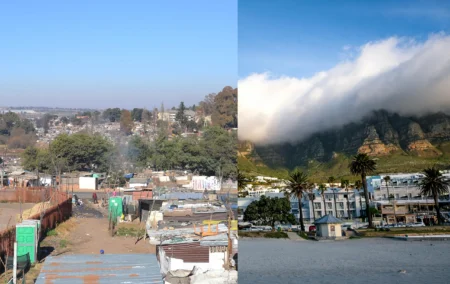
The local chapter of British multinational lobby group Oxfam has released another dubious report to demonise wealth rather than alleviate poverty.
Oxfam South Africa did a survey. It didn’t publish its report online. It sent the Africa Wealth Report 2025 (or just a press release, perhaps)to a few hand-picked journalists, like Ferial Haffajee at Daily Maverick. Presumably they thought those journalists might be sympathetic to their cause. (Sorry, Ferial, but you wouldn’t deny that you are a bit of a lefty.)
Two emails to different people at Oxfam SA to ask for the full report elicited no response. So let’s work with what we have, which is Haffajee’s article.
Oxfam SA partnered with an outfit called “Patriotic Millionaires”, which is an American organisation with no apparent presence in South Africa.
That organisation describes its members as “[p]roud traitors to their class”, and lobbies for higher taxes on the rich, higher wages, and getting money out of politics.
The latter is arguably a noble cause, although it is a lot more complicated than it sounds.
Higher wages is something that dollar millionaires can easily achieve by exercising their shareholder votes at annual general meetings, instead of appealing to the state to raise minimum wages.
But higher taxes on the rich is a virtue-signalling position that most dollar millionaires can safely hold, since it is exceedingly hard to implement and very easy to circumvent.
Dollar millionaires
Oxfam SA claims that it did a survey among South African dollar millionaires, of which it estimates there are some 41,100 left in the country. Of those, it managed to survey a meagre 543, “the majority of whom said they are willing to pay a 2% wealth tax to better fund social protection, education or the energy transition away from coal to renewable energy at scale”.
Writes Haffajee, “Nearly 64% of those surveyed … support global instruments for taxing the super-rich and the same number support a 2% tax on multimillionaires and billionaire wealth.”
The fact that the survey was commissioned in partnership with a lobby group that advocates for taxing millionaires is the first red flag. That’s not exactly an unbiased funder.
The questions only pile up from there. How did Oxfam SA identify the population of dollar millionaires in South Africa? Personal wealth is not a matter of public record, and both banking information and tax returns are supposed to be confidential.
The article claims that the sample was representative. That means it must consist of an entirely random selection from all 41,100 alleged dollar millionaires in South Africa.
How was that randomness achieved? Does Oxfam have a list of all of them? Did it call random numbers until enough people identified as dollar millionaires?
The survey team must have called 800,000 people to assemble a truly random sample of 543 dollar millionaires, so I’m going to guess that Oxfam didn’t do that.
Did it use its own mailing list? If so, we are talking about self-identified respondents who were sufficiently sympathetic to the notoriously left-wing Oxfam to participate in a survey? That would introduce significant self-selection bias.
At best, Oxfam can make a claim about the majority of the dollar millionaires they sampled. Extending that claim to the entire population of dollar millionaires in South Africa seems sketchy, and Oxfam has a history of sketchy methodology in reports that support its cause.
Sketchiness
I’ve addressed this sketchiness in several previous articles on Oxfam’s annual inequality reports.
The organisation spends an extraordinary amount of time and effort, not on the alleviation of poverty, but on going after the rich. Although its Wikipedia entry still describes it as an organisation “focusing on the alleviation of global poverty”, its own global website doesn’t even mention poverty:
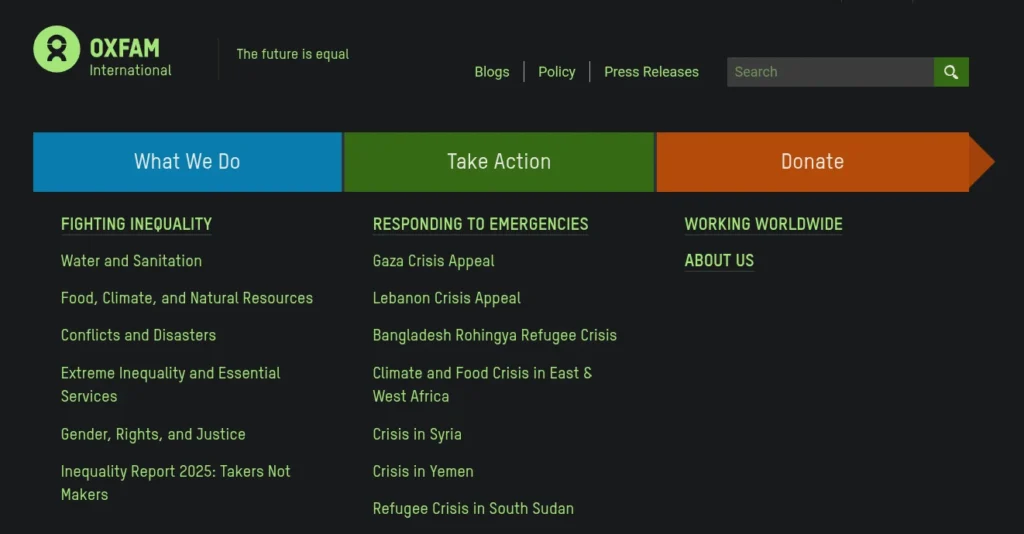
Oxfam’s entire mission, these days, is to fight inequality, not poverty. The simple reason for this is that free market economics has done an astonishing job of reducing poverty levels around the world:

This is a problem for Oxfam, because it is a left-wing organisation with a strong socialist bias, and advocates for redistribution as the solution to inequality. By contrast, classical liberals like me advocate for wealth creation as the solution to poverty. Redistribution is wealth destruction, as I’ve written before.
Oxfam is all about reducing inequality by trying to drag the rich down, instead of trying to make the poor more prosperous in absolute terms.
Wealth taxes always fail
Wealth taxes don’t work. I’ve written that argument up in detail, too.
In almost every country where they’ve been tried, they’ve been abolished, and in all cases, they led to such significant legal avoidance or financial emigration that the state ended up collecting less revenue than before.
So, it’s easy for a few millionaires to signal how selfless and generous they are by telling Oxfam they support a tax on the rich. They know that taxing their assets is a minefield that will probably never happen.
Many assets are hard to value. Many assets consist of capital that is either invested in companies, so taxing those assets will harm those companies, or in government bonds, so taxing them will make public debt more expensive. Many assets are illiquid, but taxing them annually assumes the availability of liquid cash, so people may be forced to sell assets just to pay their wealth taxes.
Hot potato
In South Africa, wealth taxes are even more of a hot potato, since they assume the government is a responsible steward of tax revenue. It is not.
Isobel Frye, the well-remunerated Oxfam spokespuppet quoted in Haffajee’s article, says: “A fair tax on extreme wealth can help strengthen public services, reduce inequality, promote solidarity and greater chance for growth.”
That is wishful thinking, not economic reasoning. The poor will get no richer because the government collects more tax. The rich are more likely to leave, so “solidarity” will be ephemeral. Public services have been collapsing no matter the amount of money thrown at them. And growth, well, we know all about South Africa’s growth, and the belief that confiscating more private capital to hand over to the state will increase rather than decrease growth is simply delusional.
“Certain classes”
Incredibly, Frye says that corruption at public institutions like Tembisa Hospital happens “when certain classes opt out of public services”. This has cause and effect the wrong way around. “Certain classes”, as she snootily calls well-off people, opt out of public services because they are corrupt and sub-standard.
Rich people don’t become rich by spending more than they have to. Rich people would love to be able to take advantage of free or low-cost tax-funded services.
They pay tax, after all, and would surely want a return on their investment. That they feel that have to pay for private services over and above what they are taxed is not the reason for government corruption. It is a condemnation of government failure.
Rewarding corruption by throwing more money at it is an insane policy proposal.
Private generosity
The article goes on to explain how generous South Africa’s wealthy people and businesses are. It is important to distinguish between private charity or private funding of specific government projects, where donors have some oversight over how their money is spent, and willingness to pay tax, where the money goes into a huge pot that appears to have no bottom, and offers no accountability.
Frye disagrees, however, according to Haffajee: “’I don’t believe in ring-fencing,’ she said, adding that all public services and the funding thereof have (sic) to be subject to parliamentary scrutiny and oversight.”
This is laughable. If Parliamentary scrutiny and oversight was effective, interest on debt wouldn’t be the largest single expenditure in the annual budget, we wouldn’t have had a state capture commission that led to approximately zero prosecutions of high-profile criminals in government, and we wouldn’t have death traps for hospitals, dysfunctional railways and ports, and collapsing municipalities.
Luxury belief
Oxfam SA and its cronies live in an elitist cloud-cuckoo land. That some rich people have socialist tendencies is not exactly news. It is, after all, a luxury belief: only the rich can afford to be socialists.
That’s why most staggeringly rich celebrities are performative socialists. It’s a public relations thing. It signals that they’re not cold-hearted and greedy. It proves that they care.
But caring has never fed anyone. Only cold, hard economics can do that.The poor will never prosper sustainably by depending on government handouts and public services. The poor will never prosper because the rich are taxed more.
If the 65% of the 543 dollar millionaires in Oxfam’s survey wish to pay additional tax, I’m pretty sure SARS will gratefully accept donations.
My bet is that 98% of them would prefer to fund their own choice of charitable or infrastructure project, like a local school, a local hospital, a job training endeavour, an NPO they know and like, or a local municipal support organisation. And that would be great. That would actually help South Africa. A 2% wealth tax is a dumb idea that would not help at all, no matter what the rich friends of Oxfam say.
[Image: Mbongeni Mpengesi and Magda Ehlers]

The views of the writer are not necessarily the views of the Daily Friend or the IRR.
If you like what you have just read, support the Daily Friend