

The refrain is well-known by now: three decades into our democracy, Afrikaners have still not apologised for Apartheid. How is reconciliation possible under such circumstances? It is repeated like a statement of faith in South Africa’s public discourse, backed up by no evidence, while evidence to the contrary is overwhelming.
Not only has the mountain of apologies from formal and organised Afrikanerdom grown, but it is still not uncommon to see well-meaning Afrikaners on social media apologising for the system of repression that ended in 1994. I have never seen even one of these apologies being accepted, though they are eagerly weaponised as being indicative of persisting collective guilt for historical wrongs.
It is time to consider the record, and ask ourselves – both as Afrikaners and as South Africans – whether it is time to call it quits.
Rhetorical and symbolic apologies
An apology is a sincere and regretful acknowledgement of an offence or failure. It is by nature rhetorical. And of rhetorical and symbolic apologies, there are many, of which I will simply cover a few:
The National Party was the natural political home of Afrikanerdom for most of the previous century. Its leaders were not merely the leaders of a political party, but the political leaders of the Afrikaner nation. FW de Klerk was the leader of the National Party and the State President of South Africa at the end of the Apartheid era, and he apologised for Apartheid.
Adriaan Vlok served as Deputy Minister of Defence in 1984 and Deputy Minister of Law and Order between 1985 and 1986. He was made Minister of Law and Order in 1986 and served to 1991. He had been at the head of the Apartheid security apparatus, and grovelled before Frank Chikane and washed his feet. Vlok called on his former colleagues to similarly apologise for past wrongs.
Afrikaners have always been and remain a deeply religious people who identify closely with their churches. Chief among these is the Dutch Reformed Church (DRC), the closest thing the Union and Republic of South Africa came to having a state church. In 1986, and twice in 1990, the DRC accepted responsibility for and renounced Apartheid. One of the declarations in 1990 concludes with “the unequivocal rejection of apartheid as sin”.
Not to be outdone, Beyers Naude, a progressive clergyman who stood among the leaders of the progressive minority of Afrikaners, famously lost his DRC ministry when he came out against Apartheid in the 1960s. He later explained that “I came to the conclusion on the basis of my theological study, on the basis of my personal contacts with ‘blacks’ and ‘coloureds’ and Indians, that the policy of apartheid was unchristian, it was immoral, and it was unfeasible.…”
These apologies represented, at the time they were issued, virtually every Afrikaner.
Apologies of action
With these in the bank, though, the professional activist-victims of South Africa will claim that they were mere words – what an apology, of course, is – and that nothing of substance was done by way of apology.
Wrong again. Afrikaners have gone above and beyond mere rhetoric and symbolism, with the most notable acts being the following.
The “civil war” of the 1990s was conducted primarily between anti-Apartheid factions, being the African National Congress (ANC) and Inkatha. The formal security forces, run by Afrikaner military leaders, did not directly participate. With the transfer of power in 1994, these military leaders could – as many cynical journalists and observers at the time believed they would – seize power in a coup d’etat.
And to be honest, if I were in their shoes, knowing the ANC as an unrepentant communist formation, I might have done exactly that.
But they did not.
The Afrikaner military elite, cultivated over a century and contemporarily fiercely dedicated to eliminating those who threatened their way of life, did not fire a single shot at the new government. These leaders abided every order that undid their control of the military. They recognised the authority of the majoritarian regime without a hint of hesitation.
It could have gone very differently.
The ANC had never won a single battle against the South African Defence Force. The continuous threats during the negotiations to end Apartheid to “return to the armed struggle” were nothing more than threats to “return to defeat”. South Africa could have gone on to be an impoverished, warring society between an entrenched Afrikaner junta and a hopeless Hamas-esque ANC that thrives in public relations but has to appoint a new leadership slate every decade after the previous ones are assassinated.
A simple “thank you” would have been kind.
But not only did the Afrikaner-dominated military lay down its arms, Afrikaner politics almost immediately shed itself of separatist designs.
The Freedom Front nominally carried the torch of the Volkstaat for a few years, but that is ancient history at this stage, and that party never came close to securing a majority of Afrikaner votes. Almost overnight, the Afrikaner voter assimilated into cosmopolitan politics and accepted the legitimacy of the institutions of the new majoritarian government.
To this, some often point out that there are not many Afrikaner members of the ANC, Economic Freedom Fighters, or uMkhonto we Sizwe.
I said Afrikaners assimilated. I did not say they were lobotomised.
This, too, could have gone very differently. Afrikaners could well have packed their bags and moved into the lowly populated Northern Cape to become a demographic majority there, and begun agitating for independence. Instead, the conscious and unconscious decision made by organised Afrikanerdom and all its members was to give the new South Africa a shot.
Apologies of reparation
Naturally, these, too, are rejected.
Effortlessly, the narrative moves on from “apology” – about which a big deal is continuously made – to reparation. It is claimed that Afrikaners never did anything to repair the damage done by Apartheid.
Of course, this is incorrect.
White South Africans in general, and Afrikaners in particular, are still said to dominate and “control” the economy. It should come as no surprise, then, that Afrikaners have, and continue to, pay trillions of rands in taxes to a government whose stated policy is to persecute racial minorities, including whites.
More than that – as we will always be reminded that “everyone pays taxes” – Afrikaners spent the better part of the twentieth century building a state apparatus that served them and their interests. Calling the police in the 1970s would always be answered. Postal parcels would arrive in good time. The light switches would work consistently.
Afrikaners saw their taxes working for them.
To the Afrikaner and other whites, that time is well and truly gone (to others, it never existed).
And yet, Afrikaners pay their taxes with a smile even as the public services they were once used to collapsed around them. One would imagine that organised Afrikanerdom would have at least insisted on a concomitant reduction in taxes! Alas, no, Afrikaners are all too happy to respond politely to each letter of demand from the South African Revenue Service.
Then there is the question of Afrikaners monopolising the economy.
Well, the major conglomerates that Afrikaners spent a century building, are virtually all today high-level Broad-Based Black Economic Empowerment (B-BBEE) contributors.
In 1918, a small group of Afrikaner capitalists established the South African National Trust and Assurance Company (Santam) and the South African National Life Assurance Company (Sanlam) for the particular purpose of uplifting the Afrikaner people. These companies grew into economic landmarks of the Afrikaner community, closely associated with Afrikaner national feeling.
Both Santam and Sanlam companies are today Level One B-BBEE Contributors (scoring more than 100 points on the BEE scorecard).
Let’s look even closer at the heart of Afrikaner nationalism, the dreaded representative of white supremacy.
In 1915, organisers of the newly established National Party, which was founded the previous year, incorporated Die Nasionale Pers Beperkt. The National Press, or Naspers as it would come to be known, was meant to be the media wing of Afrikaner nationalism, publishing its magazines and newspapers. And indeed that is what it became, with all National Party mouthpieces over the ensuing century being Naspers papers. Naspers grew into a media behemoth, a prized possession of Afrikanerdom.
Today, Naspers is a Level Four B-BBEE Contributor (scoring between 80-89) on the BEE scorecard.
The Afrikaanse Verbond Begrafnis Ondernemings Beperk (known by the acronym AVBOB today), became the country’s biggest funeral insurance company, and one of the biggest on the African continent. It is a Level One B-BBEE Contributor, and more than that exclaims that “we believe that Broad Based Black Economic Empowerment (B-BBEE) is more than a regulatory requirement, it’s imperative for South African businesses to move forward.”
Remgro (which began as Rembrandt), founded by the most notable Afrikaner capitalist of the previous century, Anton Rupert, boasts a Level Five B-BBEE score (75-79 points).
Volkskas Bank was founded in 1935 to serve Afrikaners disadvantaged by the Great Depression. As its name implies, Volkskas – or People’s Bank – was deeply rooted in Afrikaner nationalism. Absa, Volkskas’ main successor, is a Level One B-BBEE Contributor.
Dare I go on? I could, of course, but it would be to no avail, as this, too, would be dismissed offhand.
It is not about mere reparation, we will be told. It is about The Land™.
When it is not about the land, it will be about opportunity.
Professional grievers do not want an apology, in word or deed, or reparations, or land. Nothing less than absolute and complete submission, or worse yet, the total absence of the Afrikaner and other racial minorities, will be deemed acceptable.
No. No more, I hope
The days of apologies, I hope, are over.
As a red-blooded Afrikaner, I have only ever known democratic South Africa, as have most of my peers. I did not experience any of the growth of Afrikaner prosperity – in fact, my whole conscious life has been one of witnessing the crumbling of South Africa’s economy and society.
The only words I have for my parents, and their parents, who ensured that I need not suffer today, are “thank you.”
Do I wish the political circumstances they found themselves in were more equitable? Absolutely. Had South Africa adopted a free market back in those days, the economy would be much stronger for everyone today.
Alas, that was not to be, and Afrikaners have apologised, repeatedly, rhetorically, symbolically, culturally, religiously, politically, militarily, and financially.
These repeated, substantive apologies of the past were not accepted. Why would any further ones be? Afrikaner, take it from a liberal like me: do not be uncomfortable in the skin of your birth, or resent your parents. Never apologise again.
No more.
The rent-seekers of our time are arguing, in effect, that for as long as black poverty exists, Afrikaners have not apologised for Apartheid. One obviously does not follow from the other, and it need not, because it is a useful rhetorical trick that serves its political goals well, just like the argument that whites are “beneficiaries of Apartheid”.
But more than that: while black poverty might have been sparked by economically exclusionary legislation from the previous regime, it is maintained by the current government. That it persists 31 years into the new South Africa indicates that there is a political desire for it.
This is the ideology of dependency and control that underlies the National Democratic Revolution.
The political forces that keep black South Africans poor therefore have an incentive to invent little rhetorical devices that scapegoat minority communities – and it is always minorities – for what the politicians are doing.
Poverty is not nuclear physics: solving it is relatively easy. There is nothing special about poverty in South Africa, either, despite its racist origins. The same things the rest of the world did to end destitution – deregulation, liberalisation, saving, cohesive families, public order – are available and waiting for South Africa to grab onto.
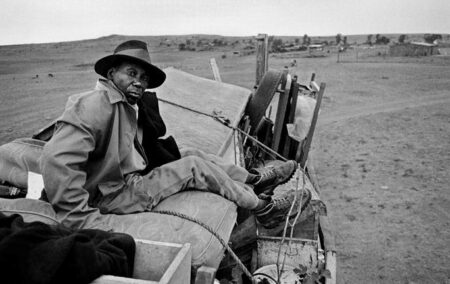
[Image: Forced removal under apartheid, Mogopa, Western Transvaal, February 1984 By Paul Weinberg – donated by Author, CC BY-SA 3.0, https://commons.wikimedia.org/w/index.php?curid=26756830]
The views of the writer are not necessarily the views of the Daily Friend or the IRR.
If you like what you have just read, support the Daily Friend