

Terence Corrigan
Terence Corrigan is the Project and Publications Manager at the Institute of Race Relations (IRR), where he is in overall charge of bespoke work, and long-form publications. A native of KwaZulu-Natal, he holds a BA (Hons) from the University of KwaZulu-Natal (Pietermaritzburg), and an MPhil from the University of Free State. He has held various positions at the IRR, South African Institute of International Affairs, SBP (formerly the Small Business Project) and the Gauteng Legislature – as well as having taught English in Taiwan. He is a regular commentator in the South African media and his interests include African governance, land and agrarian issues, political culture and political thought, corporate governance, economic growth and business policy. Corrigan is a connoisseur of films, an amateur historian and a lover of the German language.
Articles By This Author
Mbeki warns of bloodshed if BEE goes – he has it wrong
According to Thabo Mbeki – or technically, the document put out by the Thabo Mbeki Foundation – for South Africa to abandon its policy trajectory

Capital punishment – an easy answer to a complicated problem
“Death penalty: Let’s not aspire to being a bloodthirsty, barbaric nation”, read a headline last week over a Daily Maverick piece by veteran journalist Mondli

A local government design that is fit for purpose
Although largely absent from public conversation, the proposals contained in a recent white paper on local government could herald the most far-reaching set of changes in South African governance since the 1990s. Published in May, it is largely a response to the dysfunctional realities confronting the country’s local sphere.

A lefty prof comes out for Helen
Prolific and persistent, Prof Adam Habib has been a fixture of South Africa’s intellectual milieu for decades. His contributions include books, scholarly articles, opinion pieces and television appearances. These made him, arguably, the only South African academic administrator – at the University of Johannesburg, then at Wits, and now at the School of Oriental and African Studies in London – whose name became widely known.

How can municipalities get local economies moving?
Promising improvements in people’s standards of living is a de rigueur part of a South African election. Back in 1995, at the time of the first post-transition local election, the ANC had as its slogan, “Let’s make it happen where we live”.

Why we need to drive a Sherman tank through our governance
Whether it is fighting poverty, battling corruption, castigating enemies, calling out “battalions of revolutionaries” or establishing War Rooms to manage this or that initiative – not to mention this whole, gaudy cosplay aesthetic of the EFF – our politicians are fond of military rhetoric. It suggests aggression, resolve and sacrifice, a confrontation which will leave behind victor and vanquished.
The “Constitutional Coup” – less violent, equally damaging
Nearly a decade ago, in 2017, Africa in Fact ran a piece entitled “Africa’s presidents and the term-limit controversy”. It described a strategy that incumbent leaders were using to cling to office beyond the limits imposed on them by their respective constitutions. As it typically emerged from a constitutional change designed to give a sitting head of something in excess of a specified two terms, it was given the shorthand moniker of “third termism”. “Constitutional amendments or wholesale constitutional changes to alter term limits have provided avenues to stay in office,” the article commented, “The rules are being changed, though not (technically) violated.”
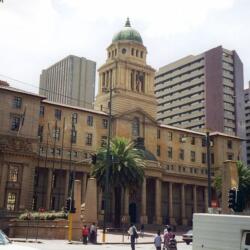
Is there a future for local government?
It’s a measure of the state of South Africa’s municipal sphere that Treasury has cut off equitable share funding transfers from the fiscus to 69 municipalities in the run up to an election. It says even more that those targeted are not only desolate, out-of-the way dorpies, but sizeable urban centres, including Johannesburg, the now much tarnished City of Gold.
Meyer will not stop the refugee programme – and he shouldn’t bother to try
It’s rare that a South African diplomatic appointment attracts any public notice, and even more so for an appointee to be invited onto a radio talk show to discuss the objectives of his posting. But Roelf Meyer’s appointment as ambassador to the United States is hardly an ordinary one, and what he had to say has garnered an uncharacteristic amount of attention.

GEM Bill provides template for thriving mining industry
It’s impossible to understand South Africa without reference to the trove of mineral wealth beneath its soil and the industry that grew up to extract it. The very borders of the country are in large part the outcome of conflict intimately bound up with resources in its soil.