

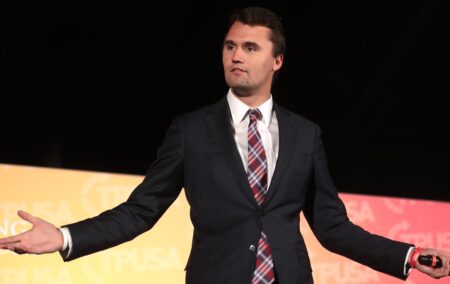
Late last Wednesday evening I was watching a podcast by my favourite source for US political news and analysis, Mark Halperin of 2Way, and he was interviewing Charlie Kirk. I had long been impressed by Kirk’s ability to listen while debating.
Halperin, a fixture of American media for decades, asked questions which were challenging, though not hostile, and Kirk is frequently seen taking notes. His responses weren’t canned but rather they reflected his being conditioned to listen attentively. When queried by Halperin about the attitudes of young Americans toward various issues, on multiple occasions, Kirk responded that he would know more after the campus tour he was about to begin.
When I woke not many hours later and checked emails I learned he had been shot in the neck. Minutes later he was gone.
“Hey fascist! Catch! ↑ → ↓↓↓” was engraved on one of the intact shell casings that was found with the rifle used to kill him. While what we learn about the killer will be shaped by the biases of the news organisations we rely on, we can confidently conclude that Tyler Robinson is not a good listener. Rather, he is an extreme example of what a cancel culture produces.
The critical question is: What produced today’s cancel culture in the US and across much of the West? I think I can provide a non-ideological answer. I consider myself a moderate in that I think the party controlling the US presidency and Congress should shift regularly between the two parties that dominate US politics. I’m also someone who appreciates that high political office doesn’t suit those easily deluded by ideals.
In the US and elsewhere the framing of events and broader perceptions, at news organisations and universities, is dominated by those whose political biases lean firmly to the left. There are, of course, many exceptions. A modest number of important news outlets, such as Fox News, and a meagre number of universities, lean decisively to the right.
Seductive appeal
In addition to those devoted to framing events to fit leftist narratives having decisive numerical advantages, they also benefit from the seductive appeal of the ideals they promote. They would have us believe that everyone would be equally happy and well-off if only the rich and powerful were prevented from exploiting the poor and less fortunate by their preferred candidates being elected.
In the US and much of Europe such idealism was to provoke a permanent shift to the left by welcoming millions of immigrants who were expected to become citizens and vote for the parties that invited them. Rather, this has created a backlash. US President Trump’s Republican party is enjoying rising support among immigrants along with black and white Americans.
The left squandered its advantages at framing issues by indoctrinating students not to think objectively but rather to judge harshly those that had not bought into its approved catechism. Karl Marx and his later disciples were adept at criticising but they scored badly at developing solutions. The same is true of the Postmodernists who insist on discrediting meta-narratives spanning ideologies, religion, family, reason, language and logic. That is, their loathing of Christian values, binary sexual categories, and traditional pronouns need not be logical. Nor is their embrace of Marx’s obsession with oppressor-oppressed lenses.
Here in SA it is easy to appreciate the fatal flaw in seeking power through such indoctrinating. It very much resembles the ANC’s efforts to control our nation’s discourse using social justice framing. ANC elites have managed to remain in power by exploiting the extreme unemployment and income inequality that their policies sustain. DEI has been similarly exploited by the Left in the US − though with less severe consequences.
Energy for lecturing
The Left has abundant energy for lecturing about what should be but that is very different from focusing on solutions and managing trade-offs. Charlie Kirk, who was not college educated, initiated a massive movement when he was 18 by exposing the hypocrisy of the left. He did this by debating indoctrinated students on college campuses.
Kirk’s movement benefited from Trump being elected in 2016 and Elon Musk buying Twitter in 2022 and Trump’s reelection benefited from Kirk and Musk’s efforts. Now, Kirk’s movement, Trump’s reelection and Musk’s X challenge the Left’s ability to frame perceptions through inculcating students, shaping how news is reported and how government governs.
Leading voices of the left would have us believe that even hard-left supporters are peaceful and that Kirk would be alive if the US was better at gun control. But Kirk was killed with a hunting rifle whose basic design traces to the 19th century. There is a strong case to ban assault rifles but there was never any reason to believe that hunting rifles can be banned in the US. Besides, if there is one country where Russia and China would want to help provoke a military coup, it would be the US. So that country’s citizens being heavily armed has the ironic effect of making the world safer.
The one shell case engraving combined the labelling of Kirk as a fascist with sick humour and some video game reference. This does not reflect discernment on the part of the alleged killer. Whereas Kirk was devoted to free speech and listening, Robinson is the product of indoctrination that leads to intolerance and hate.
The ideals that have been overindulged since the end of the Cold War won’t now be forcibly cancelled, but they will more frequently have to compete with workable solutions.
Kirk’s death will accelerate the recently begun shift toward a better balance between idealistic perceptions of what should be and practical efforts to improve people’s lives.
[Image: https://www.flickr.com/photos/gageskidmore/48941111502]
The views of the writer are not necessarily the views of the Daily Friend or the IRR.
If you like what you have just read, support the Daily Friend