

South Africa played a considerable role in World War II, but this is being wiped from our historical memory.
This year is the 80th anniversary of the allied victories over Nazism in Europe and Japanese militarism. In SA there are no high-profile official commemorations, despite the massive South African mobilisation and large toll in the war.
The war was a definitive conflict between good and evil. Axis rule over much of Africa would have set back the independence movement by years and stalled our own advance to democracy.
The ANC is not too keen to commemorate what it sees predominantly as a white war in support of the British Empire. And it is the ANC-controlled Department of Education that sets the syllabus and approves the textbooks.
Not even a wreath has been laid at a war memorial by the President, in commemoration of the 80th anniversary of the end of the conflict. The ANC views the conflict primarily as one between colonial powers, with little or no bearing on Africans and their struggles. Private ceremonies do keep the memory of the war alive, but without an official imprimatur, the record is lost to many.
The Nationalist Party was also reluctant to commemorate the war. Many of its leaders harboured deep anti-British sympathies, due to the experience of Afrikaners in concentration camps during the Boer War. And some were outright Nazi sympathisers. Afrikanerdom was deeply split over whether South Africa should join the war effort. The vote in the South African parliament to enter the war only passed by a very small margin, and left the white population deeply divided.
Despite the ANC’s reluctance to commemorate the war, it would do well to remember that Chief Albert Luthuli, who led the party from 1952 until his death in 1967, supported the allied cause. He also pointed to the hypocrisy of the SA government in calling for African loyalty while maintaining racial oppression. Significantly, Luthuli saw the war as a source of enormous political change. He wrote that the war had awakened many Africans to the idea of resistance and African nationalism.
A good case
Luthuli’s argument makes a good case that the war should hold a higher place in our collective memory. Apart from its role in helping fuel African nationalism, the sheer scale of the effort and our losses argue that it should hold a larger place in the present dominant historical narrative.
About 334,000 South Africans volunteered to serve in World War II. About 63 percent were white, 23 percent were black, and around 14 percent coloured and Indian. About 9,000 South Africans were killed in the conflict. That is well short of the 21,000 estimated by the Truth and Reconciliation Commission to have been killed in the Struggle, but it is nevertheless a significant number.
Blacks in the Union Defence Force were poorly treated. Only whites were allowed to carry weapons, but commanders were allowed discretion on arming black soldiers close to front lines. And in what is an outrage, pensions paid to black veterans were a small fraction of those paid to whites who had served.
As a matter of historical record, all this should be in, at least, the textbooks.
Some of the ANC’s closest allies commemorate World War II. Parades and commemorations often serve a political purpose for nation-building, shows of strength and as a reminder of ever-present threats. The Soviet Union lost 27 million people in the conflict, and commemorates its “Great Patriotic War” victory with a massive parade on Red Square. Last month China used its Victory Parade to show off new weapons systems and host its friends, as much as to remember victory over the Japanese.
In the US, the war’s commemoration consists mainly of wreath-laying ceremonies. In the UK, the war’s dead and those of other wars are marked in very sombre Remembrance Sunday ceremonies, and on Victory in Europe Day, May 8th, with fly-pasts and local events.
Officially there might not be complete neglect of World War II commemorations, but there is nothing substantial. In 2012, a South African National Defence Force delegation (SANDF) visited Egypt for the 70th anniversary of the Battle of El Alamein. But there is no evidence of any South African official attending the 80th anniversary of the Battle three years ago.
Wiping the historical record
In what is the equivalent of wiping the historical record, textbooks at both private and public schools today have nothing on World War II itself. The heavy focus of history textbooks today is on racial segregation, the Struggle against apartheid and how world history feeds into those themes. Hence, there is a considerable amount in the “Spot On” Grade 9 Social Sciences textbook used to teach mostly 14-year-olds on the Treaty of Versailles, Nazism and Japanese militarism, and the rise in anti-Semitism and the Holocaust. But there is absolutely nothing about the War itself.
Apart from the War as a great historical conflict, full recognition would also impart great themes in military history, strategy, the planning of a post-war world and much else. South Africa’s involvement in East Africa, the defeat at Tobruk, the victory at El Alamein which denied oil supplies to the Nazis, and the fight in Italy would give students a glimpse into what should be general knowledge.
And then there is nothing on the inspiring story of Job Maseko, the former miner from Springs who was captured after the surrender of Tobruk to the Germans. While in captivity, he worked as a stevedore at the port of Tobruk, and managed to place a sufficient amount of cordite into a tin can to blow up a German vessel. He later escaped captivity and walked through the desert for three weeks to join allied forces at El Alamein. This is a gripping story of great valour and immense resourcefulness, which teenagers would enjoy.
There is also nothing in textbooks on Group Captain Adolph Gysbert “Sailor” Malan, a South African Royal Air Force Group Captain, who was the leading fighter ace of his time. Soon after his return to South Africa, Malan became a leader of the Torch Commando, an organisation of former servicemen opposed to the removal of Coloured people from the voters’ roll in the Cape. This story and his “Ten Rules of Air Fighting” would also improve the textbooks.
Frustrated
History teachers to whom I spoke were frustrated by the wiping out of World War II in the textbooks. “History is written by the victors,” they both said. This quote is often attributed to Winston Churchill, but it appears to derive from the statement that, “History will be kind to me, for I intend to write it.”
We now have a DA Minister of Basic Education, Siviwe Gwarube, but she has not yet addressed the textbook issue.
For the sake of a more open-minded version of our history, she should rapidly take advantage of her position as a new victor.
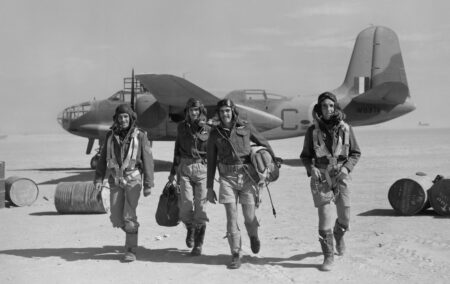
[Image: The crew of a Douglas Boston Mark III of No 24 Squadron, South African Air Force, walking away from their aircraft on an airfield in Libya after a sortie. By Royal Air Force official photographer – http://media.iwm.org.uk/iwm/mediaLib//37/media-37937/large.jpg, from the collections of the Imperial War Museums, Public Domain, https://commons.wikimedia.org/w/index.php?curid=24465808]

The views of the writer are not necessarily the views of the Daily Friend or the IRR.
If you like what you have just read, support the Daily Friend