

If you want to see what happens when a generation loses patience, look to Nepal.
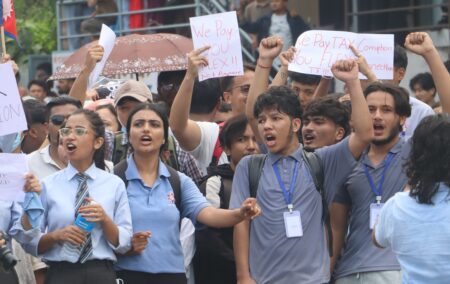
On September 8, the Himalayan republic’s young people lit the match. Within days, the parliament building was torched, the homes of former prime ministers razed, and the Supreme Court burnt to the ground. Prime Minister K.P. Sharma Oli resigned after security forces opened fire on crowds. At least 51 protesters were killed. By September 13, the army had entered negotiations,not with political parties, but with a leaderless, digital generation organising through the gaming app Discord.
The protesters demanded that parliament be dissolved, and appointed Sushila Karki, a former chief justice and veteran of Nepal’s 1990 pro-democracy movement, as interim prime minister. Incredibly, the army agreed. Elections are now scheduled for March 2026.
It sounds like a modern Jeffrey Archer novel, but it is very real. And for South Africa, it is a cautionary tale about youth unemployment, corruption and the fragility of legitimacy in a dispensation.
Nepal is no stranger to political upheaval. The country of 30 million has lurched between monarchy, parliamentary monarchy, civil war, and finally a fragile republican system since the 1950s. In 2008 the monarchy was abolished and Maoist insurgents briefly held a majority. But ten prime ministers in ten years have since come and gone.
Oli’s fatal misstep was trying to ban 26 social media platforms. This was the trigger for protests and wider dissatisfaction. The deeper cause was distrust, which accumulated over decades of corruption and elite capture. Young Nepalis have long mocked their politicians with hashtags like #NepoKids, highlighting the sons and daughters of leaders flaunting luxury cars and designer clothes in a country where the average income is about $1 400 a year, similar to that of Lesotho and Eswatini. Combine that with youth unemployment of roughly 21%, and the country clearly had tinder waiting for a spark.
But what makes Nepal’s uprising remarkable is not so much the destruction that followed. Destruction and revolt have always gone hand in hand. But what is surprising and unique is that this uprising was organised in typically Gen Z fashion. It wasn’t a Maoist insurgency in the mountains or an old-style military coup, but a decentralised, digital, and overwhelmingly youth-driven one.
Gen Z (those born in the late 1990s and 2000s) clearly don’t play by the old rules of politics. As with much else in their lives, their politics live on their screens. And as part of their apparent need for instant gratification, they did not wait politely for election cycles. So they gathered online, coordinated through networks, and acted with a speed that outpaced the Nepalese bureaucracy and security forces.
Nepal’s army, to its credit, or perhaps in desperation, recognised the overwhelming reality rather quickly. Rather than crush the movement, it conceded to its demands.
Patterns across Asia and Africa
Nepal is not alone. Bangladesh’s prime minister fell last year after a student uprising. Indonesia has been convulsed by protests against President Prabowo Subianto, led by student unions. Kenya’s youth have mounted sustained protests against corruption and economic failure, despite police killings.
Each country shares three features: a history of authoritarianism, pervasive corruption, and youth unemployment that locks millions out of economic life. Each uprising has been driven not by party structures, but by digitally-connected young people, willing to endure state violence.
That insight deserves the attention of Pretoria and Cape Town.
South Africa’s youth unemployment crisis is not just severe by local standards, it is among the very worst in the world. According to the World Bank, more than 61% of South Africans under 25 are unemployed: a rate second only to Djibouti. For perspective, the global average sits around 13.6%, while Nepal, where the streets recently erupted, has youth unemployment of about 21%. Even in Bangladesh, where protests toppled Sheikh Hasina’s government last year, youth unemployment is well below ours.
What’s more, unemployment doesn’t spare the educated. Stats SA estimates that roughly 12% of university graduates can’t find work, which means even those who’ve “done everything right” face long odds. The picture darkens further when one looks at NEETs, young people who are Not in Employment, Education or Training. Nearly 44% of South Africans aged 15–34 fall into this category, according to Stats SA’s Quarterly Labour Force Survey. That’s almost half a generation effectively written out of the economy before their adult lives have even begun.
What does this mean in practice? It results in millions of young people in townships and informal settlements who will likely never find formal employment, no matter how many skills programmes or youth development funds are announced. By the age of 25, if you’ve never had a job, your chances of entering the labour market shrink to almost nothing.
At the same time, wealth is flaunted shamelessly by some of our political elite and their enriched connections. Expensive German cars driving through townships and Instagram feeds show ministers’ children sipping champagne. The optics are indistinguishable from Kathmandu’s ‘Nepo Kids’.
Despite our country’s very violent daily living, South Africans have been relatively docile when compared to other countries, when it comes to political violence. It might not feel that way, but globally political violence is considerably more routine. It includes governments toppled in Asia and Africa, armies deployed against their own citizens, leaders ousted by mobs who have finally run out of patience.
But South Africa’s youth are not uniquely apathetic. They have filled the streets and campuses during student fee crises, and protested about service delivery failures. What they lack is not anger but cohesion. If that changes, if they ever coordinate at scale, digitally and outside the old party system, South Africa might witness something similar.
Closing thought
Nepal’s uprising is extraordinary and unsettling, because it shows how fast legitimacy can collapse and how strange the future of politics may look. A former judge elected on a gaming app now leads a country once ruled by kings. The absurd has become reality.
South African leaders should not take comfort in the idea that “it can’t happen here.” History rarely announces itself before arriving. The deeper lesson is that politics no longer belongs only to parliaments, party lists, or liberation movements; it belongs to whoever can claim legitimacy in the eyes of the public. If institutions fail to carry that trust, the streets, and now the screens, will.
We already see fragments of this in the privatisation of the public sphere: private security companies patrolling where police are absent, business coalitions fixing electricity substations, community groups maintaining roads when municipalities fail. Functions once reserved for the state are steadily shifting into the hands of private actors.
When legitimacy weakens, authority doesn’t vanish, it migrates. In Nepal, it migrated to Discord. In South Africa, it may migrate to whoever can provide what the state cannot: safety, services, and above all, a sense of representation. And if that transfer gathers enough force, the burning of parliament will not be a metaphor.
[Image: https://commons.wikimedia.org/wiki/File:GenZ_protest_against_government_in_chitwan,_8_september_2025.jpg#/media/File:GenZ_protest_against_government_in_chitwan,_8_september_2025.jpg]
The views of the writer are not necessarily the views of the Daily Friend or the IRR.