

Poland’s message for Africa emphasises the importance of agency in development and defence, the attractiveness of an alternative to the Chinese model of high growth and illiberal politics, and the shared need to defend democracy and the rule of law, without which not only Ukraine, but Africa, is at risk.
Radosław Tomasz ‘Radek’ Sikorski says that his luck was to be born at the right moment, that he came of age when communism failed in the early 1980s.
His mother’s investment in an English tutor saw him travel to the UK, where he was granted political asylum after the declaration of martial law in Poland in December 1981, after which he studied at Oxford.
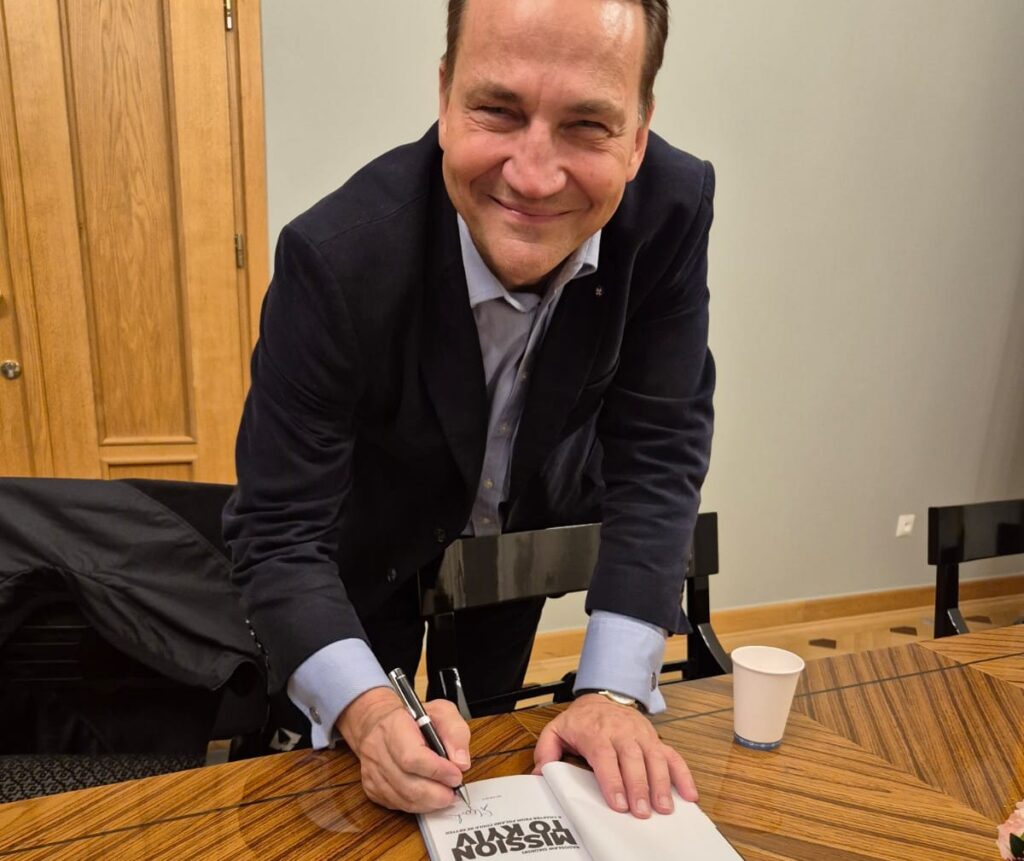
[Radoslaw Tomasz ‘Radek’ Sikorski. Image: Greg Mills]
He earlier served as Minister of Defence of Poland and, since 2023, as Minister of Foreign Affairs, previously holding the office between 2007 and 2014, and since 2025 also serving as Deputy Prime Minister. He has worked as a journalist in Afghanistan and Angola, and held various visiting academic appointments in the UK and US.
“We have a positive story to tell,” he says, “which has a message for Africa.”
This is contrary to what has become a common whine of younger generations about the attractiveness of the Western model.
In the West, a majority of Generation Z (those born between 1997-2012) now perceive capitalism as having failed.
The Guardian, for instance, has reported that in the UK, almost “eight out of 10 of young Britons blame capitalism for the housing crisis and two-thirds want to live under a socialist economic system”. In the US, 43% of both millennials (born between 1981-96) and Zoomers reportedly see capitalism as having negative connotations.
Capitalism is today blamed for the climate crisis and inequality, as the system where the rich get richer.
Thus, it is with some irony that steel tycoon Lakshmi Mittal is said to be the latest of the super-rich to exit the UK, his decision apparently linked to the UK’s abolition of the long-standing “non-domiciled” tax status. Other very rich people have recently described the UK economy as “uninvestable”, never mind the irony of passing that judgement about a country that would take it on the chin rather than lock critics up or seize their assets like other presumably “investable” geographies.
The rise of “hard right populism” is also cited as evidence of social disquiet, as much as it is evidence of external meddling and funding, and weaponised immigration.
But the classification of failure depends on where you look. Lumping all of Europe together is a little akin to saying all of Africa is one thing, or that liberal-capitalism per se has failed. That’s both lazy and wrong, and confuses – perhaps deliberately – personal interests with overall circumstances.
Take Central Europe. In 1993, Poland’s gross domestic product per capita was $4,700. Today it is, in real terms, $18,000. Over the same period, to take a comparative example, South Africa’s went from $4,400 to $5,700.
There are, says Sikorski, two models today to modernise: one, the Chinese version, “hugely successful in terms of growth, where the state liberalises the economy but keeps control of the politics”. The other model is “Poland, where you liberalise both politics and economics. Crucial to our success is the role of institutions and the rule of law. We don’t have a super-rich oligarchy controlling the government. But since 1994, we have grown our economy cumulatively by 1,663%,” he notes.
“We have achieved this without national resources. It has been based on the creativity of people and open markets, with 75% of our exports going to the European Union. We believe that this model is more attractive to Africa than the alternative Chinese example.”
Difficult decisions – such as what to do with state-owned enterprises – largely took care of themselves during Poland’s reform process. “The majority of them went busy just as the majority of successful enterprises were created from scratch.” One of the largest industries in his hometown of Bydgoszcz in northern Poland was a bicycle works, once employing 5,000 workers. That shrank inevitably in the face of foreign competition. Now Bydgoszcz has reinvented itself as a centre of international banking, insurance and an Industrial and Technology Park.
Much of Sikorski’s energy is understandably taken up with the situation in Ukraine, and specifically the embryonic peace process. “Currently the two red lines”, which Ukraine and Russia regard as non-negotiables, “do not meet.” Although he commends the US peace initiative, he worries that Ukraine, as the victim, “is being made to accept concessions, rather than ensuring the aggressor should not be able to do this again.”
“For there to be a long-term peace Ukraine must emerge with defensible borders, receive the resources to rebuild, and have the prospect of European integration.” The Ukrainian constitution stipulates the ambition to join NATO and the EU, though this only came about in 2019 after the annexation of Crimea and parts of the Donbas in 2014.
As for Russia “it has to accept that its colony has a right for a separate existence. Naturally it’s difficult for a metropolis to do so. But it has to be made clear to Putin that he can no longer expect this.” He describes Russia’s actions in Ukraine as a “recolonisation” given the independence of Ukraine after the break-up of the Soviet Union in 1991.
Upholding international law and borders is, he points out, “in the interests of Africans who, like Europe, also live with accidental borders.” Given that international affairs is based on the pretext of the protection of minorities “it will mean the depths of hell for Africa if the continent’s bigger countries can change borders based on force.”
This is linked to the rise of authoritarianism and the saleability of democracy.
“Democracy is not a Western imposition,” he argues. “It is a basic human need for citizens to have influence over their own lives. And democracy tends to prevent or correct the worst abuses of those in power.”
For these reasons, among others, “(w)e believe our model is more attractive to Africa than China’s,” he concludes. The statistics on the preference of democracy to Africans – that 70% polled prefer it to the other systems on offer – backs up Sikorski’s observation.
Poland illustrates, like other smaller countries in Europe, that agency is a most important commodity, in defence as in development. It is a reminder, too, thus that a bad peace in Ukraine is a bad peace for Africa.
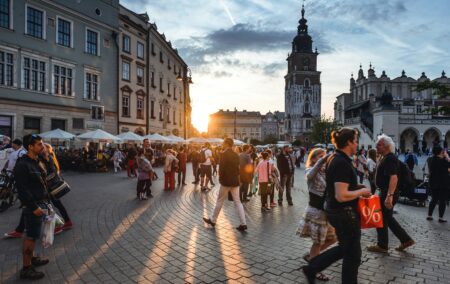
[Image: Jacek Dylag on Unsplash]
The views of the writers are not necessarily the views of the Daily Friend or the IRR.
If you like what you have just read, support the Daily Friend