


A quarter century ago 91-year-old Philip Johnson stood in the atrium of Frank Gehry’s Guggenheim Museum in Bilbao, Spain and wept. Moved by the astonishing beauty before him, Johnson, a godfather of modern architecture, proclaimed the Guggenheim “the greatest building” of our time and Gehry “our greatest architect.”
I.
I have come to know three Gehry creations, beginning with the 1996 Fred and Ginger building in Prague, the city where I was living at the time.
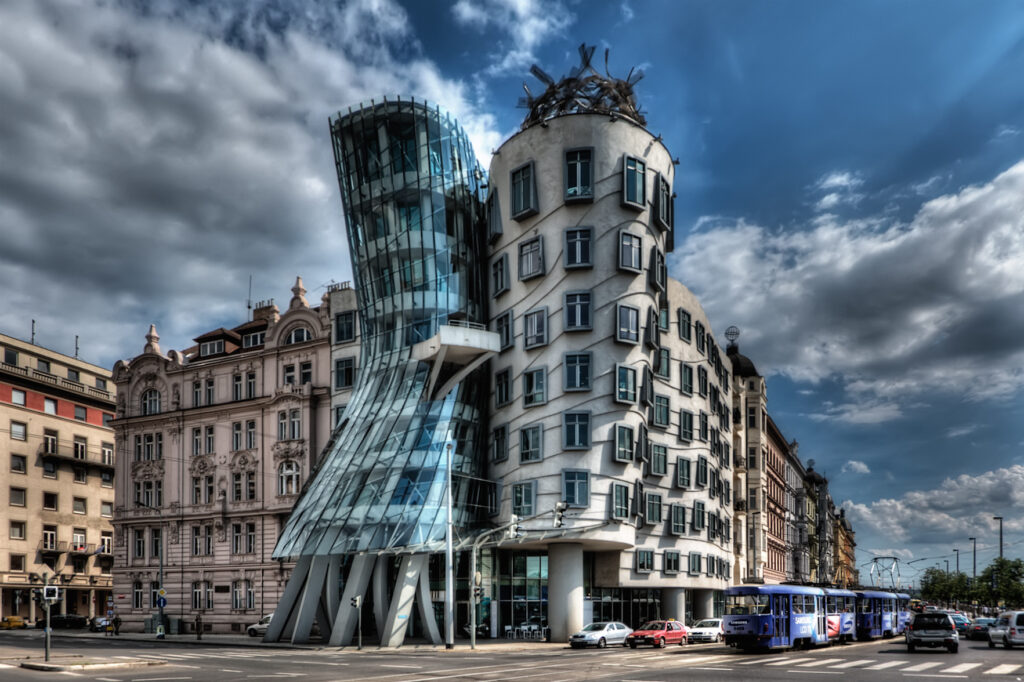
[Dancing House, Prague: By Pedro Szekely from Los Angeles, USA – Dancing House, Prague, CC BY-SA 2.0, https://commons.wikimedia.org/w/index.php?curid=24326800]
This whimsical structure of contrasting glass and concrete at a busy corner on the Vltava River embankment was a bold and risky addition to the austere apartment block to which it is attached. Playwright and future president Vaclav Havel grew up on this street. The site for the Fred and Ginger building was empty for 40 years, uncleared from destruction wrought by a stray Allied bomb during the Second World War.
It is the sinewy curve of metal and glass billowing at the bottom as if it were Ginger Rogers’ gown that gets attention. Her dancing partner Fred Astaire stands tall in pastel concrete. The public loves it, the site is much photographed. The Dancing House, a fashionable restaurant perched at the top, has become a Prague landmark.
II.
Gehry’s Walt Disney Concert Hall in downtown Los Angeles is a stunner. Crouched near the city center, Gehry’s building consists of stainless-steel slabs that rise in multiple directions, challenging the eye to make sense of what at first glance is a jumble, a pile without coherence.
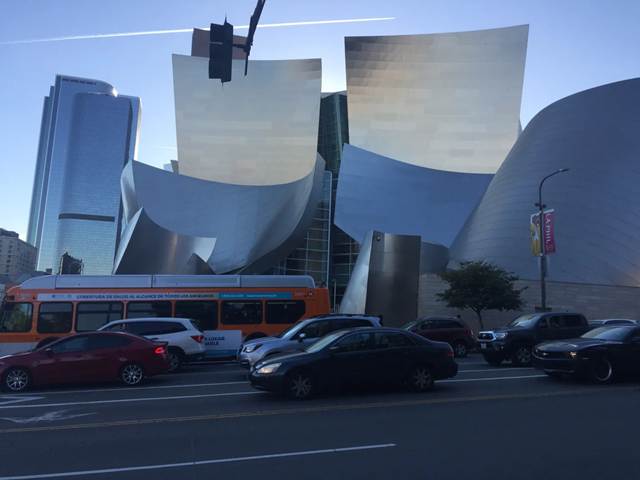
[Disney Concert Hall, Barry Wood]
The real beauty of the Disney is inside, where curves, ramps, and textured walls flow gracefully above blond flooring. The irregular space with nooks, crannies, cushioned benches and alcove seats is inviting, even captivating. Concert goers venturing outside to a plaza on the western side are greeted by lush greenery, palm trees, winding paths, and benches that invite pause and reflection.
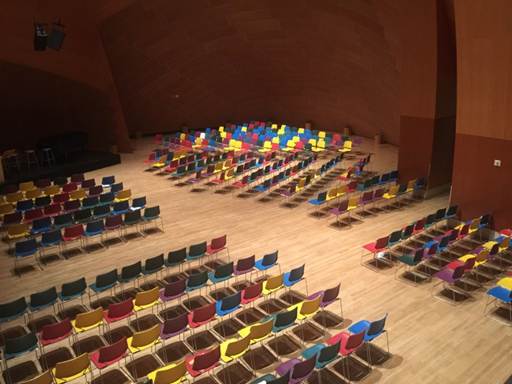
[Disney Concert Hall interior, Barry Wood]

[The view from behind the orchestra, Disney Concert Hall, Barry Wood]
The principal performance venue has four and in places five levels of seating. There are defined sections with varying characteristics. The space feels curiously democratic, with first-time visitors being unsure of where the best seats are. Surveying the tableau from behind the orchestra I was enveloped within a beautiful space.
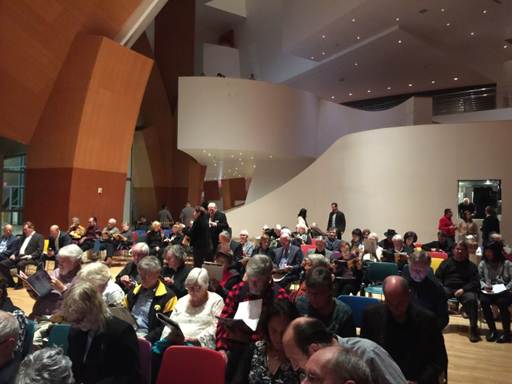
[A side hall, Disney Concert Hall, Barry Wood]
At once hailed as a masterpiece, the Disney has been described by respected architecture critic Paul Goldberger as “the finest public building in America”. Goldberger is the author of a biography of Gehry.
III.
Meta’s headquarters in Menlo Park at the northern end of Silicon Valley presented Gehry with a different challenge. His MPK 20 (the letters standing for Menlo Park) building in 2015 is an elongated, flat structure separated from the lower reaches of San Francisco Bay by a busy highway on one side and unused rail tracks on the other.

[Meta headquarters, Barry Wood]
Within this narrow wedge the building boasts a magnificent rooftop park with 400 trees, a café, hiking trail and terrific views. It can house 2,300 employees in “the world’s largest open plan office.”
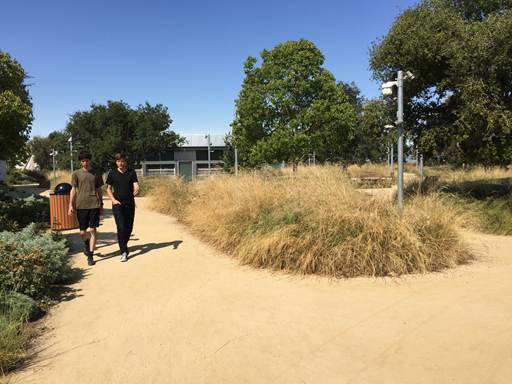
[Walking route through the rooftop park at Meta headquarters, Barry Wood]
Facebook’s army of youthful employees glide through MPK 20 either on foot or bicycles. When I visited, the place was reminiscent of a college dorm. Random notices were posted on the walls. Signs declared, “keep calm and ride on,” “think local, scale global,” and “even busy bees stop and smell the roses”.
Backpacks and bicycles leaned against dividers. Micro-kitchens and cafes dispensed free food. Responding to a comment that people were dressed very casually, a Facebooker replied: “The only suits we see are visiting lawyers and bankers.”

[Meta headquarters, Barry Wood]
More recently Gehry designed Meta’s MPK 21 adjacent to the building described above. It is even larger, with rooftop gardens and a nearly one-kilometer-long walking loop.
Frank Gehry, who grew up in Toronto but made his home in L.A., worked well into his 90s, as did his illustrious predecessors Frank Lloyd Wright, I.M. Pei and Philip Johnson.
With his fondness for bold fanciful design and irregular shapes, Gehry reinvented modern architecture. He will be greatly missed.
The views of the writer are not necessarily the views of the Daily Friend or the IRR.
If you like what you have just read, support the Daily Friend