

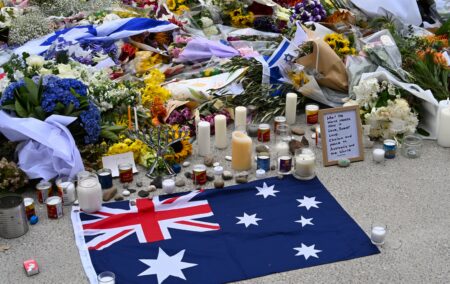
Chanukah is meant to be a defiant celebration of light – a refusal to grant darkness the final word. Yet on the evening of 14 December 2025, as Jewish families across the world lit candles to mark survival against overwhelming odds, darkness arrived unannounced on the shores of Bondi Beach in Sydney.
Sixteen people were killed and around 60 wounded. Among the dead was Rabbi Eli Schlanger, a Chabad rabbi and emissary whose life was devoted not to politics or power, but to community, continuity, and care. His murder was not merely an attack on individuals enjoying a summer evening. So far, the youngest victim is 12 years old: a beautiful young girl named Matilda whose light has now been snuffed out.
This was an act of proxy terrorism: violence against Jews far removed from any battlefield, carried out in the name of a conflict they neither command nor control. This is the reality the world continues to struggle to name.
The attack on Bondi Beach occurred in the tense aftermath of renewed ceasefire negotiations between Israel and Hamas. Negotiations were weighed down by unresolved disputes over hostages, humanitarian access into Gaza, and the lingering shadow of Trump-era Middle East diplomacy that prioritised deals over durable peace.
As has become disturbingly routine, when talks stalled and rhetoric hardened, Jewish communities thousands of kilometres away became targets. Not Israeli soldiers. Not policymakers. Not negotiators. Civilians. This is the logic of proxy terrorism: when Israel cannot be reached, Jews will suffice.
We saw this again earlier this year. Following the recognition of Palestine as a state by NATO allies, a Manchester synagogue was attacked, with the loss of two Jewish lives. That violence did not emerge in a vacuum. It followed political decisions by governments in the UK and Australia that signalled legitimacy without restraint. In the same period, a German judge ordered the pre-trial detention of three Hamas operatives involved in a plot to murder Jews, yet again.
It is not coincidental that the Bondi attack came shortly after Rabbi Schlanger personally wrote to Australian Prime Minister Anthony Albanese, warning of escalating antisemitism and growing fear within Australia’s Jewish community. That letter now reads as a chilling testament to foresight ignored. Speaking to the media, the Co-CEO of the Executive Council of Australian Jewry confirmed that his own family and friends were among the victims: a stark reminder that such warnings are not abstract. They are rooted in lived vulnerability.
Rarely unpredictable
The attack was described as ‘unexpected’ and ‘out of the blue’, much like the attacks on 7 October 2023 in Israel. But history teaches us that violence against Jews is rarely unpredictable. However, it is inconvenient to confront such violence.
The warning signs were visible: protests sliding into incitement, Jewish institutions requiring permanent police protection, and online spaces normalising dehumanisation beneath political slogans. Yet when violence erupts, society defaults to surprise rather than accountability. Surprise is easier than introspection.
I call this proxy terrorism, and it does not always require direct operational links to Hamas, ISIS, or any formal organisation. Its power lies in ideological outsourcing. It thrives when violent intent is morally laundered through political grievance.
In this framework, Jews become symbolic stand-ins. A synagogue becomes “Israel.” A rabbi becomes “Zionism.” A family dinner becomes a legitimate target. Bondi Beach was not chosen for military value, but for symbolic exposure. It was public, visible, unguarded: mirroring Jewish life across the diaspora today. This was by no means accidental violence, but rather calculated and strategic.
Once that distinction collapses, the broader moral conversation becomes unavoidable. There is always the same defence: that the hostility is aimed at “Zionists,” not Jews. Bondi exposes that claim for what it is. Little Matilda was not a government official, a soldier, or a policymaker. The families attacked were not debating borders or ceasefires. They were Jews – visible in public, living Jewish lives. “Zionism” has become smoke-and-mirrors: a linguistic shield that allows an old hatred to present itself as political critique. Strip away the slogan and the target remains unchanged. What is being punished is not ideology, but identity.
The suffering in Gaza is real, devastating, and deserving of empathy. Civilian pain should never be denied or diminished. But acknowledging Palestinian suffering does not require legitimising violence against Jews elsewhere, or anywhere. Here lies a moral asymmetry the world continues to avoid.
That difference matters
Palestinian communities have not faced surprise mass-casualty attacks in Sydney, Paris, or Toronto as global retaliation. Jewish communities have. And that difference matters.
It reveals how Jewish vulnerability is treated as politically negotiable rather than morally absolute. This helps explain policies such as recognising Palestine as a state while war rages in Gaza, without confronting the downstream consequences for Jewish safety abroad.
Jewish communities live under an invisible siege. Children attend schools behind security gates. Synagogues resemble fortresses. Holidays require police patrols. This is not resilience but rather adaptation to government neglect. Rabbi Schlanger was not powerful; he was visible. And visibility has become a liability.
The helplessness Jews experience is not born of weakness, but of exposure without protection. They are told they are powerful enough to influence global politics, yet they are murdered in public spaces without sustained global outrage. That contradiction is not incidental. It reflects something deeper and entrenched.
The Australian government was right to classify the Bondi attack as terrorism under the Criminal Code Act of 1995. Naming matters. But naming without consequence risks becoming performative.
The illusion that geography offers insulation has been shattered. Like many democracies, Australia discovered that ideologies travel fast, and borders can’t stop them.
When Jewish leaders warn governments and are dismissed as alarmist, the failure is not Jewish. It is institutional. Antisemitism is too often treated as an intellectual puzzle rather than a lethal threat. It is contextualised, debated, and relativised until Jewish suffering fades into background noise.
This is how blindness works: not through ignorance, but through selective attention. The world rightly mobilises against racism and Islamophobia. But antisemitism is repeatedly explained away as “politics.” Bodies are buried beneath that distinction.
Violence normalised against one group never remains contained. History is unambiguous. The tolerance of proxy terrorism against Jews lowers the threshold for violence everywhere else. Bondi Beach now joins a grim list of places where Jewish blood was spilled to make a political point. The question is whether the world will remember.
Openly and boldly
Chanukah teaches that light does not defeat darkness by denying its existence. It confronts it, openly and boldly. Honouring Rabbi Eli Schlanger, little Matilda and the others murdered at Bondi requires more than condemnation. It demands honesty in naming proxy terrorism for what it is, proactive protection of Jewish life, and the abandonment of the moral cowardice of silence.
Distance does not dilute hatred. Silence amplifies it. And the cost is not theoretical. It is measured in lives.
[Image: By Sardaka – Own work, CC0, https://commons.wikimedia.org/w/index.php?curid=180044060]
The views of the writer are not necessarily the views of the Daily Friend or the IRR.
If you like what you have just read, support the Daily Friend