

What distracts so many countries from prioritising their core interests?
Reflecting how transport and communication costs have plunged, free trade’s potential to deliver win-win benefits is immense. This, however, presumes adherence to crucial rules. China routinely frustrates WTO enforcement mechanisms to an extraordinary extent, while most government responses remain feeble.
Cultural, educational, and scientific interactions are important, but international relations are dominated by economic and security considerations. The reason we no longer live in a rules-based multipolar world is that China’s government has sought to offset its economy’s imbalances by subsidizing overproduction in strategic sectors. This so-called “involution” is on track to bankrupt large swathes of foreign competition.
China’s exporters have become extremely effective at thwarting the WTO’s anti-dumping tools. Thus, the logical thing for Western nations—their most valuable markets—to do is to apply high tariffs on goods that are being exported at artificially-reduced prices. But consumers, aka voters, like low prices.
Notwithstanding high political polarisation, the US’s governing structures and style can, with considerable difficulty, accommodate the use of tariffs to counteract dumping. Irrespective of the Supreme Court’s upcoming rulings, US presidents can wield various tariff tools. This is vastly more difficult for today’s 27 European Union countries.
Germany’s global exporters benefit from having their costs denominated in euros rather than Deutschemarks, and its regional sales benefit from common market membership. But Europe’s largest economy relied on buying cheap energy from Russia, “free riding” on the US’s security umbrella, and selling to a rapidly industrialising China.
A further complication for Germany and many European nations is that they have considerable investments in China. The structure of the EU fundamentally undermines that region’s ability to play hardball on economic or security issues. Variations in European interests and views have contributed to a sclerotic decision-making culture amid a rapidly evolving global economic landscape.
Continental Europe’s share of global GDP declined from 28% in 1990 to 18% in 2024; China’s share increased from barely 2% to 17%. The US’s share has fluctuated around 25%. China’s slowing growth trajectory is expected to soon resemble that of the US, whereas Europe’s is projected to significantly lag behind the two largest national economies.
China’s manufacturing prowess is truly formidable, but its typical households have modest assets and spending power. High savings rates have been offset by poor investment returns. Correcting the country’s overinvestment in housing is greatly complicated by a rapidly-shrinking labour force. China’s domestic consumption is insufficient for full employment or for supporting healthy growth.
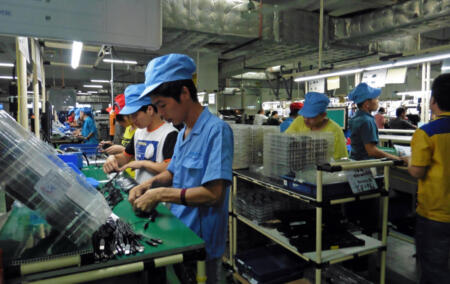
Growing its exports is a top priority, and China is accomplishing this through the state very aggressively subsidizing investments in strategic sectors to fund excess production. This violates WTO core prohibitions well beyond what the organisation’s designers anticipated.
Last month in Beijing, the IMF’s managing director reiterated the bank’s position when she said, “China is simply too big to generate much (more) growth from exports, and continuing to depend on export-led growth risks furthering global trade tensions… It requires brave choices and determined policy action.”
Europe’s path to brave choices and determined policy actions is complicated by its national governments having outsourced the management of their core economic, governance, and security interests to supra-national institutions such as the EU and NATO. Europeans mixed such outsourcing with choosing to focus their political energies on climate change, immigrants, and social justice issues.
The post-Cold War era was largely defined by China outpacing Europe, and even now the region’s leaders flail about when trying to manage their security and economic challenges. They should be coordinating with the US to increase tariffs on China’s subsidised exports—except that this is insanely difficult, given Europe’s factions, structures, and preferred priorities. Even Russia’s invasion of Ukraine hasn’t curtailed the continent’s bureaucratic impulses.
The expertise born of multi-dimensional political structures qualifies Brussels, in the opinion of its bureaucrats, to be the global regulator of key technology and information sectors. But it is precisely Europe’s regulatory prejudices that explain the region’s non-competitiveness in these sectors—and more broadly.
A large-scale war in Europe wasn’t sufficient to motivate that region’s NATO members to finally increase their defence-spending commitments. This only happened after various threats and insults from US President Trump made clear that he saw the war in Ukraine as Europe’s problem.
The regimes of rogue nations, including Iran, Venezuela, and Cuba, are wobbling. Russia and China are losing much influence in the Middle East and South America. Yet there are no paths to restoring a rules-based global order as long as China is subverting global trade. And there is little reason to think this will change, if Europe’s voters don’t demand that their leaders take a harder line on trade.
As long as China can aggressively manipulate global commerce, it will. Western intellectuals and bureaucrats need to appreciate that this prohibits a return to their revered rules-based liberal world order.
[Image: https://commons.wikimedia.org/wiki/File:G.Tech_Technology_Factory_Zhuhai_China.jpg]
The views of the writer are not necessarily the views of the Daily Friend or the IRR.
If you like what you have just read, support the Daily Friend