
Implausibly, on the morning of 16 June 1976, I first heard there was trouble in Soweto from London.
Editors at NBC, the American broadcast network, telephoned me in Johannesburg to say that students were marching to protest the unequal, segregated school system. Could I get into Soweto, 12 miles from the city, as soon as possible?
On the radio there was no mention of unrest. Television, newly arrived in South Africa, didn’t come on until evening.
After filing a couple quick reports, my wife and I climbed into my battered Ford Escort and headed towards Soweto. On city streets there were no indications that anything was amiss. It was just another Wednesday morning in winter, clear and chilly. It wasn’t until we left the N1 traffic flow into what we knew as the Soweto highway that tension escalated.
Up ahead was a police roadblock. Vehicles were being turned back. Of course, we also knew that at no time were white journalists allowed into black areas. Off to the right there was a rutted service road for an industrial area. We turned into it and slowly crept through the heaps of tailings from an abandoned gold mine. The muddy path eventually led back to the main road well past the roadblock.
Our destination was the American reading room in the White City Jabavu community center, a place I knew from having been at the opening of this mini-library that was a US administration jab into the apartheid armor that denied blacks unfettered access to information. In the reading room Sowetans could read American magazines and newspapers without restriction.
I thought I knew the way but Soweto is dense and vast and I wasn’t sure.
There was little traffic as we went through Diepkloof and Orlando. Turning south towards Jabavu we became enveloped in that monotonous sameness of Soweto – rows of identical brick dwellings housing Soweto’s population of well over half a million.
To our horror
There were no street signs. I was lost. Groping for familiar landmarks, I turned into a side street where to our horror in front of us a throng of protesting students were marching in our direction. We were terrified, particularly when some marchers reached down for stones they would hurl at us. We knew students assumed that white people in a car in Soweto were part of the administrative structure, and thus a target. I slammed the Escort into reverse and we sped off.
Relieved at surviving a very close call and breathing easier from no longer seeing protesters, we stopped a lone pedestrian to ask directions. He was helpful. We were near our destination and a few minutes later our journey ended in the library parking lot. We hurried into the building where staff members were aghast at our presence. “What are you doing here!”, one shouted. But this wasn’t a time for talk. Fearing for everyone’s safety, two staff members hustled us down to a lower level in the back and ordered us to remain there. We were now fully aware of the danger.
Soon we heard the chopping whir of helicopters overhead. Peering out through a barred window we watched armed police or military being disgorged from an army helicopter.
A reading room staff member recounted what had been going on: Thousands of junior and senior high students from dozens of Soweto schools had gathered near Orlando stadium and marched toward the West Rand administration complex to protest the government decree requiring that half of each day’s instruction was to be conducted in Afrikaans, the language derived from Dutch spoken by Afrikaners. Class boycotts had gone on for weeks.
This 16 June protest was planned to be big. Organizers were insisting that instruction remain solely in English or African languages. Police arrived to break up the march. Police were inflamed by an incident where the car of a white administrator was attacked, stopped and set on fire. The driver was beaten and was perhaps dead.
Mayhem
Tear gas was fired, chaos ensued as the teenagers dispersed, running in all directions. In the mayhem police fired their weapons, first into the air and then into the crowd. Several students lay wounded or dying. The confrontation escalated as more students and police arrived. The pandemonium was a full-fledged riot with looting and vehicles and stores being set alight. The first victims, we were told, died very near to where we sheltered.
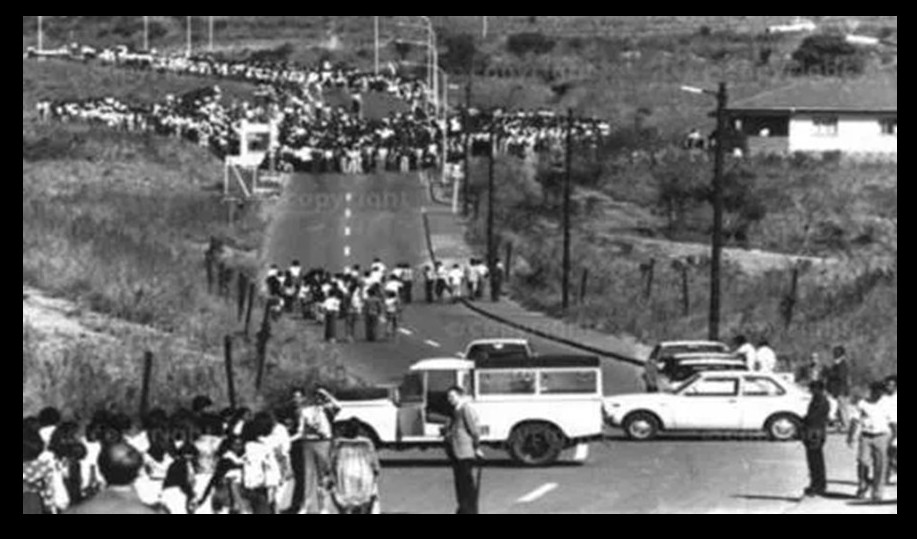
Soweto standoff [Image: https://sahistory.org.za/image/soweto-riots-16-june-1976]
Later with daylight fading, students had scattered, the violence subsided, moving elsewhere. A staff member— I never got his name—came to say he would drive us to safety. I gave him the car key. We stepped outside. It was quiet, the air didn’t smell of teargas. Our driver insisted that we lay on the floor between the front and back seats. We drove off and proceeded to Diepkloof without incident. There he pulled over, got out and said he would make his way home. We got up, thanked our friend, got into the car and drove back to the city without incident.
I regret that I never got the names of the people who protected us, saving us from injury or death.
My day was not over. London wanted more. By the end of the day I had filed 11, typically 30-second reports, bringing news of the violence to NBC’s 24-hour American radio audience. There were numerous live Q and As. South African radio and television news could no longer ignore the unrest. Their newscasts focused on rioting and student provocations. Jimmy Kruger, the justice minister, appeared to say the situation was under control. Soweto was sealed off. Two people were dead, 14 injured. Those numbers, of course, kept rising as the disturbances continued and spread to other black townships. In fact, Soweto ignited a paroxysm of protests throughout the country, continuing for months.
The public got unfiltered news from black reporters inside Soweto. In the crusading anti-apartheid Rand Daily Mail’s readers learned of a far higher death toll, with perhaps 23 teenagers killed by police on that horrific first day. The white population did not uniformly rally to the government’s position. In Joburg 500 English-speaking students from Witwatersrand University marched through the downtown in solidarity with the Soweto protesters. Their march was attacked by the police. For perhaps a majority of South Africans Soweto was a signal that the system of organized oppression of blacks could not endure.
Wider context
The Soweto uprising must be seen in the wider context of profound changes in southern Africa. Township youth were acutely aware that events were evolving in their direction. Mozambique, an immediate neighbor of South Africa to the east, had gained independence from Portugal 12 months earlier. To the north whites in Rhodesia were waging war against insurgents armed by the Soviet Union and China, allies in the fight for majority rule and an end of colonial rule. Thousands of Cuban troops were arriving in Angola to the northwest, fighting alongside communist guerillas against rival factions. Henry Kissinger, President Ford’s secretary of state, was engaged in shuttle diplomacy concerning Rhodesia’s future with John Vorster, the South African prime minister.
South Africa’s path to freedom was not easy, as the 1980s witnessed some of apartheid’s worst excesses. Tangible measures towards democracy came in 1990 when revered freedom fighter Nelson Mandela was released from 27 years imprisonment. That same year FW de Klerk, the last apartheid leader, moved step by step to dismantle segregation and promote reconciliation. Black opposition parties were unbanned, laws mandating separate living areas, racial identification and job preference for whites were dismantled. In 1994 Mandela became president in South Africa’s first all-race elections. Mandela and De Klerk were partners in building what Mandela called the rainbow nation. They were jointly awarded the 1993 Nobel Peace Prize.
The Soweto uprising changed the course of South African history. It both electrified and terrified people. At least 600 people died in the disturbances that went on until early 1977. In its aftermath up to 100,000 whites migrated to other lands, taking with them skills vital to building the rainbow nation.
When I ended a three-year journalistic assignment in South Africa in 1977, colleagues remarked that by leaving I would miss the revolution. But there was no revolution of the kind that wrecked a prosperous Zimbabwe, the former Rhodesia. Instead South Africa experienced a mostly peaceful evolution in which political power shifted to the black majority while property rights, a free media and judiciary were preserved. It was a miracle.
Basic freedoms
What about today and the future? Since Mandela’s death in 2013 and even before, economic progress and an improvement in living standards has been meager or non-existent. That said, basic freedoms have been preserved. The dominant, corrupt ruling party—in power since 1994—has thus far accepted the rules of a parliamentary democracy. Failures in governance caused the African National Congress to lose its electoral majority and since 2024 rule in a coalition with a smaller pro-business party.
Will this rich, diverse, energetic country of 64 million stagnate or prosper? If you’re an optimist as I am, you’d say things will likely get better.
Economics journalist Barry D. Wood lived in SA from 1974 to 1977 and has returned multiple times to the new South Africa since 2010.
The views of the writer are not necessarily the views of the Daily Friend or the IRR.
If you like what you have just read, support the Daily Friend