

Parts of me feel like an American refugee; ‘n verrraaier, even. At times, I feel as if I snuck off the battlefield early, leaving the rest of the troops behind to fend for themselves.
I moved to Cape Town from Johannesburg just over a year ago, and I still consider myself to have dual citizenship in South Africa. I was reminded of my existential peculiarity recently when Marius Roodt appeared on the Daily Friend Show, broadcasting from Germiston, while every other colleague on the show was stationed in Cape Town.
“So I am the only one broadcasting from the real South Africa?” he quipped. There were some wry smiles and a few downcast eyes, and I thought: “Dammit, he’s right. I am not in the true South Africa anymore, and I miss it. I miss the way it feels and being able to claim I am part of it.”
Roodt lives in Germiston, where I grew up and spent much of my life. The place has a different texture from Cape Town. There are mine dumps instead of ‘the mountain’, railroad tracks criss-cross a landscape dotted with factories and industry, while smokestacks represent profits and jobs.
The N3 runs fast, furious and very straight. So do its people. It’s a no-nonsense environment where the sheer number of interpersonal interactions between individuals of various economic classes, races and cultures has, over time, knocked off the sharper edges of separatist thinking and left a delicious stew of multiculturalism and street-level democracy, so pervasive that people don’t realise they are in the pot.
I miss the weather in Joburg. In winter, I used to go out barefoot on the frost and walk the large lawn until my feet got so numb that I couldn’t tell whether it was hot or freezing. Then I’d run inside shrieking and walking funny, delighting in the defrosting experience. By midday it was hot, and you faced the sun on the back stoep wearing no jersey at all!
Sound of a thousand horses
With a bit of luck, you might encounter a thunderstorm out of season. Man, what a light display! It starts with lightning that cracks open the sky. Then the sound of a thousand horses galloping across the tin roofs till the deluge hits and the air is filled with freshness. Sometimes, the rain goes 3D and you get hailstones the size of golf balls which you mix into your cocktails, and they melt in your mouth or hands. Then the storm clears. Extraordinary turbulence and stunning chaos are resolved; the rhythm of the people is like that too.
On any given day, while walking to the spaza in our Crocs and curlers, you would get the real national dialogue as it unfolds on the streets.
Intense anger and flashpoints, aimed at the government and projected on to each other, lead to uncomfortable community meetings on the corner. What are we going to do? Are we going to wait for the council to repair the substation or get our hands on some circuit breakers ourselves?
A messy solution follows, but there is electricity. The group is united. The gogo’s oxygen tank is working again, and the mother can bathe her child before sending him to school. I miss the rawness and brutality of it. I saw how ideology and real life play out in an ever-moving tableau of humanity. I miss how alive the place is, because life is so difficult there. It’s a hustle. It’s a game. But it is the pressure that pushes the light through the cracks.
The free market is alive in South Africa. A version of libertarian economics exists. It is not in the world of our liberal think tanks, commentators and academics. It thrives in our townships, where micro, small and medium-sized businesses are flourishing, abiding by rules they made themselves. Spend time in Soweto, and you will see what I mean.
The informal sector accounts for almost R1 trillion, but it remains invisible to the mainstream media and intellectual elite. We talk about decentralisation, lack of government intervention, job creation, and economic liberty, but when it shows itself in this form, we look away. Freedom does not sit in a suit in a boardroom using big words. It is messy and scary, while being beautiful and vibrant.
Audacity
I miss Joburg because it has the audacity to be as it is, not as we think it should be.
Cape Town is beautiful. It is efficient. It makes me feel safe. Cape Town is also lucky. The place has not had to solve major problems. Yet. Many of its people want to keep the province separate from the rest of the country. Its current people are separated from each other by ‘the mountain’, and they prefer it that way. It keeps the peace. It keeps things the way they always have been.
Its energy is low. It is ‘Slaapstad’, after all. At times, it feels like a picturesque cocoon wrapped in a force field that keeps reality out. Here, the concept of liberty is spoken about like a narrative theme someone suggested in an opinion piece. The place is well run. I have running water, I have electricity. Our problems are small here, our conversations even smaller. It doesn’t have that visceral sense of consequence.
And yet, a massive migration is underway. It is not as scenic as the annual trek of the wildebeest across the Serengeti, but it is pretty spectacular, when you are into that type of thing. They are coming from Joburg, the Eastern Cape, and north of the Limpopo on the one side. On the other hand, we are being colonised by the super-rich from other continents. The landscape is shifting, as I saw it shift in Germiston. When I left after 45 years, I had one foot in a suburb, the other in a township.
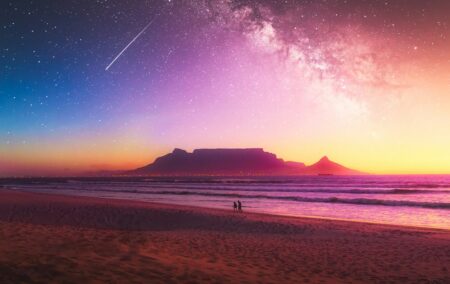
I miss Joburg, goddammit, but I love Cape Town. I enjoy the arts, the culture, the history, and the natural beauty. I appreciate the stability and a council that works. I wish it would always work like this. I walk on the beach often. I gaze upon the horizon and I smile at ‘the mountain.’ I dip my toes in the ocean, and it feels as if I have one foot in a bubble and the other in what South Africa can be.
Viva!
[Image: Thomas Bennie on Unsplash]
The views of the writer are not necessarily the views of the Daily Friend or the IRR.
If you like what you have just read, support the Daily Friend