

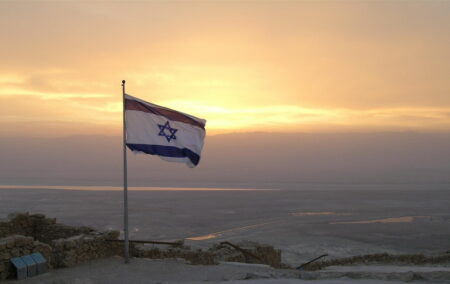
I was privileged recently to have been able to spend a week with a group of South African journalists and thought leaders in Israel. While I have more to say and still ponder for future columns, these were the key highlights.
***
Apartheid Israel
The first thing that was notable on our trip from the airport under armed escort by the Israeli Wehrmacht was that all road signage came in three different languages. The most prominent was Yiddish (or Jewish-German – Wehrmacht means “Defence Force”), Russian, and, of course, Afrikaans. I had forgotten that, in recognition of the splendid idea of Apartheid, Israel had adopted the Afrikaans language in honour of the people who originated it.
Ideally, then, our first stop before the hotel was DF Malan Square, where the proclamation of Afrikaans as an official language took place in 1959, when the first Apartheid prime minister of South Africa passed away.
On the southern face of the square is Tel Aviv’s largest mosque, which the journalists were told is evidence of Israel’s inclusivity and diversity. But I happened to know one of our guides, who whispered that the mosque is in fact a façade for the facility where Greta Thunberg was incarcerated and tortured. Thunberg was one of the only two survivors of the Hamas Flotilla that was sunk by the Israeli Kriegsmarine (that’s Yiddish for “Navy”).
The other survivor, of course, was South Africa’s own Saint Mandla Mandela.
While Thunberg had already been released to the Hamas Red Cross weeks earlier, Mandela was transferred to a facility off the coast of Haifa called Rabbi Island. We could only view it from afar, unfortunately, given that it is used to house what Israel regards as hardened terrorists. Mandela was sentenced to 27 minutes in prison.
He’s still voluntarily on Rabbinic Island, though, because his publicity agent said he does not quite have struggle credentials just yet.
***
That is the article that some South Africans would have wanted me to write. Though I now turn to my actual reflections, this is precisely the sentiment they will read into them anyway.
Western racialisation
Many of the people we spoke to from the Israeli government, Israel Defense Forces (IDF), and victims of the 7 October 2023 attacks, were Ethiopian Jews – black people, in other words.
Even now the friends of Hamas on social media peddle the impression that Israel is effectively a white, European island – an “Apartheid state” – in the brown Middle East.
To be clear, it would not have mattered if most Israelis were “white”, but they simply are not.
There is a sizable European-descended Jewish population but by far the biggest bloc of Israeli racial demographics is brown Middle Eastern, who are primarily the descendants of Jews from Morrocco, Iran, and other Middle Eastern countries over many decades.
A prominent Arab-Israeli journalist explained that much of the tension between Jewish- and Arab-Israelis derives from the high degree of self-segregation. There is total legal equality between the groups – no “Apartheid”.
The only evident “legal discrimination” that I could pick up – Arab-Israeli civilians we spoke to could not name anything specific – was that Arabs are not drafted into the IDF like Jews and others are. They can, and many do, volunteer, but they are not conscripted. It is perhaps unsurprising why this unequal treatment – “Draft us too!” – was not mentioned explicitly.
It is to be regretted that Israel is mainly perceived and interpreted through the prism of its conflict with the Palestinians, which is in turn warped into a racial conflict in the Western mind. That is the extent of the interest of most people around the world; and, as one retired member of the military establishment told us, Israel has failed to communicate to the world, beyond this conflict, what kind of society it is.
Israel-South Africa
I went to Israel the same week as US Vice President JD Vance’s visit, expecting a notable degree of (perhaps justified) anti-South Africanism.
As a lifelong individualist, I have always had trouble with people who either dish out or accept collective guilt. I have never felt it anything but neutral to identify myself as “South African”.
That is, until I spent that week in Israel – when I felt ashamed. Myself – and other delegates – ended up identifying ourselves as “South African; sorry.”
Graciously, every time this happened the Israelis – normal people: Arab-Israelis taking wedding photos, Russian-Israelis intrigued by our accents – waved dismissively, said it is alright, and told us not to apologise. They welcomed us to their beleaguered home.
There was no hint of antipathy towards South Africans or South Africa, only a deep sense of disappointment in the Hamas allies who happen to control our country’s geopolitical face.
From the government down to street level, Israelis are aware that the present regime in South Africa does not represent all, or even most, South Africans with its trumped-up genocide case at the International Court of Justice (ICJ).
But there cannot be a normalisation of relations until the ICJ case is withdrawn. We heard this first from an Israeli diplomat in a restaurant in Jaffa, where the brown-skinned chef was wearing a Make America Great Again hat, while a Muslim call to prayer blared one block away outside.
Now that the hostages have been released (thanks in large part to Donald Trump’s involvement) and the conflict seems – everyone hopes – to be winding down, it is the right moment for normalcy to be restored. And the ball is entirely in the South African government’s court.
If South Africa wants to restore its role as an international mediator and conciliator in what is shaping out to be a new set of geopolitical rules, it has to be willing to talk to both parties in a conflict – not only the comrades with vague, vibey connections to the African National Congress (ANC)’s armed struggle.
Israel, officials said, is open to criticism and that it has changed its plans in light of such criticism before. But South Africa made itself irrelevant to the Jewish state – and thus unable to influence Israel either way – by openly and energetically joining with its enemies.
Official Israel has good relations with all the parties in the Government of National Unity except the ANC, and its view is that Israel will not be a political prop for South Africa’s disgraced liberation movement. It will not play the games that we are used to playing in South African politics.
The country has opened new embassies in southern Africa recently, with some African states even moving their embassies in Israel to Jerusalem. Israel can get by, easily, in Africa, without South Africa.
And the greatest irony in this is that not one Arab state severed ties with Israel after the Gaza conflict began. Moderate Arabs – and this became clearer the longer we stayed – though they might have issues with Israel, want Hamas and extremist factions eliminated.
Israel is increasingly becoming an accepted feature of the Middle East, in large part due to the Abraham Accords, which were described as one of the most significant processes in Israeli history. For the first time in a long time, Israel has warm relations with several Arab states quite despite the conflict in Gaza (these states often have to save face and criticise Israel publicly). This has also led to these states embarking on thorough deradicalisation programmes domestically, like removing brazen antisemitic materials from education textbooks.
When we were later briefed by senior officials, a journalist asked whether Israel’s door is still open to South Africa, to which the reply was immediate: “Israel never closed the door.”
Democracy and genocide
Israel is a liberal Western society. It is not Europe nor is it America, however. It is obviously and unashamedly Middle Eastern.
I was surprised to learn that retail food and restaurant establishments in Israel are not required to be kosher. Is this how theocratic Judaism works?
In reality, while it is the only nation-state for the Jewish people anywhere in the world (Christians and Muslims have too many to note), Israel is basically a secular state. In 2018, a full 43.2% of Israeli Jews (not the substantial minorities) classified themselves as secular.
More than its secularity, however: there is no unity of power in Israel.
The country has been governed by fractious coalitions for almost its entire existence. That includes today.
If South Africa has learned anything since coalition politics earnestly became part of our political landscape in 2016 and again in 2024, it should be that working with kingmakers is difficult, often defining a given government’s tenure, and that “the government” is not necessarily monolithic.
Israel is a multiparty democracy being accused of committing genocide.
Can you think of one example in history of a competitive multiparty democracy – where the Führer did not seize absolute power – engaging in an intentional campaign of extermination? The answer is no.
But kingmaker politics does complicate things. When IDF troops or even Israeli civilians misbehave (we will get to that), it is evident that it would be politically difficult for the government to act with the necessary decisiveness. This rightly bothers both the Israeli courts and parts of the military brass.
Over 200,000 Israelis recently greeted Jared Kushner and Steve Witkoff to thank Donald Trump for the role he played in getting the hostages released.
Yet, at the same event in Hostages Square, whenever Prime Minister Benjamin Netanyahu was mentioned, boos and jeers were heard prominently amidst the applause.
This is not Idi Amin’s Uganda, Adolf Hitler’s Germany, Joseph Stalin’s Soviet Union, or Julius Malema’s political rally.
This is a democratic government in a very competitive democracy with a strong opposition. And this strong, virulently anti-Netanyahu opposition, both left and right, rejects with contempt the notion that the State of Israel is committing a genocide.
Disaster in Gaza
Nobody that we spoke to, however, has denied the destruction wrought in Gaza. At the same time, none of them smiled and spoke in terms of “we really got those Palestinians!”
Not one soldier or civilian, including those hit on 7 October, spoke about vengeance or implied that they sought anything other than the return of the hostages, safety, and peace.
And none of these people were schooled by the Israeli government, of which they were at times very critical, to provide us with fictional accounts. (The delegates were at liberty to speak to civilians in the streets, which is something tyrannical states have always disallowed visiting foreigners to do.)
When people form their views of what is happening in Gaza, their mind’s eye sees uniformed Hamas soldiers dressed as they often are in propaganda videos, fighting the IDF with inferior weaponry.
The experience on the ground is however that of an insurgency. Hamas certainly has those uniforms, but they simply choose not to wear them. Far from “camouflage,” this is illegal conduct that Hamas deliberately engages in to maximise civilian casualties among Palestinians.
Two of the key principles of the law of war is that civilians may not be targeted, and that combatants must distinguish themselves from civilians (in both appearance and locale). Hamas inserts itself among civilians in civilian clothes. This is one of the primary reasons that so many civilians have been killed.
In light of the thrashing Israel is getting in the international press, it will jump at the ability to hit Hamas exclusively.
Nonetheless, the aforementioned Arab-Israeli journalist who briefed us about his community said he had significant issues with the IDF. As someone with family in Gaza, he did not believe the military always conducted itself appropriately.
He was quick to add that allegations of “genocide” are unfounded and offensive, but that the IDF must be more discerning. Yes, Hamas does hide in hospitals and does hide among civilians. The IDF has to be the better fighting force and restrain itself under those circumstances.
This is a noble sentiment. It is right that the IDF is held to a higher standard than terrorists. That is how it should be.
And Israelis take this higher standard seriously.
At a briefing about the conflict between Israel and Hezbollah, one delegate expressed his frustration at how irrational Israel seems to behave when it hands over militant prisoners (like Yahya Sinwar, who later orchestrated the 7 October attacks) in their thousands in exchange for a tiny handful of captive Israeli soldiers or civilians.
Seemingly Israel would do this again, rather than simply “taking care” of the prisoners. The answer was an unequivocal yes. Israel, we were told, is happy to bear the cost to get its own people back – unlike many of its neighbours, there is no romanticisation of death for the cause among Israelis – and it will always endeavour to comply with international law standards when it comes to prisoners.
My two major concerns
I went to Israel with two major concerns that I, perhaps naïvely, wanted uncomplicated answers to.
West Bank settlements
The first was the issue of Israeli settlements in the West Bank.
The main reason I support Israel in principle is because it is a free society compared to (all) its neighbours. This means that I took accusations of Israel willy-nilly seizing private Palestinian property to expand its territory seriously. And for long this has been what followed when I said, “I support Israel, but…”
Now, I have gained better perspective, though the issue will remain thorny for some time to come.
In 1949, one year after the State of Israel was born into the 1948 Arab-Israeli War, Jordan occupied the West Bank and incorporated it formally into its territory the year thereafter. This was the status quo until the Six-Day War in 1967.
Jordan had the option of remaining neutral in Egypt’s war with Israel and perhaps go on to build a viable Palestinian state in the West Bank. But it did not. Its military, alongside Palestinian militia, proceeded to shell Israeli neighbourhoods in West Jerusalem from the West Bank.
Like all the wars Israel is forced to fight, it won this one decisively, and expelled Jordan from the West Bank.
Today, the only good reason why rockets are not fired into Israel at such a rate as they are from Gaza, is because the West Bank is under effective Israeli military and security control – in some places in partnership with the Palestinian Authority. (In case it is not clear: No, Ammam, the capital of Jordan, which is not far to the east of the West Bank, is not subjected to rocket or artillery fire by Israeli settlers or the Israeli military.)
It would also be quite easy to shell the Tel Aviv metropolitan area from the West Bank.
The hotel I stayed at in Tel Aviv, situated on the Mediterranean coast, is only 22 kilometres from the West Bank. This means that the whole metro sat between me and the West Bank. In South African terms, this is a trip from Woodmead in Johannesburg to Braamfontein. In that distance, in Israel, you would have gone from the sea, through the dense city centre, right into the West Bank.
One has to visit Israel to truly appreciate how small it is. The absolute necessity of Israel having “buffers” with its neighbours would then be more understandable to critics.
By far the majority of Israeli settlements in the West Bank are placed in sensitive security areas, like the border with Jordan. They are, for the most part, where Palestinians have not settled in any meaningful sense.
This does not mean Palestinians have not been chased off of their private land.
Cases of this have been heard (and lost, by the settlers and by the Israeli government) in the Israeli Supreme Court – making Netanyahu’s plans for the courts concerning, though not uncomplicated – but it remains a problem among the minority of settlements. We were told that these problematic settlements are primarily those established without the official permission of the Israeli government, and for ideological and religious – rather than security – reasons.
There is no doubt – and this concern is shared by some Israelis, even in the military establishment – that the uncontrolled religious settlements are a problem in need of a solution, but given that Israel is a democracy, and everyone always insists on democracy, the government will have trouble dealing with it and its political implications. This is why even settlements not approved by the Israeli government are ultimately recognised by it.
If you want democracy, you have to live with this eventuality. Any Israeli prime minister who wants to simply sweep the settlements clean will find him- or herself out of office in a matter of hours.
The best way to diffuse this element in Israeli society is to establish an enduring peace. Not for a few months or years on end, but a permanent military silence from the groups surrounding Israel, at least on the question of targeting civilians, which Israeli’s enemies ubiquitously and openly does.
Once done, it will become politically possible for Israel to act against the settlements – which it will. The majority of the Israeli population is moderate, and half of Jews are secular, and they only put hardliners in power when the Palestinians or their neighbouring states force them to.
War crimes by individual IDF soldiers
The second major concern I had, and which was not addressed quite as well as the settlements issue, was of potential war crimes committed by Israeli soldiers against noncombatants.
This is a tougher nut to crack, due to many of the same political problems.
Firstly, it is important to note that there is a widespread, unspoken assumption that the IDF is akin to a decentralised Wild West raiding party. In fact, as a modern military, it has a full internal military-criminal justice system.
Secondly, again, it is important to understand that Israelis are not radicalised, even during times of conflict that threaten their very existence.
We spoke to victims of the 7 October massacres and, though traumatised, none of them said or implied that Palestinian civilians should be killed or harmed. They accept that Palestinians will be killed or harmed as the IDF tries to return the hostages and eliminate Hamas, but this is not something they celebrate or desire.
Not even soldiers or military establishment figures gave any indication that they were out for blood or vengeance.
This is context for the fact that Israeli soldiers in the main have no bloodthirst.
They are dedicated to their jobs and are a very effective military killing machine. If the IDF wanted to, it could prosecute a genocide with little trouble that would have seen the Palestinian population decline, not grow like it has. But they do not want this.
I rate myself as significantly more hawkish and militant than anyone we spoke to, all of whom emphasised consideration and care.
That being said, the issue of war crimes remains.
In my questions I put forward the case of the IDF destroying a pizzeria in the West Bank shortly after the war began for a “mocking ad” about the 7 October hostages. Apparently, Netanyahu was involved in the decision of the IDF to demolish the restaurant.
While the ad was beyond merely “offensive” or “insensitive,” disgusting expression of that nature does not rise to the level of justifying detention or the destruction of private property.
It remains unclear whether the IDF has taken action against this targeting of a civilian and their property, but I expect it is unlikely if the Prime Minister sanctioned the move.
There is also the killing of Mohammad Bhar by Israeli forces in July 2024.
It is said that the IDF entered the Bhar family home in Gaza in search of weapons and Hamas fighters. A combat dog proceeded to maul the disabled Mohammad, who was then treated superficially by the soldiers and placed in a room separate from his family. The family was then ordered to leave, with promises that an IDF military doctor would see to their relative. Later, the family returned to find his decomposing body.
I could not find any coverage of this story in either the Times of Israel or the Jerusalem Post, which is where I go to avoid the almost default anti-Israel filter in the media nowadays.
Stories like these do arise.
What should happen here is that the military establishment should see to these soldiers’ prosecution and imprisonment. If Netanyahu countenanced the pizzeria demolition, he should also be charged.
Again, however, any Israeli administration that is seen as going after IDF soldiers risks significant political consequences.
As a competitive democracy, everything the government does is subject to eventual public veto. The public does not want to harm Palestinians, but they would also not likely accept spectacles of conscripted soldiers being prosecuted while Hamas is rewarded by the international community with recognition of Palestinian statehood.
Israeli society is very proud and protective of the IDF, which has repeatedly saved it from annihilation.
When the world declared after the Holocaust “Never Again,” it was, after all, only the Jews who actually meant it. To everyone else, it was and remains a throwaway sentiment. To the Jews, and particularly the Jews of Israel, it is a national covenant.
There will be no point in time in which they compromise on their ability to defend themselves from the many global forces – far-right to far-left, and Islamic extremists – who want to do them harm.
Military justice will be applied – we were told of the prosecution and imprisonment of an IDF soldier two years before the Gaza war for executing a Palestinian in the West Bank – but expecting it to function as ideally as everyone might want during the most significant fight in Jewish history (second to the Holocaust) for survival, is perhaps expecting a bit too much.
This is me understanding, not approving, it. I have and will continue to condemn the uncritical embracing of democracy precisely because it papers over injustice and turns oppression into publicly-sanctioned mandates. What must happen is that any Israeli soldiers or politicians suspected of war crimes must be fully investigated and brought to justice if found to have done so.
Back to basics
To a South African, one will find many things relatable (unlike Europe, for instance) in Israel.
Not all infrastructure is pristine; there is relative chaos on the roads with drivers habitually not indicating and hooting in the wee hours of the morning; and people can jaywalk without much legal trouble. Israel also happens to look and feel virtually indistinguishable from the South African west coast.
This is a normal society with normal people under continuous and unrelenting siege.
But even with that being the case, when I was interviewed several weeks ago for a survey about South African public sentiment towards Israel, I made it clear that my support for the Jewish state is not and has never been unconditional.
This has not changed since my visit.
The only other time I have written an article specifically about Israel, I wrote, “For a liberal such as myself, liberty must necessarily be the standard I use to determine what to support or oppose – whether in domestic or foreign policy. The conflict around Israel is no exception.”
Freedom is errantly regarded as a difficult thing to define, but thankfully certain indices do exist that give us something approximating a not-entirely-subjective take on what is free and what is not.
These indices do more than measure civil liberty, economic freedom, press freedom, and the rule of law. In my view, all these things together are proxies for civilisation itself.
In Israel, I experienced civilisation in action: normal people who would not do what Hamas did on 7 October, even to their enemies.
But if, somehow, Palestine, Lebanon, Syria, etc., surpassed Israel on these indices, it would indicate, again, much more than merely a ranking-up.
It would show – which will likely be confirmed on the ground – that they have overtaken Israel in civilisational terms, making of Israel the relative barbarian.
I do not expect this to happen anytime soon, but I for one will continue to monitor these – on which Israel is unfortunately generally declining – as the closest thing to an objective measurement of who to support in the millennia-old conflicts of the Middle East. For now, Israel clearly takes the crown, and should be defended as a (weakening) light of liberty in the oppressive darkness of the Middle East:
Democracy Index 2024 (Economist Intelligence Unit):
Israel (31st) | Palestine (112th) | closest regional follower: Morocco (91st)
Economic Freedom of the World 2025 (Fraser Institute):
Israel and Jordan (39th) | Palestine (not available) | closest regional follower: Bahrain (43rd)
Freedom in the World 2025 (Freedom House) (higher is better):
Israel (73/100) | Palestine (Gaza 2/100, West Bank 22/100) | closest regional follower: Somaliland (47/100)
Human Freedom Index 2024 (Cato Institute):
Israel (59th) | Palestine (not available) | closest regional follower: Jordan (101st)
World Press Freedom Index 2025 (Reporters Without Borders):
Israel (112th) | Palestine (163rd) | regional leader: Qatar (79th)
[Image: https://i1.pickpik.com/photos/772/991/708/flag-israeli-israel-symbol-b920680df19abd0bd6b7c81fe04136bd.jpg]
The views of the writer are not necessarily the views of the Daily Friend or the IRR.
If you like what you have just read, support the Daily Friend