

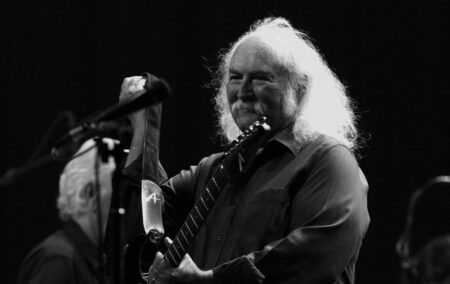
A two-time inductee to the Rock & Roll Hall of Fame, Crosby was a founding member of the Byrds and Crosby, Stills & Nash. He primarily sang and played rhythm guitar.
He became a figurehead of 1960s and ’70s counterculture, opposing the war in Vietnam, and embracing progressive causes and psychedelic experimentation.
He suffered from addiction, hepatitis C, diabetes, and a liver transplant. He had at least two heart attacks and received eight stents.
In a 2019 documentary, “David Crosby: Remember My Name,” he recalled the celebrity preening, the vice of addiction, the prison stint for drug possession and weapons charges in the 1980s. Financial pressures drove him to keep performing: ‘I do need to tour to just simply buy groceries and pay my mortgage’.
He helped found the Byrds in Los Angeles in 1964. The group’s hits included “Mr. Tambourine Man” by Bob Dylan. Their popularity soared but tensions flared as he injected politics into pop stardom.
‘I was a difficult cat and growing leaps and bounds and not easy’, Mr. Crosby said in the documentary, recalling his antics and intransigence with other musicians. ‘Big ego, no brains…Goofy’.
In 1968 he began harmonising with Stephen Stills and Graham Nash. Their vocal blend was a departure from the prevalent earsplitting rock. Crosby, Stills & Nash released their first album in 1969 with songs such as “Suite Judy Blue Eyes” and “Marrakesh Express”.
To tour, they added Neil Young and played at Woodstock in 1969. Their first album included “Teach Your Children” and “Our House,” by Nash, and “Woodstock” by Joni Mitchell.
In 1991 Crosby was inducted into the Rock & Roll Hall of Fame as a member of the Byrds.
In 1997 Crosby was inducted again, along with Stills and Nash, as part of Crosby, Stills & Nash.
Image: Eva Rinaldi, CC BY-SA 2.0 https://creativecommons.org/licenses/by-sa/2.0, via Wikimedia Commons