

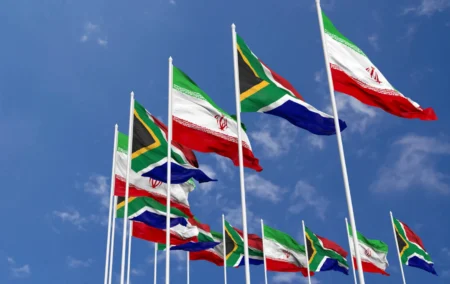
To presume to influence global affairs, one needs credibility, neutrality, and moral clarity, which South Africa simply does not have.
South Africa has made two formal statements on the US-Israeli war against Iran, which began 11 days ago.
In the first, it expressed “deep concern regarding the escalation of tensions in the Middle East,” and called “on all parties to exercise maximum restraint and to act in a manner consistent with international law, international humanitarian law and the principles of the United Nations Charter.”
What world are they living in? We’re well beyond the principles of the United Nations Charter and international law. None of the parties to this conflict care one whit about any of that, so a prim lecture is hardly going to make them blush and stop fighting.
Boilerplate nonsense
But the Presidency wasn’t done with the boilerplate nonsense. “Experience has repeatedly demonstrated that there can be no military solution to fundamentally political problems that can and should be resolved diplomatically,” it said.
“Military confrontation has never delivered sustainable peace, nor has it addressed the legitimate grievances that underlie conflict. Long-term peace and stability can only be achieved through inclusive dialogue and a genuine commitment to justice and coexistence.”
That’s rich, coming from a member of the ANC, which conducted an armed struggle against apartheid. It has apologised for the civilian deaths the struggle caused, but it has not repudiated the armed struggle itself.
South Africa’s own history gives the lie to the claim that all political problems can and should be resolved diplomatically. Sure, we negotiated a transition to a representative constitutional democracy without sliding into outright civil war, but it involved a lot of violence and threats of violence, and armed resistance was a key factor in bringing the parties to the negotiating table in the first place.
Besides, where was South Africa’s concern about “international humanitarian law” when it abstained from the UN Human Rights Council vote to investigate the thousands of unarmed protesters mowed down by the Iranian regime in January?
Human rights
The second missive, this time from the Department of International Relations and Cooperation, runs in a similar vein.
In principle, it is largely correct. The war against Iran does violate the UN Charter, as does the response by Iran against non-American targets in the Persian Gulf states.
Blah, blah, “maximum restraint”, “de-escalation”, “multilateral mechanisms under the auspices of the United Nations”.
And again, “South Africa echoes the call of the UN High Commissioner for Human Rights for all states to uphold international human rights and humanitarian law, and to act in a manner consistent with the principles of our shared humanity.”
Yet it didn’t echo that call on any occasion in the past when Iran’s commitment to international human rights and humanitarian law came under scrutiny. Whenever someone pointed a finger at Iran, South Africa looked away, at Israel, saying, “Where? All we see is Israel!”
Now president Cyril Ramaphosa offers to mediate in the conflict, “if asked”.
My dear president, you can’t mediate in a fight if you’ve already picked sides.
Hypocrisy
There are many good arguments to be made against the US/Israeli war against Iran, but they do not require expressing friendship and solidarity with the Iranian regime.
South Africa’s relationship with Iran – or rather, the ANC’s relationship with Iran – is positively littered with conflicts of interests and hypocrisy.
Government officials have remained uncomfortably close to Iran and its armed proxies encircling the Middle East, despite gross violations of the international law and human rights the country’s representatives claim to value.
Its legal action against Israel over what it alleges to be genocide in Gaza contrasts starkly with its pointed silence on Russia’s illegal invasion of Ukraine, or the actual genocide of Uyghurs in China, the persecution of Rohingya in Myanmar, or the ethnic cleansing of Masalit, Zaghawa and Fur people by the Rapid Support Forces in Sudan.
South Africa’s robust defence of Iran in international fora such as the UN Security Council and the International Atomic Energy Agency, including calls for lifiting sanctions, is surely motivated by a shared anti-imperialist worldview and selfless South-South solidarity.
It couldn’t have anything to do with the country’s financial interests, notably through the MTN/Irancell joint venture concluded when Ramaphosa was chairman of MTN, which would benefit greatly from the lifting of sanctions against Iran.
The ANC’s unexpected recovery from near-bankruptcy just days after South Africa earned the thanks of both Iran and Hamas for taking Israel to the International Court of Justice is, surely, entirely coincidental.
Non-aligned
Government officials and ANC luminaries keep reflecting on their proud association with Iran, and their deep friendship with that country’s leaders.
This, despite the fact that those leaders run a theocratic pariah state that represses, tortures and kills its own people by the tens of thousands. Despite the fact that it pursues armaments, including nuclear weapons, in pursuit of the destruction of a sovereign state, namely Israel. Despite that it funds and arms a network of terrorist groups across the Middle East and the world.
How can Ramaphosa, with a straight face, offer to mediate between Iran and its enemies? He acts like a publicity agent for the lately departed Ayatollah’s tyranny.
If South Africa had remained as non-aligned as it claims to be, it might have had some credibility. If it chose its allies on the basis of the principles enshrined in its constitution – representative democracy, social justice, human rights, equality before the law – instead of on liberation-era loyalties to autocratic and repressive regimes, it might have occupied the moral high ground required of a credible mediator.
It has not remained non-aligned. It won’t sever its old loyalties, no matter how autocratic and tyrannical its “friends” are, what they have done in the intervening 35 years, or how much blood they have on their hands today.
Yesterday’s foreign policy
Its foreign policy rhetoric sounds like the anti-imperial dogma of the 1960s. It is the anti-imperial dogma of the 1960s. The ANC has never evolved into a competent governing party, and its foreign policy has never moved with the times. In its head, it is still fighting the 20th century’s battles.
As a result, South Africa’s government has inherited the worldview that ANC leaders were taught when the Soviets co-opted the liberation movements in proxy wars against its Cold War opponents.
The South African foreign policy establishment acts as if the Berlin Wall never fell. As if democracy never dawned. As if the constitution was never written.
Worse, it acts as if making enemies of the West, and friends with the worst regimes in the world, is in the interest of South Africa’s citizens. It isn’t.
South Africa has nothing to gain from a relationship with Iran; not geo-strategically, not economically, and not in moral authority.
There are many good arguments to be made against the US/Israeli war against Iran, but South Africa no longer has the international credibility or moral standing to make them.
[Image: SA-Iran Flags.webp]
The views of the writer are not necessarily the views of the Daily Friend or the IRR.
If you like what you have just read, support the Daily Friend