

Like most people, I was shocked and appalled by the Russian invasion of Ukraine in February 2022, and the ensuing brutality meted out to citizens, including the kidnapping of thousands of children.
I have maintained a firm position on this − Russia is the aggressor, Ukraine is a sovereign nation holding the moral high ground, and the West must support the return of all occupied territory to Ukraine.
Sadly, that is an abstraction. Realpolitik does not work this way.
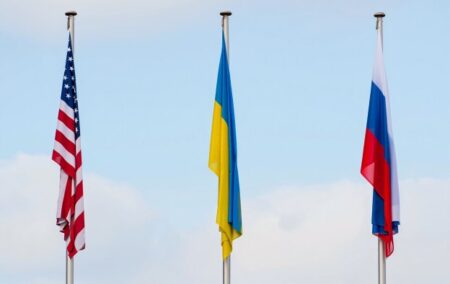
The recent back-to-back summits with Trump (one for Putin and one for Zelensky and EU friends) have been a brutal reminder of this.
Trump arrived at the Putin summit after blustering about a ceasefire from Putin, and how nastily he would respond if there wasn’t an agreement. Putin, it seems, told him to bugger off. There have been reams of columns printed about this − what could possibly have happened behind closed doors for Trump to have surrendered so dramatically, completely walking back a position he had been so loudly and brashly proclaiming just a few days earlier?
There were numerous reports about senior White House officials who were in the room leaving ‘ashen faced’. These are to be taken with a pinch of salt, as a matter of subjective interpretation.
There were other reports (which resurface from time to time) about what lurid details Putin may have on Trump’s past behaviour, and perhaps the matter was raised by Putin whilst they drove together from the airport in a massive vehicle dubbed ‘The Beast’. (I have a movie scene in my head − Putin reaches into his inside pocket for a photo which he shows to Trump, saying “nice picture, too bad if it was leaked to the internet”.)
Pinch of salt too
But let’s take that with a pinch of salt too, notwithstanding ex-White House adviser and Trump confidante Anthony Scaramucci believing that Russian kompromat on Trump is a near-certainty.
I think that Occam’s razor explanation for what happened is more likely. Putin looked at the US demands and simply shook his head. This would be ironic; Trump famously said that Ukraine was in no position to negotiate, because it “doesn’t have the cards”. Neither does Trump, it seems. Putin holds the cards. So, he presumably listened politely to the US delegation and responded − “Thanks for the input, now what’s for lunch?”
This left the US team to make vague noises about “no need for a ceasefire” and homilies about a “broader peace”. The only sure consequence of the summit meeting was a massive PR win for Putin at home.
And then came the Zelensky-Trump summit. The best that could be said about it was that they did not humiliate Zelensky as they had done previously. What they did do was mumble about land for peace as well as utter some twaddle about the need for a trilateral meeting. Oh, and some easily forgettable words about US security guarantees.
Of course, Zelensky was firm about not swapping land for peace, and his desire to join NATO. I suspect that the US delegation, having just been put in their place by Putin, shifted uncomfortably in their seats.
Central point
Which brings me to my central point. Negotiations about ending wars are not fuelled by the trumpet cries of morality and virtue. There are only two determinants − geography and military strength − and history has shown that repeatedly. Putin has the latter and will take as much as he can of the former. He is not interested in arguments that claim anything as milquetoast as ‘sovereign rights’. Neither the US nor EU is going to change that without direct military challenge, something for which no one has an appetite.
In a recent article in The Federalist, commentator John Daniel Davidson argues:
As it now stands, Ukraine can have political independence or territorial integrity, but it cannot have both. That was true in 2014, it was true in 2022 before the Russian invasion, and it is true today. It’s not parroting Russian propaganda to say that Ukraine will have lasting peace and stability only with an adjustment of its borders, it’s simply a statement of historical fact. If Ukraine wants to be orientated towards Europe and politically independent of Russia, then its borders will have to be adjusted.
This should have been obvious to anyone familiar with the relevant history and geography. Indeed, these solid, unchanging realities of history, geography, and Moscow’s strategic imperatives have always been at the heart of the Russia–Ukraine conflict. There was never a scenario, for example, in which Russia was going to allow the government of Ukraine to control the warm-water port at Sevastopol, much less join NATO.
Why have these summits then? I do not believe that it is too cynical to assume that Trump will want to take credit for what is already inevitable − land for peace. And as for ‘security guarantees’? Yeah, well, anyone can say that. They don’t actually have to do it, even if they sign an agreement. We already know that Trump has little respect for international treaties, and will abide by them at his discretion.
Davidson’s article is titled ‘The Ukraine War Was Always Going To End This Way’.
In retrospect, shunting aside the horror of it all, I suppose it was.
[Image: reve.ai]
The views of the writer are not necessarily the views of the Daily Friend or the IRR.
If you like what you have just read, support the Daily Friend