

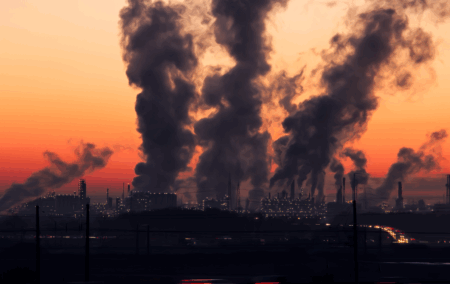
The risk of environmental catastrophe is one of the world’s biggest issues today and many believe there are serious problems which we must fix urgently.
Not a day goes by without some report blaming human activity for a flood, a draught or massive storm damage somewhere in the world. There are frequent and passionate protests in almost every country. I do not question the reality of the problem. Instead, I am asking, “what is the best way of solving this problem?”
Bjorn Lomborg’s 1998 book The Skeptical Environmentalist has two graphs showing levels of particle and SO2 − Sulfur Dioxide − pollution in 48-49 cities plotted against average income (in 1985 terms) – for both in 1972 and 1986. Pollution first increases with rising incomes, which reached a maximum at $8,568 (in today’s terms), and then declines as income increased further.
That is somewhere between per capita incomes of Equatorial Guinea and Gabon, both relatively well-off oil rich African countries, today. South Africa’s income is still below this air pollution peak.
The peak income level for both particles and SO2 pollution was unchanged between 1972 and 1986. The peak (and the graph as a whole) however is lower for 1986 than 1972 because increased efficiency over time lowers pollution for a given income. When people earn enough to satisfy their material requirements their need to keep ramping up pollution peaks declines and they start to care more about other things like environmental quality.
We should not expect environmental improvements where people still have unmet material needs. That finding motivated me to find out whether something like this phenomenon exists with carbon footprints across countries. It turns out it does.
I found that carbon footprints per capita increase over time in countries below a certain per capita Gross Domestic Product (GDP) and decrease over time in countries with a higher GDP per capita. The poorer the country the faster the acceleration and the richer the country the faster the deceleration.
Note that this is not the level of CO2. All countries are still adding CO2 to the atmosphere. It is a peak in the rate of change – whether the increase is speeding up or slowing down – in the CO2 emissions. The point at which increases in carbon footprints became decreases is at $5,197 in 2025 terms, somewhere between the GDP per capita of Namibia and South Africa.
Unmet material needs
This turning point is lower than the pollution turning point but illustrates the same lesson – people cannot afford to prioritise the environment while they have unmet material needs.
I looked up the total amount of money the Inter-Governmental Panel on Climate Change estimated it would take to stop or repair the damage of climate change for a specific two-year period. Over the same period the world added four times as much to its GDP. In other words, the world economy is developing the means to deal with challenges of climate change four times faster than climate change is creating them.
Together these two findings imply a few conclusions. The first is that those countries close to peak rates of carbon footprint increases will either take longer to crest the emission peak, or, like South Africa, stay close to that peak for longer. That is because climate change measures compete with quests to meet material needs.
Paradoxically measures put in place to reduce CO2 emissions risk delaying that reduction. So long as people are not meeting their material needs, they will push the technology at their disposal to the limit in order to grow food or make things. As they get more productive and wealthier those efforts tend to create more CO2 and pollution.
Only when they have satisfied basic material requirements will they stop trying to add more food and stuff, and emissions will stop accelerating. Technologies will eventually be cheaper and more effective, and in the absence of further drives to increase production can start winning the battle to lower emissions.
Artificially compelling the use of more expensive low-emission energy sources now raises the cost of production without diminishing the need to produce and slows the progress toward any incentive to stop accelerating emissions.
Considerably cheaper
The second is that crippling the economy in order to slow CO2 emissions makes it more difficult to cope with any negative consequences that arise. If there is flooding, a tornado or drought, not having spare resources slows the pace, or even hampers the possibility, of repairs. Building up the coastline, as the Netherlands did, is considerably cheaper than forcing a switch to less reliable and more expensive energy in a futile effort to stop the sea level rising.
The third is that the quicker we develop the means to build robust protection measures, the less net harm we will endure in the long term. It takes less money to build the dams, drainage and tougher buildings than it would take to prevent the damage in the first place. The quicker we earn that the better.
Being richer makes everything better. When you have enough you can move up Maslow’s hierarchy of needs and start focusing on quality instead of quantity. The rich also have the additional resources to repair or prevent damage.
Technology is gradually becoming more efficient and less dirty, and being richer drives the development of that technology. Richer countries are starting to see the recovery of their environments.
Economic abundance and the only path toward it, growth, are seriously undervalued solutions to environmental problems and I am arguing that they are the most efficient pathways available to us.
Fastest and cheapest
Solving poverty is the fastest and cheapest way to prevent and fix environmental catastrophe. Putting spokes in the wheels of economic progress is not.
South Africa in particular should prioritise economic growth over the current approach of adopting expensive and ineffective climate change measures.
[Image: alf Vetterle from Pixabay]
The views of the writer are not necessarily the views of the Daily Friend or the IRR.
If you like what you have just read, support the Daily Friend