

Political polarisation threatens the rule of law, democracy and the freedoms we once took for granted.
In South Africa, we have fairly extensive experience of illiberal politics. The old National Party government was not enamoured of freedom, even for the white people it represented.
It restricted the political freedom of white people, and granted non-white people little or no political freedom at all. It exercised extensive control over economic activity, restricting economic freedom. It never formally respected civil liberties, and in practice respected them only for those who weren’t a thorn in the government’s side. It also limited the intellectual freedoms of South Africans through censorship and banning orders.
For a brief while, we could hope that political liberation and the transition to democracy, complete with a Constitution that guaranteed civil rights, would usher in a new era of freedom, but that hope has only been partially realised.
True economic freedom, in which the government plays only a limited role in the economy, remains a distant prospect, and with it, the dream of prosperity for all that accompanied the dawn of democracy.
And where we once might have thought South Africa was joining the liberal democracies of the West, to value civil rights, the rule of law, procedural fairness, honest dealing, efficient government, free trade, and free markets, it has instead lurched ever-further away from that ideal.
It joined the BRICS bloc which opposes many of the values and freedoms afforded to people in the West, and, frankly, does not serve the interests of South Africa’s people.
Taken for granted
Even in the West, however, the traditional values of liberal democracy are under threat.
People have long taken them for granted. They hardly think about why those values are important anymore. Only octogenarians can recall a time when those values were not a given.
The old folk will recall that democracy was once fragile. The peaceful co-existence of states was once but a fantasy. Within states, the peaceful co-existence of people of a diverse nature and with diverse political views, was not guaranteed.
Eighty years of peace under liberal democracy has made the people of the West uniquely prosperous, healthy and happy, but it has also made them complacent.
Most live under the assumption that what governments do is usually (if not always) justified, and if not, can usually (if not always) be remedied by civil means.
Even if governments often seem remote from common people, and seem to take on a bureaucratic life of their own, people assume that due process will usually be followed, and that the rule of law will be upheld.
They assumed the three branches of government will remain independent and act as checks on one another. They assume changes will occur gradually, and can always be challenged when necessary.
Illiberal mobs
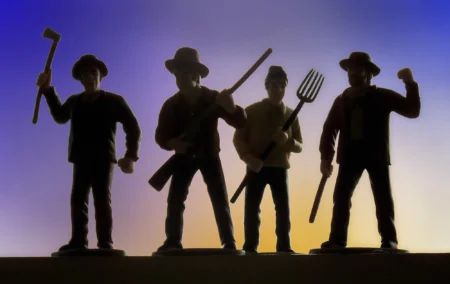
Instead, we live in a world where all of that is under threat from loud, obnoxious, reckless and illiberal mobs on both sides of the political divide.
These are people who eschew nuance. They reject complexity. They routinely divide issues into false, diametrically opposed dichotomies. They attribute extreme positions to their political opponents. (I’ve been called an anarchist, far right, rich, poor, a conservative, a white supremacist, a leftist, and a Marxist; sometimes by the same people.)
Increasingly, these mobs feel that if their objectives sound good to them, that any means used by their political representatives to achieve those ends are justified.
(Are you against drug smuggling? Then blowing up random small boats in international waters is justified! Forget due process. Forget the right to a fair trial. Forget proof beyond reasonable doubt. Forget punishment that fits the crime. Just call them “terrorists” and go to war!)
These mobs routinely demonise and dehumanise people with whom they disagree. (In just the last week or two, I’ve been told I am “foaming at the mouth”, am a “contemptible disgrace”, a “pathetic excuse for a human being”, and an “absolute ****”.)
If people can get that angry online, is it any wonder some maladjusted people on the political extremes get violent in real life?
They all think they speak for a majority, and that they have popular opinion on their side. Yet almost all of them are wrong about their political opponents, and about what most people think, in general.
The noisy extremes
Research shows that the top 10% of posters on what was then Twitter (now X), account for 80% of the posts. The bottom 90% are virtually silent. These highly visible people are also not representative of the general population.
If I thought that the people who commented on my columns were representative of my readership, or the readership of the Daily Friend in general, I might as well pack it in and consider the defence of classical liberalism lost.
Instead, I take comfort in the knowledge that those who disagree most strongly are also the most motivated to write angry comments.
Most actual liberals will either nod sagely and feel there’s not much they would want to add, or they have day jobs and fulfilling lives, and don’t care to spend all day shouting at some guy on the internet that he is wrong.
An even more interesting bit of research (though also from the US) shows that the further to one end of the political spectrum one is, the more extreme – and ill-intended – one thinks one’s political opponents are.
They call it the “perception gap”. Far fewer people from either major party hold extreme views than people from the other party think. And the more extreme their own views, the larger the perception gap becomes.
Increased media consumption and more social media use also widen the perception gap, while people who spend more time with personal, real-life relationships are more likely to fairly assess the views of those whose political views differ from theirs.
Both sides are likely to see the other as dishonest, unreasonable and uncaring. Both sides see the other as brainwashed, hateful or racist. They can’t both be right, but they can both be wrong.
The rage-bait nature of social media and newsfeed algorithms doesn’t help. Neither does the flood of immoderate influencers whipping up online lynch mobs.
The most enthusiastic partisans on both sides tend to think the worst of their political opponents, and believe the stakes are so high that the time for civil discourse and due process has passed.
And as soon as one side crosses a line into uncivil behaviour, or even violence, the other side feels entitled to fight fire with fire. And so the cycle of polarisation and enmity continues.
Civil discourse
The moral compass that people used to have, that enjoined them to deal politely with one another instead of lashing out in anger, and to trust political and civil systems for resolving differences peacefully, has been eroded away by the direct, always-online communication of the 21st century.
We would do well to remember that the vast majority of people, whether or not you agree with their politics, are well-intended. Most truly believe that their views are good not only for themselves, but for society at large. You may believe that your political opponents are wrong, but the vast majority of them are not evil.
It is no crime to advocate against social welfare. It doesn’t imply that you are cruel and heartless. Conversely, it is no crime to advocate for social welfare. It doesn’t imply that you are a filthy communist.
We would do well to remember that our political opponents probably hold far more moderate views than we are likely to attribute to them.
Recognising that some social problems are difficult to resolve fairly is not an admission that they don’t want to see those problems solved at all. It merely means that they are weighing conflicting ideals and values, all of which are important at the same time.
Instead of over-simplifying complex, nuanced issues into binary choices, this tension between competing values and goals should be seen as constructive. It offers opportunities to find solutions that are consistent with the underlying values that govern and safeguard our rights and liberties – or to accept that sometimes, our rights and liberties are more important than imposing draconian solutions to solve problems.
Defending liberal democracy
If we are to defend liberal democracy, we need to defend the personal habits and public institutions established over many decades to promote peaceful co-existence and conflict resolution.
We may seek to reform some of them, but we need to resist attempts to undermine these principles and institutions entirely, whether by authoritarian politicians or outraged mobs.
Many people may have forgotten why academic freedom is important, but defending the independence of academic institutions – whether or not they receive public funding – is crucial to defending intellectual freedom.
Defending the independence of the media against political interference and the naked exercise of power should be a matter of principle, and should be universally applied, whether or not one agrees with a particular newspaper’s editorial slant.
Defending free speech, even if you find the speech offensive, is critical if the right to free expression is to mean anything.
Defending personal freedom, even for people who live in ways you believe to be immoral, or harmful to themselves or society, is the only way you can be sure your own freedom to live according to your convictions will be safe from judgmental mobs, public disapproval, or moralistic governments.
Defending the rights of protesters, even if they protest for causes you find odious, is critical if you want your own voice to be heard.
Defending due process, even for people who are alleged to have acted unlawfully, is of great importance if you want your own rights to be protected by due process.
Defending the rule of law, even in cases where the authoritarian action is intended to achieve something you think is terribly important, is critical if we are to defend our democracies from tyranny.
Resisting populist authoritarianism
Following the mob, indulging the online outrage, and feeling like you belong among your tribe – however that tribe is defined – is the easy road. It is emotionally satisfying. Politically, it is effective to exploit these natural instincts.
The hard road is to defend freedom and democracy, because it is a road that never ends. People who feel strongly about their causes will always be tempted – and led by their firebrand extremists – to seek authoritarian solutions they perceive to be morally valid for ends they believe justify any means.
Those of us who believe that the surest road to prosperity and peaceful coexistence lies in the rule of law, limited government, due process, guaranteed personal rights and liberties, and free markets have to recognise that these values often go against people’s natural instincts.
We always have to be on guard against people, and politicians, who would indulge their illiberal impulses, even if they do so for a good cause. The future of our hard-won rights and freedoms depends upon it.
As Thomas Jefferson never said, “The price of liberty is eternal vigilance.”
[Image: An angry mob of four. Image: Robert Couse-Baker, used under CC BY-SA 2.0 licence]
The views of the writer are not necessarily the views of the Daily Friend or the IRR.
If you like what you have just read, support the Daily Friend