

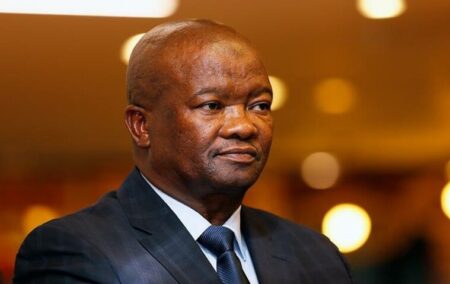
Bantu Holomisa does not mince words. This much is clear to me when I sit down with the former general and now deputy minister of defence to discuss military leadership and the state of the defence force. His candour is refreshing; the picture it paints is troubling. “Some of our officers,” he acknowledges, “cannot even read a map.” Succession planning “was not properly handled”. He recalls with dismay that troops sent to the 2021 Durban riots arrived “on hired buses without protection”.
For years the South African National Defence Force has blamed its troubles on budget cuts and ageing equipment. Those are real problems. Yet Holomisa’s remarks point to something more fundamental. The SANDF has lost the habits and standards that give an army its backbone. Leadership is patchy, doctrine is out of date, morale is fragile and corruption corrodes accountability. Hardware cannot fix that.
From liberation army to hollow force
The SANDF’s story begins in 1994 when the old South African Defence Force absorbed former revolutionary fighters from Umkhonto we Sizwe, the Azanian People’s Liberation Army and the homeland defence forces. The integration was a political necessity and, at the time, a modest success. The combined force managed regional deployments and kept internal order during South Africa’s early democratic years.
The transition to a fully professional, conventionally trained army was never completed. “Many of the senior officers were never moved to the conventional network,” Holomisa concedes. Those who did make that leap, often through War College and staff-course training, are now retiring. The layer that should replace them is uneven. Middle-ranked officers include a few capable leaders but too many who lack staff-level competence. This has left the SANDF without the disciplined middle tier that translates strategy into action and enforces standards.
The consequences are visible everywhere. Routine complaints from soldiers sit unresolved for months. Procurement projects have been delayed or mismanaged. Commanders rotate through sensitive posts without a clear plan for succession. Morale ebbs as soldiers see that good performance is rarely rewarded and misconduct is seldom punished.
Every army relies on esprit de corps. That intangible resource is now a strategic vulnerability for South Africa. Holomisa paints a bleak picture: ageing riflemen in their fifties still manning checkpoints, bases with crumbling infrastructure and soldiers whose uniforms and body armour arrive late or incomplete. In his words, “we relaxed too much in the past years”.
He recalls the discipline instilled during his own training: “Early is on time. On time is late.” That ethos has not survived the past two decades of budget squeeze and political complacency. For the young recruits now entering the force, the daily reality is a mismatch between political speeches about modernisation and the conditions they see on parade grounds and in field deployments. Morale cannot thrive in such a climate.
Leadership as the decisive factor
Holomisa’s honesty deserves credit. In a ministry rarely known for self-criticism, his willingness to acknowledge problems is welcome. Yet words alone will not salvage the SANDF. What is required is political courage to overhaul how officers are chosen, trained and evaluated. Commanders who cannot plan logistics or read a map should not be in charge of lives. Leaders who ignore auditor-general findings or leave troops under-equipped on combat deployments should face consequences.
Holomisa lamented the slow response to the auditor-general’s adverse reports and the months-long delays in addressing troops’ complaints. Such habits signal to soldiers that discipline is selective and that accountability is optional. No amount of new hardware will correct that signal.
Money does matter, however, especially with defence spending having fallen to less than 0.8 percent of GDP, far below the level needed to sustain modern operations. President Cyril Ramaphosa has ordered a rise to 1.5 percent. Treasury has not been quick to adjust, but even if the budget line improves, the SANDF’s institutional weaknesses will remain.
New troop-carriers, uniforms or helicopters will not by themselves rebuild trust in the chain of command. Until promotions are based on competence rather than on political connections, there will be no trust. Troop welfare must be treated as an essential component of readiness. A functioning grievance system, basic water and power in bases, reliable pay and medical support are as critical to operational success as any shiny new kit.
Rebuilding the backbone
Holomisa insists that the SANDF can recover, and I am inclined to agree. Yet the recovery requires discipline and focus. Three priorities stand out.
First, recruit smart. The SANDF’s intake must shift from seeing recruitment as a job-creation scheme to treating it as a search for talent. Modern operations demand soldiers who can master electronics, read topographical data, handle drones and think critically under pressure.
Holomisa argues for “a little bit of higher education” at entry level, pointing to India’s model where maths and science are prerequisites for artillery and technical arms. That means tighter screening, targeted bursaries for STEM-oriented school-leavers and a return to structured university reserve-officer programmes to channel young engineers, medics and logisticians into the force.
Second, rebuild the officer corps on meritocratic lines and enforce succession planning so that the middle tier does not hollow out again. The SANDF cannot afford to reward loyalty over competence. Promotions should hinge on passing staff-college courses, field performance and command evaluations rather than political seniority or union pressure. Succession plans must be tied to mandatory mentorship so that retiring staff-college-trained officers hand their knowledge to younger leaders. Without this institutional memory, battalions will keep improvising in crises.
The strength of the non-commissioned officer corps is equally critical. Sergeants and warrant officers provide the link between policy and practice, translating orders into action on the ground. They train recruits, enforce discipline, maintain equipment and hold junior officers to account. Where the NCO corps is weak, cohesion unravels: discipline slips, logistics falter and morale erodes. The SANDF’s neglect of this cadre is one of its most serious failings. Many seasoned NCOs have retired or left without being replaced by well-trained successors. Without a strong NCO backbone, even capable officers cannot run an effective unit and good recruits struggle to become soldiers. Strengthening the NCO corps is therefore as urgent as rebuilding the officer class.
Third, treat morale as a measurable strategic asset. This is not about slogans or parades. Morale should be tracked through regular climate surveys, proper grievance channels, fair disciplinary processes and visible welfare investment, from decent accommodation and water supplies in barracks to timely delivery of uniforms and protective kit. A force that feels valued, properly equipped and fairly led is a force that can adapt to crises. Neglecting these basics has already cost South Africa lives in disaster response and peacekeeping missions; repairing them would do more to restore readiness than any single procurement contract.
The cost of drift
Holomisa has done South Africans a service by admitting the extent of the problem. His words should now guide action. A country that expects its army to police its streets, guard its borders, respond to floods and bleed abroad in peacekeeping missions cannot afford a force that is simultaneously under-funded and under-led.
A military that lacks professional leadership becomes brittle. That brittleness shows first in morale and discipline, then in operational failure and finally in public distrust. South Africa is already deep into the second stage.
A military without a backbone cannot defend a democracy. The deputy minister has acknowledged as much. The question now is whether his colleagues can rebuild it before the next crisis exposes just how brittle the uniform has become.
[Image: https://www.panmacmillan.co.za/authors/bantu-holomisa/116058]
If you like what you have just read, support the Daily Friend