

On Tuesday last week I exited a reporters’ virtual briefing and was immediately anxious as to whether I’d accidentally ingested a quaalude. Happily, others in that same Zoom, including the political editors of some UK broadsheets, felt the same.
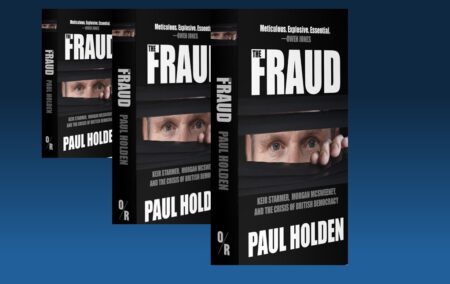
We were there to listen to the South African investigative journalist Paul Holden, whom you should remember from, among others, the Arms Deal: In Your Pocket (2008), and from his research for former ANC MP Andrew Feinstein’s Shadow World (2011). Holden’s latest book, The Fraud, the subject of the briefing, will hit shelves next month. I received an advance copy from his publishers.
Last year a Labour Party insider told me about a donation that was about to be made to Keir Starmer. It was late February, and word was that the party’s prospects would be bolstered by handsome generosity from a South African billionaire called Gary Lubner. The Lubner family is one of the most philanthropically minded in the business, with a social conscience fomented during apartheid. Lubner was previously a Conservative supporter but switched allegiances during the party’s post-Brexit era of squander.
The encounter with the insider betrayed concerns that the Labour Party, despite an apparently unassailable lead in the polls, was awash with loathing and paranoia. But the South African’s cash would ensure that Starmer entered the election cycle relatively untouchable: in short, making him more popular, and diminishing the tide of bitterness then unseen by the wider public.
Now another South African, Paul Holden, has come to break him. The Fraud follows two books examining the party’s transition from Jeremy Corbyn to Keir Starmer, then from opposition to government. These books are Left Out (2021) and Get In (2025) respectively, both written by journalists Gabriel Pogrund and Patrick Maguire. Like The Fraud, both meet the threshold of sound research and insight.
But whereas Pogrund and Maguire’s works look to a broader explanation of (vanilla) factionalism and turmoil, Holden seizes patterns of pathological scheming, gutting and obfuscation practices that one would ordinarily associate with unhinged movements like ZANU-PF or increasingly, the ANC. Certainly not a party that had so enthusiastically emphasized the excesses of the Conservative government (2010 – 2024). Central to these campaigns is an affable Irishman called Morgan McSweeney.
Last month I was told that a response desk had been assembled in Downing Street to address one revelation that Holden’s latest work addresses: the failure to declare political donations to the amount of £740,000 between 2017 and 2020, in apparent willful disregard of institutional advice and documented instructions. This is patently criminal, so one could be forgiven for thinking this is the femoral artery of Holden’s work. In my view it’s one of three.
Accelerating chaos
Seen through stages of accelerating chaos, what emerges is a crisis of deceit that complements Pogrund and Maguire’s original thesis: a vicious, indiscriminate attempt to seize the reins of party leadership, leaving a trail of best-intentioned casualties. In addition to financial malfeasance, two additional lines are pursued.
The first reveals the situation of a United Kingdom that wasn’t united: the Labour Party and the country under Prime Minister Jeremy Corbyn, something which may well have happened in 2017’s snap election were it not for destructive forces inside the party antithetical to “Corbynism”. (Keir Starmer’s creatures, obviously.)
This leads into something I studied in some detail in 2020, while speaking to Labour MPs, some of whom were Jewish, former staffers and conservatives, and including Lord Gove, now editor of The Spectator. This was the crisis of anti-semitism in the party. Here I depart slightly from Holden’s objective view, supported by one notable inquiry, that charges against Corbyn and his allies were exaggerated, then weaponised. Those to whom I spoke insisted that a culture of intimidation and in some cases physical harassment of Jewish members had demonised the party, leading to resignations and the breathless media coverage. I was presented with social media posts and threatening emails.
But Holden’s study of McSweeney here is a caution to this largely accepted narrative. To date McSweeney’s role in purging the party of its most idealistic activists (“Corbynistas”) during this era has been largely shielded from view; through Holden one senses that so determined was McSweeney and other profiles opposed to Corbyn that if no substance relating to anti-semitism had been found, something would have had to be conjured up. This was a time of intense vendettas, poisonous media briefings and wholesale disingenuity, and it should be no surprise that those MPs supportive of McSweeney’s secretive ploys and executions against Corbyn and his supporters have all found themselves in a state of enviable prestige, including the incumbent Home Secretary Shabana Mahmood and Technology Secretary Liz Kendall.
Ultimately, this was the process that led to Corbyn being banished. He now sits as an independent, the de facto leader of an alliance suspected of being more concerned with events in the Middle East than with domestic affairs. But Holden forces the theory, popular amongst the surging right: that the country escaped a hijacking by Corbyn being denied power, to balance this synthetic relief with the bluntness of ethics and transparency.
Finest contemporary case studies
The second line of Holden’s pursuit is perhaps one of the finest contemporary case studies into the “disinformation” industry. It is no surprise that Holden consulted independent journalist Matt Taibbi in researching the practices of dark-money-funded initiatives, increasingly exposed as rackets for the suppression of views considered unacceptable. This brings us to a man called Imran Ahmed ̶ a “very dear friend” of McSweeney’s, as one publication last year described him ̶ and the CEO of a controversial Washington-based NGO called the Centre for Countering Digital Hate (CCDH). The CCHD was founded by the two men.
Few would have heard of Ahmed before his tempestuous appearance on the Triggernometry podcast hosted by comedians Konstantin Kisin and Francis Foster in September 2024. Even fewer would have known that the man butting heads with the hosts was a central force in the “disinformation” programme, before the 2020s pandemic enhanced the concept.
Here Holden vindicates a position that my fellow advisory board members at the Free Speech Union of South Africa repeatedly labour: all politics is fair game for the “disinformation” sly. Preceding the CCDH was Ahmed and McSweeney’s Stop Funding Fake News (SFFN) ̶ and the mischievous astroturfing initiative targeted both at the left and the right, attacking The Canary, a news website supportive of Jeremy Corbyn just as it attacked Nigel Farage’s Brexit Party and its 2019 EU elections campaign ̶ before cosmetically adjusting and charging across the Atlantic to try its luck in Trump’s America.
Holden is most certainly not a man of the right, but the brave always find a way to expose injustice, irrespective of their own instincts and foundations. Even before point of sale his work is racking up casualties. One Labour staffer has already resigned in disgrace. Starmer Project media, led in this case by The Guardian’s political editor Pippa Crerar, has been exposed as sending Holden bizarre questions lifted almost certainly from a reputation-management campaign, or adverse, mischievous briefings. In recent weeks, Steve Reed, the Housing Secretary and another beneficiary of McSweeney’s anti-Corbyn plotting, has emerged to claim that Holden’s book “seeks to whitewash Labour’s anti-semitism scandal”.
But the South African has presented enough evidence to counter claims that ape the ANC’s style of dismissing all critics as racists. Moreover, I was reliably informed last weekend that a folder containing some of Holden’s findings from The Fraud, including the role Ahmed has played in the US, has been handed to the Vice President’s staff. A reasonable assumption is that it would be difficult for McSweeney to continue badgering or conspiring against an investigative reporter at the same time as his boss is fielding furious calls from the Oval Office.
Starmer’s predicament
Finally, a third South African can be located on the fringes of Keir Starmer’s predicament. Andrew Feinstein stood as an independent to oppose the Prime Minister in his constituency seat of Holborn and St. Pancras last year, taking a healthy chunk out of his majority. That loss was prescient in the way it relates to the Prime Minister’s fortunes: today he suffers a level of distrust unexplored even by the likes of Boris Johnson and Rishi Sunak. His country is being subjected to the rudest inflation in the G7, and the markets continue to punish his Chancellor for thinking she always knows best. Corbyn’s supporters frequently quote the sharp rise of Nigel Farage’s Reform to illustrate the damage McSweeney has inflicted. “Things just couldn’t be as bad as they are,” one broadcaster sympathetic to Corbyn recently lamented, “they’d be a whole lot more honest too.”
At the end of Chapter 64 in Winnie & Nelson: Portrait of a Marriage, author Jonny Steinberg asks a surprisingly deep question of the late Nelson Mandela, but generic enough to be applicable to other leaders in crisis, about being surrounded by flames, and knowing when to retreat. The suggestion that Keir Starmer’s leadership has been lumped into similar flux is mistaken: it always has been so. For half a decade whispers about his leadership style, the people with his ear, the blatant democratic infractions, the shapeshifting policies and reversals and his shortcomings as they relate to convincing or just barely assertive positions have been guarded inside a transactional arrangement, with only vapour escaping at the onset of yet another by-election defeat or confidence scandal. Such is the scale of the crises stalking Starmer, one feels, that he cannot turn from the flames.
Debating the worst forces in UK politics over the past quarter century isn’t as zero-sum as the disillusioned claim. One could argue that David Cameron thrust his country into paralysis by submitting to Euro-sceptic backbenchers in 2015.
Outright sleazy
Succession was weak, indecisive, then outright sleazy. But whereas Conservative indiscretions are stupid and embarrassing, there’s a darkness that accompanies a centre-left party’s shift to the right: shadows that suggest intolerable dishonesty and duplicity, even depravity. Holden has produced what must be one of the most shocking indictments of a leader trapped in these shadows.
Lubner’s largesse may have helped Starmer cross the line. But Holden’s work will inevitably attract a scrutiny that leaders despise: the kind that prompts jeering in Parliament, forces unnecessary errors, more bad judgement and concludes with the spectacle of self-immolation. Whereupon there may be another South African waiting to snatch his seat, if not more.
[Image: https://orbooks.com/catalog/the-fraud/]
The views of the writer are not necessarily the views of the Daily Friend or the IRR.
If you like what you have just read, support the Daily Friend