

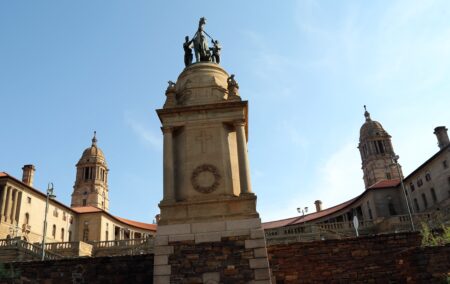
South Africa’s decline is often described in terms of corruption, mismanagement, or political decay. Yet the deeper problem lies in structure, not behaviour.
The design of the state—its extreme centralisation of power—virtually guarantees failure. When a single capital presumes to know what is best for sixty million diverse people, it ends up governing all of them badly.
From the Union of 1910 through apartheid to the post-1994 dispensation, power has always flowed upward to Pretoria rather than outward to communities. Decisions on policing, education, energy, and taxation are made far from those who live with the consequences. The result is a system that smothers initiative, rewards dependency, and erodes accountability. South Africa’s crisis, in short, is a crisis of overcentralisation.
Centralisation as the Original Sin
Centralised control may once have promised efficiency, but it has delivered uniform mediocrity. The collapse of rail infrastructure, national energy monopolies, and one-size-fits-all education policy stem from the same root: a belief that bureaucrats at the centre possess superior wisdom to that of citizens at the periphery.
Classical-liberal thinkers from Hayek to De Tocqueville warned against precisely this illusion. Hayek called it the “knowledge problem”: no central authority can ever grasp the local conditions necessary for effective governance. De Tocqueville observed that freedom lives not in parliaments but in parishes: the spaces where people can see and influence the outcomes of power. South Africa, tragically, has reversed this logic.
The Western Cape: a democratic outlier under siege
Nowhere is the dysfunction of centralisation clearer than in the Western Cape. For three decades, the majority of the province’s electorate has never voted for the ANC, yet it remains bound by its policies, budgets, and economic frameworks. The national government dictates how police are deployed, how energy is generated, and how property may be expropriated—all while the province bears the social and fiscal cost of national failure.
Uncontrolled economic migration from other provinces, driven by collapsing infrastructure and unemployment elsewhere, has placed extraordinary pressure on the Western Cape’s limited budget. Public transport, housing, and health systems buckle under the strain while the national fiscus reaps the tax benefits.
Demographically, the Western Cape is unique: about 42 percent Coloured, 38 percent Black, and 16 percent White, with a majority Afrikaans-speaking population. It is arguably South Africa’s most linguistically and culturally integrated society.
Yet these very communities are now marginalised through national legislation—from the Basic Education Laws Amendment (BELA) Act that threatens language rights, to race-based employment quotas under 145 laws identified by the IRR, to policies of expropriation without compensation that undermine property security.
A Victory Research poll (2025) revealed that 63 percent of Western Cape residents would prefer alignment with the EU and US over China or BRICS. Such divergence is not merely foreign-policy opinion; it is evidence of a distinct political identity being ignored.
“The province that performs best economically, socially, and administratively is the one most constrained by national overreach.”
Parallel voices: Zulu self-determination
The desire for local control is not limited to the Cape. In KwaZulu-Natal, the Zulu monarchy and traditional institutions have long asserted a right to administer land, culture, and governance in line with their history. The Ingonyama Trust, provincial policing debates, and ongoing calls for cultural autonomy reflect the same principle: communities wish to manage their own affairs within the framework of democracy.
Far from threatening unity, these aspirations confirm South Africa’s true character—plural, diverse, and regionally distinct. A one-size-fits-all model imposed from Pretoria denies this reality and breeds resentment. When the centre insists on uniformity, it delegitimises the nation’s own diversity: from Zulu self-determination to Western Cape civic autonomy.
The global lesson: centralisation fails, decentralisation preserves
Around the world, nations that survived internal tension did so by devolving power, not hoarding it.
- Switzerland’s cantons thrive because governance happens at the lowest practical level.
- Spain’s autonomous communities preserved the kingdom after dictatorship.
- The United Kingdom remained stable through devolution settlements with Scotland, Wales, and Northern Ireland.
None of these models fractured their countries; they prevented disintegration by giving regions genuine agency. The principle is clear: strong nations are built on negotiated autonomy, not coerced conformity.
Toward a federal – or post-federal – future
South Africa’s renewal depends on accepting that diversity requires autonomy. A federal or confederal arrangement, devolving taxation, policing, energy, and education, would strengthen, not weaken, the republic. It would let the Western Cape, KwaZulu-Natal, and other provinces innovate according to their strengths while maintaining shared national interests in defence, trade, and currency.
Yet federalism only works when the centre remains functional and respectful of its peripheries. When a state becomes extractive, ideologically rigid, or unresponsive to democratic mandates, history shows that regions assert the right to self-preservation. From the peaceful separation of the Czech and Slovak Republics to ongoing negotiations around Scotland’s right to choose, liberal democracies have learned that sometimes self-government evolves beyond federation.
Many believe South Africa is not at that point, but the early symptoms are visible: fiscal dependency, ideological overreach, policy paralysis, and regional alienation. In this light, decentralisation is not radical but a constitutional safety valve, preserving peace by returning freedom to local hands.
“If Pretoria refuses to share power, power will eventually slip away. Responsible reform today is wiser than remedial separation tomorrow.”
The courage to reimagine democracy
South Africa’s diversity is its strength, not its weakness. But diversity cannot survive enforced uniformity. Radical decentralisation, whether federal, confederal, or something new, is the only democratic path that honours both freedom and unity.
If South Africa truly wishes to remain a single nation, it must first accept that it is not a single society. Freedom begins when power returns to where people live, work, and vote; not where bureaucrats rule. The choice before us is stark: evolve through voluntary decentralisation now, or fracture through exhaustion later.
[Image: https://www.flickr.com/photos/flowcomm/30485533156/]
The views of the writer are not necessarily the views of the Daily Friend or the IRR.
If you like what you have just read, support the Daily Friend