

It is easy to hate the rich. Entire economic systems are based on it. Yet we should cherish the rich, instead of always trying to tax their wealth away.
I’ve often argued that economic inequality does not matter; the living standards of the poor does.
The way I usually phrase it is that I don’t care how rich Bill Gates is; what matters to me is whether I can pay my bills and have a little left over to save or spend. It doesn’t matter how rich the rich are; it matters how rich the poor are in absolute terms. My own living conditions and financial security do not depend in any way on how much richer the rich are than I am.
Writing this, two things come to mind.
The first is for how long I must have been saying this. Bill Gates is only the 13th richest person in the world today. He hasn’t topped the charts since 2017, when a paltry $86 billion was enough to earn that position.
The second is that I actually do care how rich the rich are. Not because I’m jealous, you see (well, I am, of course, but that’s not a good basis for economic policy). I care for a different reason.
Want to buy a painting?
A couple of weeks ago, my wife sent me this meme:
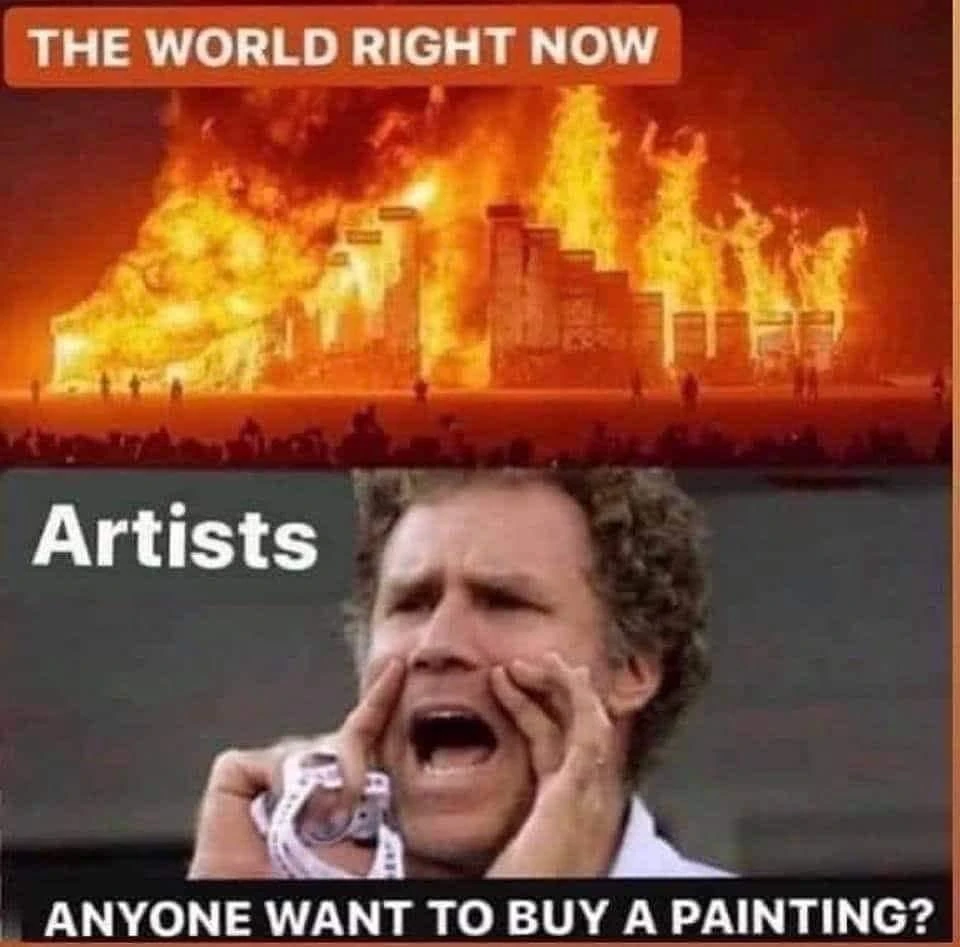
Since she started an art studio a few years ago, and now depends on selling art to supplement our income, this struck me as very funny.
It also got me to thinking: the less well-off rich people are, the fewer people will buy art. The fewer people who buy art, the less income my wife will make. Therefore, we need rich people to be rich, and more importantly, feel rich.
We want them to have plenty disposable income, that we don’t want taxed away, because we want some of that disposable income.
I care how rich the rich are because that directly affects how well I, my friends, my family, and my community do.
This isn’t true only for art. It is true for restaurants. It is true for safari companies. It is true for guesthouses. It is true for car dealerships. It is true for all the people who work on and around yachts.
It is true for non-profit organisations like the Institute of Race Relations, which can pay me for my work as long as enough rich people are willing to be donors.
Who needs millions?
People often ask, well, who needs a billion dollars (or, to be more realistic, R100 million)? What harm does it do to tax most of it away? That would give the government more money to spend on hospitals… like Tembisa.
The problem has to do with an old truism Leon Louw of the Freedom Foundation likes to trot out at dinner parties.
When you spend your own money on something for yourself, you care about both quality and price.
When you spend your own money on something for someone else, you care only about price.
When you spend someone else’s money on something for yourself, you care only about quality.
And when you spend someone else’s money on something for someone else, you care about neither quality nor price.
That is how we get R200,000 wooden-handled mops. That is why our schools and hospitals and railways and police services are falling apart.
Government officials have no personal incentive to care about raising quality, and they have no personal incentive to care about keeping costs low. It won’t cost them anything if they make the wrong choices. They are spending other people’s money on other people.
This is true the world over. Only the degree of not caring differs.
Beta testers
The money spent by the rich has both a direct and an indirect effect on the quality of the goods and services the rest of us get. Companies are much more likely to care about the quality they offer their biggest clients, which raises the quality they offer to everyone else, too.
Indirectly, the rich are always early adopters. Think of them as beta testers.
At Computex in Taipei in 2007, Rico Shen snapped this photo of wireless engineer Martin Cooper holding a DynaTAC cellphone prototype from 1973. That was the year when Cooper, now 96, made the first ever public call with a handheld mobile cellular telephone he helped develop for Motorola.

For 20 years, mobile phones were expensive show-off toys for the rich. Few people really needed one. They were a luxury. The rich bought them anyway, however bulky they were, however short their batteries lasted, and however limited cell coverage was in the early days.
The rich provided the revenue that paid for manufacturers to improve their handsets and for network operators to build out their networks. In due course, almost all of us were able to afford far better mobile phones than the early models that catered to the rich.
When home computers first came out, only the rich could afford them. But they provided the revenue that turned computer manufacturers into giants, and funded the research and development from which we can all benefit today.
Most new technologies, from washing machines and fridges back in the day, to electric vehicles and graphics cards today, are first sold to rich customers. They pay a premium, which provides the revenue to expand the market and iron out the early bugs, until these products are ready to hit the mass market at mass-market prices.
Cash piles
Very few rich people just sit on cash piles. Almost all of them have most of their wealth invested in various market instruments. That provides the capital for the companies that supply the rest of us with goods and services, and with employment.
Some rich people have the time, money and inclination to invest in charities and non-profit activities like sports clubs, private schools, feeding schemes, health programmes, think tanks, or other social benefit projects.
In my town, rich residents are funding a lot of infrastructure repair and maintenance. They work closely with the municipality to improve turnaround times and to train and mentor municipal employees. They provide project management skills, engineering skills, well-established commercial and industrial networks, and cold, hard cash that the rest of us cannot afford to spend on fixing the failures of a municipality left to its own devices.
Even apparent extravagances, like palatial mansions, or lavish garden parties, or luxury yachts, or cosmetic surgery, are ways in which the rich employ builders, interior designers, artisans, musicians, artists, waiters, chefs, bartenders, cleaning staff, yacht crews, doctors, and nurses.
These extravagances are how the rich improve the financial fortunes of an endless variety of suppliers that fulfil their wants and needs and charge top dollar to provide only the best.
The better those companies do, the better we all do. The more money these companies make, the more people they can employ, and the more they can afford to pay. The more profitable high-end products are, the more competitively companies can price their mass-market offerings. The more a surgery makes from facelifts and nose jobs, the less it has to charge poorer patients, and the better the techniques get for dealing with disfiguring accidents.
Direct interest
Now you could argue that the government has an even bigger interest in redistributing money from the rich to the poor. Instead of funding artists and yacht builders, government funds social grants and pensions and free healthcare and cheap education for the poor.
But cast your eye over the economy, and tell me who provides better products and services: the companies that supply the rich, or the government when it takes money from the rich to supply the poor?
The rich drive the economy, and increase the total value it generates. The government can only extract value from it and drag it down.
Every rand taxed away from a rich customer is a rand less they can spend on all the middle-class companies and working-class employees that make their wealthy lives possible and our own tolerable.
By contrast, every rand taxed away by the government is a rand of which perhaps a few cents actually makes it to the poor who need it most. The rest is gobbled up by inefficiency, poor quality control, white elephants, shoddy financial control, and outright corruption.
Here’s to the rich
I think we underestimate just how important the prosperity of the rich is to the economic success of the nation, and to our own well-being. We forget how important they are to raising general living standards, and improving the price and quality of the goods and services that are available to us.
Our tax policies take their money, and our economic policies drive them out of the country, at our own peril.
So, here’s to the rich. No matter how crazy the global economy gets, and no matter how badly South Africa’s economy does, may you always want to buy a painting.
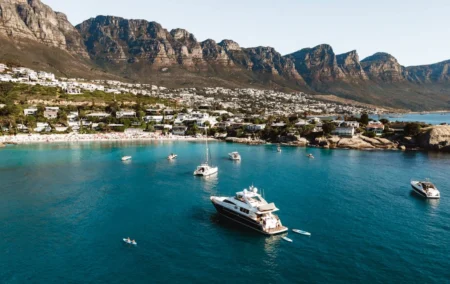
[Image: Clifton, in Cape Town, a playground for the rich and famous. Here’s to them! (Undated photo by Stephan Louis, used under a Creative Commons licence.)]
The views of the writer are not necessarily the views of the Daily Friend or the IRR.
If you like what you have just read, support the Daily Friend