

solipsistic
/ˌsɒlɪpˈsɪstɪk/
Adjective
Very self-centred or selfish.
“their solipsistic belief that only their cares are the ones of any importance”
Philosophy
relating to the view or theory that the self is all that can be known to exist.
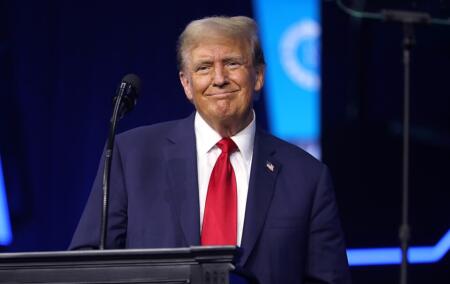
Donald Trump defines the term. But there is also a fair spread of other personalities in the political and business worlds who fit this bill.
These are the people who like to think of themselves as possessing superior intellect, even, to use Trump’s words, being “a very stable genius” in dispensing great knowledge magnanimously to the world’s benefit and solving problems that no one else can see. Some of this might be hyperbolic, in saying things for dramatic effect, but generally, these personality types don’t do irony. And when they do, it’s usually unintentional, because empathy and a sense of audience are not their strong suit. Rather, choosing their parents well is.
“If a windmill is within two miles of your house, your house is practically worthless. They make noise. They’re intermittent. They kill your birds. They break down all the time. You have to replace them every 10 years because they wear out. And they cost a fortune. And they need subsidy. Other than that, they’re quite good,” said Trump at an August 2019 rally in Ohio, at least proving that sarcasm, if not irony, is a tool in his rhetorical arsenal.
Windmills and taxes are just two of the many subjects that the US president claims to know better than anyone, a list which includes construction, campaign finance, consultants, drones, technology, infrastructure, horse-racing, forest management, environmental impacts, renewables, and polls.
The state of his personal taxes certainly demands some irony. And his history of bankruptcies would not suggest he is a business genius: a condition usually taken to denote someone capable of seeing things which others miss, or possessing an uncanny ability to translate exceptionally complex things into identifiable and thus easy-to-understand (and if necessary to solve) issues and problems.
Great wealth is a contributing factor. You are continuously buffered from the consequences of your own actions and inactions, where life is one big jumping castle of little cost and pain, except to others. Everything that negatively impacts you can be wished away, no matter how foolish, by a combination of money and layers of lawyers.
But legality is not morality. As a result, this condition seems to travel together with insecurity, a fear of being wanted for your money and the status that this affords, rather than your real, emotional and intellectual value. There’s real irony, of course.
This explains the lack of empathy for those who have suffered hardship, whether this be from wildfires in California, in Gaza, across Africa, at the hands of authoritarians, or, for that matter, even among Trump’s military.
The US president has repeatedly disparaged the intelligence of service members, commented that those who lost their lives in the service of their country were “losers” and “suckers”, and has asked that wounded veterans be excluded from military parades. Trump has reportedly referred to former President George HW Bush as a “loser” for being shot down by the Japanese as a Navy pilot in the Second World War, a label which helps to explain the poor relationship he has with the Bush family.
Trump has also expressed contempt, among others, for the war record of Senator John McCain, who spent over five years as a prisoner of the North Vietnamese after being shot down in his Navy jet. “He’s not a war hero,” Trump said in 2015. “I like people who weren’t captured.” When McCain died in 2018, Trump reportedly informed his staff, “We’re not going to support that loser’s funeral,” his ire turning to rage when flags were lowered to half-mast in respect to the former Republican presidential candidate. “What the fuck are we doing that for? Guy was a fucking loser,” said Trump to aides.
Trump was not invited to McCain’s funeral.
Such a lack of humility and empathy would seem to indicate emotional blindness. Jealousy may also have a part, given Trump’s lack of a war record (and, indeed, military service), but his narrow perspective seems to align with his understanding of patriotism and duty.
Amplified by the age of self-media, this version of self-preferentialism is not simple narcissism or selfish infatuation. It’s something different. It is solipsism.
Solipsism is reflected in Descartes’ famous axiom – Cogito ergo sum, “I think therefore I am” – taken to extremes, that everyone else is a figment of their imagination. Their self-centredness is only matched by their incredulity in finding out that many more people do not adopt their views and ideas. They are too absorbed – and probably not sufficiently well-read – to realise Descartes’ following observation that Dubito ergo sum, “I doubt therefore I am”.
There are other indicators. Jean-Paul Sartre held that the feeling of shame proved solipsism and idealism to be false, as it denotes the existence of the ‘other’, but presumably only if you felt shame. And as Einstein reminds us, anything existing alone in its own universe has no meaning.
Solipsists do not seek the approval of others. They are incapable of taking an interest in others, their only point of reference being themselves. They would rather be criticised than not spoken about, preferring to be centre-stage rather than back-stage, no matter their pleading to the contrary.
And yet solipsists are not transformational leaders. They do not have a destination in mind, and then work out how to get there, adjusting the journey all the time: leaders of the sort of Reagan, Mandela, Tambo, Thatcher, Havel and even De Klerk. (Mikhail Gorbachev had a destination in mind – the end of the Cold War – but not the end of the Soviet Union.)
Trump’s solipsism manifests in other ways. His inability to appreciate service and sacrifice seems to be related to his failure, in turn, to understand non-transactional life choices, ones that don’t result in a personal financial benefit. Those who make those life choices are “suckers” in his mind.
For the solipsists, after all, it’s not about others. It’s all about them.
It doesn’t matter to them if the world turns out worse for their theories and bulls**t policies, whether this be due to tariffs or peace processes struck at any price, including the history of international relations and its sovereign and legal underpinnings. This is unsurprising, since they usually are not students of history.
They go back to the equivalent of the jumping castle, playing golf, flying in their private jets, and sitting in comfort on their vast estates, sighing great breaths as to why the masses don’t prefer cake or the medicine they offer, one which routinely centres on less tax and accountability for the super-rich.
Why do we get such people in power?
It is miserable in today’s media age being a public personality, given the levels of abusive commentary, especially in social media, which is unregulated, unfiltered and without symmetrical reproach. It takes a special skin and motivation to make this journey.
The extent of leadership latitude is limited further by the news cycle being so short. This makes it very difficult to devise and adhere to long-term policy and outcomes – in other words, to be strategic rather than reactive, to set that transformational goal and stick to it.
As a consequence, in a vicious cycle, the wrong people become politicians, because they are less interested in service than power.
How to deal with such people?
John MacArthur writes in the Guardian that covering the Trump presidency “like bringing up children, is an art, not a science.”
There are costs to ignoring their prattling, however, not least given America’s global station and the state of geopolitics today. It seldom helps arguing back. They don’t listen and nor do they like that, especially in front of the cameras, as President Zelensky learnt to his cost in the Oval Office. Humour might help, as does ridicule, especially of their great intellect, though that tactic risks feeding their insecurity and the ravenous beast of attention.
Indifference works then, but only to a point. Another solution is in activation of civil society in a different way, not just from the usual sources.
In Israel, for instance, respected leaders took the unusual step of speaking out against the war in Gaza as a strategic danger to their country, including various past heads of Israel’s security agencies, including the Mossad and Shin Bet, the external and internal intelligence services respectively. It’s hard to argue against their patriotism or that they are losers. They are highly capable individuals.
Retired members of the US military have, by comparison, been surprisingly loyal and strangely silent so far about Trump, despite his seemingly endless reservoir of disparaging commentary.
Of course, the options depend on the circumstances in which one finds oneself.
Another irony is that many of the better leaders, with a sense of values and purpose, are in opposition in Africa. That they are largely cut off from external assistance, given the swing away from rights and democracy to naked and narrow self-interest by the world’s leading power, speaks volumes for the extent of geopolitical drift.
Bobi Wine and Kizza Besigye in Uganda, Nigeria’s Peter Obi, Tanzania’s Tundu Lissu, Adalberto Costa Junior in Angola, Kenya’s Martha Karua, and John Heche, Tendai Biti and David Coltart in Zimbabwe … the list of principled African democrats in opposition is long, much longer than the list of similar people in power.
“The supreme quality for leadership is unquestionably integrity,” said Dwight Eisenhower. “Without it, no real success is possible, no matter whether it is on a section gang, a football field, in an army, or in an office.” While identifying and managing complexity and in the process maintaining such integrity – determining what’s right and wrong – may not be fashionable or instantly gratifying, it’s still the right thing to do.
[Image: https://commons.wikimedia.org/wiki/File:Donald_Trump_%2853808876351%29.jpg]
The views of the writer are not necessarily the views of the Daily Friend or the IRR.
If you like what you have just read, support the Daily Friend