

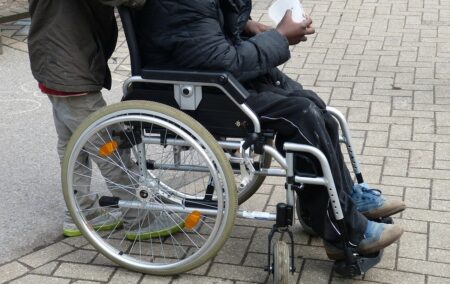
People with disabilities are the group worst-affected by South Africa’s unemployment crisis.
Most estimates place their unemployment rate between 80 and 90%. Supported Employment Enterprises (SEE) are the key to addressing this problem: 13 state factories across eight provinces, purpose-built to give people with disabilities dignified work, skills and a bridge into the open labour market. Yet that engine is idling, starved of orders, short of working capital, and too often treated as an afterthought by the very state that owns it.
The model is simple. SEEs hire people with disabilities, produce goods that the public sector and broader economy routinely need (furniture, textiles, protective clothing), and, in doing so, pay wages, build skills and provide opportunities to move into the open job market over time. The Department of Employment and Labour (DEL) itself describes SEEs as key to moving people with disabilities into work, with scope to employ around 3,000 people at full capacity. Today, they employ fewer than a thousand.
Beyond these numbers lies a deeper injustice. Mpumalanga is the only province in South Africa without an SEE factory. This means that people with disabilities in Mpumalanga, who already face some of the highest unemployment rates in the country, have no access to these jobs. There is no factory, no training facility, no pathway to economic inclusion. In effect, they have been written off. This is not just a policy gap; it is a moral failing.
Adding to this injustice is the reality that many of the workers currently employed in SEE factories in other provinces have been there for years, some their entire working lives, because they have been shut out of mainstream employment. Yet nowhere in any DEL performance plan or public statement has the Department outlined what would happen to these long-serving workers, should SEE factories close or be rationalised.
DEL has acknowledged that SEEs need predictable, multi-year funding to buy new equipment and strengthen pathways to the open labour market. However, funding without procurement is a hollow promise. Factories are standing idle not because workers are unwilling, but because government departments are not buying from them, despite SEEs producing the very goods that the public sector routinely procures.
Entirely solvable
This demand problem is entirely solvable. The Western Cape Department of Health has consistently procured goods from SEE factories, demonstrating a functioning model that sustains employment, boosts local manufacturing and delivers real value for money. There is no reason why other provinces and national departments cannot follow suit. Treasury’s procurement frameworks already allow for preference to be given to enterprises that advance social objectives. What is missing is political will, accountability and enforcement.
The ecosystem for SEEs must also be anchored in broader policy coherence. The DA’s Economic Inclusion for All Bill includes provisions for just this kind of procurement. SEEs would score highly on Sustainable Development Goals 8 (Decent Work) and 10 (Reduced Inequalities) by providing employment opportunities to people with disabilities. Inequality of opportunity, among other drivers like poor educational outcomes, wealth inequality and spatial disadvantage, must be tackled by growing the economy and enabling access to business, investment and jobs. Specifically, the DA proposes reducing red tape, supporting small-business creation (including in disadvantaged communities), creating a regulatory environment that allows every individual “regardless of background” to start a business with ease, and leveraging procurement to deliver meaningful inclusion for all.
We must draw on this focus on growth and apply it to Supported Employment Enterprises. Instead of under-utilised factories, with sufficient demand these can become micro-hubs of inclusive industrialisation: government procures goods at a reasonable price, while workers at SEEs get access to the dignity of a job, and the opportunity to develop their skills and transition into other sectors over time. If the state creates an enabling environment, there is real potential for inclusive opportunities.
So, what must be done? First, an SEE must be established in Mpumalanga urgently. The absence of one is, in effect, discrimination. The Department must table a timeline, identify a site and begin capacity-building immediately. People with disabilities in Mpumalanga cannot continue to be treated as invisible citizens.
Support the pathway
Second, provinces and national departments must do better in procuring from SEEs, following the Western Cape’s example. Instead of enriching tenderpreneurs, departments and provinces have the chance to support the pathway to employment for people with disabilities, while likely often saving money on inflated tenders for the politically-connected.
Third, ring-fence funding to modernise equipment. Current allocations are inadequate to replace old machinery. A properly capitalised modernisation fund is essential to ensure factories are competitive.
Fourth, protect workers from abandonment. DEL must publish a contingency plan providing that long-serving people with disabilities will be given new opportunities, not discarded, if factories are mothballed. Reasonable accommodation within the public service for SEE employees must not merely be theoretical.
Fifth, build the bridge to open employment. Each SEE job must come with a clear pathway to a job on the open market. Success must be measured not by factory headcount alone, but by workers’ graduation into sustainable employment. Finally, we should measure and publish outcomes. Employment, revenue generation, placements into the open labour market, and provincial coverage must be transparently reported.
South Africa spends billions annually on goods that SEEs already produce. The moral case: economic dignity for persons with disabilities, is beyond dispute. The economic case: local manufacturing, job creation and reintegration into the labour market, is equally compelling.
Yet as long as Mpumalanga remains without an SEE, and as long as there is no safety-net for existing SEE workers, we are not a country enabling inclusion, we are perpetuating exclusion.
If we cannot guarantee dignity, economic inclusion and equal opportunity to persons with disabilities, beginning with the simple act of providing meaningful work, then we have not only failed them, we have failed the Constitution itself. The time for symbolic commitments has passed, it is now time for deliberate action and measurable justice.
[Image:https://picryl.com/media/disability-rehabilitation-wheelchair-people-a81d7b]
The views of the writer are not necessarily the views of the Daily Friend or the IRR.
If you like what you have just read, support the Daily Friend