


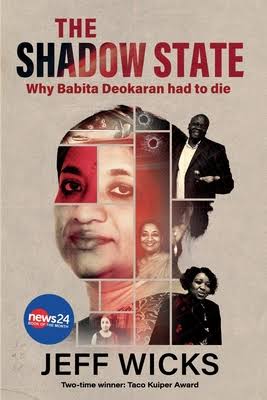
Jeff Wicks’s book The Shadow State is a great work of investigative journalism in which, at risk to his own life, the author exposes one of South Africa’s most obscene wealth-extraction rackets.
In The Shadow State, Wicks tells the story of the murder of whistleblower Babita Deokaran, the subsequent investigation, his role in the story as an author of exposés, and how a small group of corrupt politically connected businessmen organised their extraction network from Tembisa hospital.
The book is a very useful companion to the ongoing Madlanga Commission in laying out deeply-tied-together ANC politicians, police officers and mafiosos. Notorious characters like “Cat” Matlala also appear, albeit briefly, in the book.
While many of The Shadow State’s revelations are shocking, they are not surprising to anyone who has paid close attention to the rotting of South Africa’s law enforcement institutions. One of the most gripping and memorable parts of the book is Wicks’s description of the police investigation into Deokaran’s murder.
The initial police response is completely and utterly inept with almost no evidence collected. The car in which Deokaran was murdered was simply left for her relatives to deal with. Her laptop and cell phone, key pieces of evidence which would become the key to cracking the whole case, were simply left in the car by the police.
Whenever we talk about policing, my colleagues and I always make sure to mention that despite everything, there remain good cops in our police force. In Wicks’s telling, some of these are in the Gauteng Serious and Violent Crimes Unit, including in particular now ex-police captain Freddie Hicks.
Had Hicks not taken over the murder investigation of Deokaran, her murderers would likely never have been caught, and the key evidence in exposing the people involved in the corruption around Tembisa Hospital would never have been exposed. At every step of the way the Directorate for Priority Crime Investigation (better known as “The Hawks”) seemed intent on interfering in Hicks’s investigation, and once they finally took full control of the case, Wicks reveals that they appear to have entirely stopped investigating the matter, not even opening the laptop and cell phone evidence. Is this because of incompetence, or due to political pressure not to look too deeply into the case? Wicks never states which view he holds but strongly implies the latter.
Grounding chapter
The book has essentially two parts. The first is an examination of the murder, murder victim and investigation, the second, a dive into the corruption networks and the people who probably ordered the murder of Deokaran. Between these two sections is a powerful but grounding chapter describing the mistreatment of a young man named Shonisani Lethole, who during Covid was admitted to Tembisa hospital and was severely mistreated and starved, eventually dying after several days.
This chapter is well placed, bringing home the human cost of the looting Wicks is about to describe. While I read a lot of South African news and am therefore usually numbed to the horror of so much of what goes on in SA, this chapter broke through my emotional numbness to fill me with a genuine rage towards all those responsible.
One of the themes of the book, perhaps unintentionally, is how South Africa is essentially held together by heroic individuals, despite the machinations of the state apparatus. When Captain Hicks investigates the murder, he is fighting back against the police hierarchy while working together with private-sector security and Vumatel, the fibre provider who helped provide CCTV footage. Deokaran could easily have ignored the obvious corruption network and likely would have faced no consequences. Yet she decided to try to halt payments to Tembisa, and paid for it with her life.
Wicks himself is the hero of his own book, perhaps unintentionally, and deservedly so. His investigative reporting is perhaps the only reason the people behind the looting of Tembisa hospital were uncovered at all. So little was the appetite for looking into the murder and the network which paid for that murder, that had a journalist not chased the evidence in the case it likely would have gone largely unnoticed. Today’s SIU investigation into the Tembisa hospital kingpins is largely built on the foundation that Wicks built.
While the first part of the story has much of the human drama: Babita’s murder, the impact on her brother Rakesh and daughter Thiara, the investigation and the interrogation of the hitmen, it is the second half of the book that names the names of the kingpins. Wicks details how the extraction syndicates worked, tracing them back to essentially just three men who together appear to have stolen around R2 billion from just this one hospital.
Most dramatic link
When it comes to naming names, Wicks is not shy, and whenever the name of some powerful ANC politician comes up in his investigation, he doesn’t hesitate to report his findings. Perhaps the most dramatic link between an ANC leader and the murder of Deokaran comes early in the book when Captain Hicks captures the first of the hitmen. After moving him to a quiet area, he begins asking him about the murder, and according to the police report, the hitman says “he is not going to jail alone” and proceeds to give up all his comrades. He even claims that he personally met and was promised payment for the murder by then Health Minister Zweli Mkhize.
The hitman would later recant this accusation claiming Hicks had tortured it out of him, which considering the reputation of the SAPS is not an entirely dismissible claim, even if it seems an untrue one in this instance.
Many powerful leaders in the ANC come up at points in the investigation: everyone from Panyaza Lesufi to Ramaphosa (although in that case it’s a very distant connection). However, while Wicks is here very good at explaining the How and the Who, he never discusses the larger picture of how it came to be that corruption and politics have come so completely to infiltrate the state.
In chapter 12, Wicks recounts an email exchange between Babita and one of her colleagues, who seems to have been one of the first people to flag the obviously suspicious activity at Tembisa. However, when the dodgy payments are flagged, the then CEO of Tembisa, Dr. Ashley Mthunzi, reportedly berated this person for raising the issue, saying they were “nit-picking transformation and part of an anti-transformation agenda. This person subsequently dropped their enquiries into the problem until Deokaran picked up the matter later.
It’s here we get a glimpse of the Why which has gone unexamined. The Tembisa Hospital corruption was a particularly good example of the fake transformation programme so tightly clung to by the ANC and its fellow travellers. In the name of racial equality, value for money and merit are discarded in favour of political connections. Any criticism of this scheme is decried as anti-transformation or racist.
Ripped off
In the end, the poor suffer, the middle class are ripped off, and a tiny group of politically connected gangsters make off with billions.
The other part of the Why is the policy of Cadre Deployment. Wicks makes it clear that certain people throughout the hospitals, government and police are enormously complicit in these corruption networks, and the vast majority of the money flows to this small group of people. This is only possible due to the policy of cadre deployment, a deliberate policy of the ANC to fill every position of power in government and society with people who are first and foremost cadres: that is loyal to the ANC. Merit or any other criteria are a distant later consideration.
The inevitable result of this is corruption. Even if you yourself are not corrupt, there is huge pressure on you, “Please comrade, don’t make a fuss about this; you will embarrass the movement”. Any attempt to crack down on corruption is seen as a betrayal of the movement, (‘after all why are you being so mean to your comrades?’) In the end, the honest submit, or become corrupt themselves.
The culture of corruption is so entrenched that I was struck by how little effort to hide their fraudulent activity was made by the kingpins of the Tembisa syndicates. It didn’t take a master accountant to figure this out. It was blindingly obvious, its perpetrators coming off as cowardly, violent and treacherous rather than Machiavellian criminal masterminds.
What reporting this scheme did take was courage not skill. One suspects that so common is this kind of corruption in government that any sufficiently brave investigation of any government institution will find similar if perhaps not as audacious looting networks.
Ironically, the decision to murder Deokaran is probably what ultimately led to the exposure of these syndicates. Had Babita been allowed to flag the payment issues and ask for an investigation, i have no doubt that eventually the political protectors of these syndicates would have fired her or demoted her, and the looting would have continued. Maybe there would have been some media outcry, but ultimately the key evidence would have been lost.
Arrogance and cruelty
However, the arrogance and cruelty of someone in the network saw them organize her murder, and this provided the gap for a good journalist, a good cop and a host of whistleblowers to break open the case.
While the kingpins will likely never face criminal justice for the murder, the SIU’s investigation, which directly collaborated with Wicks, at least seems to be making their lives difficult.
Babita’s story tells us that, despite its many problems, South Africa is still being held together by heroic people who risk much to do the right thing. It’s up to the rest of us to support and empower them. The “shadow state” is not invincible.
If you like what you have just read, support the Daily Friend