

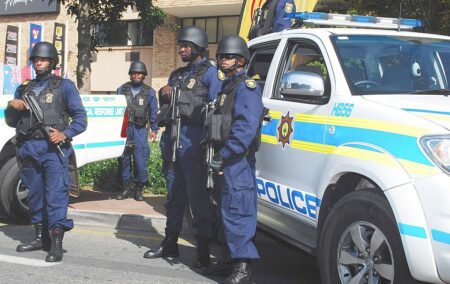
After long and unjustified delays, the South African crime statistics for quarters 1 and 2 of financial year 2025/26 were finally published last week. Across both quarters, some 64 reported murders occurred every day. Attempted murders averaged some 75, assault with intent to inflict grievous harm some 435, and rape some 106, all per day.
These figures are disturbing, but not surprising. It is nothing new.
They exceed anything that even a concentrated analysis of the most violent cities in the United States (take your pick: Birmingham, St Louis, Baltimore) can produce. So much for the toxically positive commentariat persistently rushing to tell us that the “violent” US, with its “gun culture”, can never “lecture” South Africa about anything.
Contra the (ra)mampara who calls himself President, no, “beautiful things” are not happening in South Africa. Horrible things are.
The Free Market Foundation (FMF) recognised in the runup to the May 2024 general election that not one political party was proposing anything of note to deal with violent crime, other than good vibes and “police better”. In response, we launched the Section 12 Initiative for a Safer South Africa, which included a set of solutions aimed in particular at violent crime, organised into four “Ds” – Definition, Decriminalisation, Decentralisation, and Development.
These were repeated in our Liberty First proposals to the new Government of National Unity after it was formed in June 2024.
Here follows a slightly modified extract from the FMF’s “Liberty First: Legal System and Property Rights” proposals in particular, under the heading of “Civil Liberty”. Do bear in mind that the crime stats relied on here are different (though not meaningfully) from the new updates.
***
Civil Liberty
Freedom under law should be respected, especially when it is exercised in ways some subjectively deem to be offensive or hurtful.
Freedom that is not protected by law is fleeting. When the law is itself weaponised against the very thing it exists to protect, the very legitimacy of the state itself is drawn into question.
With tens of thousands of “crimes” on the statute books, scattered across the national, provincial, and local spheres of government, and spread over hundreds of legislative Acts and many more executive regulations, legal certainty is threatened. While South Africa is not an exceptional case in the world in this respect, it has become difficult for ordinary legal subjects to know, precisely, what is a criminal offence and what is not.
Most people have a good idea about the mala in se crimes that one intuitively know to be criminal, but given the wide variety of domains the state today regulates, there are thousands upon thousands of pages of peculiar offences that could land one in prison, make one liable for a fine, or burden one with a criminal record.
These pages are scattered all throughout the hundreds of statutory and regulatory books of the central, provincial, and municipal governments. The result is that many peaceful, well-intentioned South Africans contravene potentially dozens of criminal law rules every single day without knowing it.
(A crime is a malum in se when it amounts to conduct that the reasonable person – indeed most people around the world – would regard as criminal by its very nature, without having to have been declared criminal by some positive state action. The other category of crime is a malum prohibitum, which is conduct that is “criminal” only and exclusively because a group of politicians called “government” has deemed it as such.)
Definition – towards a criminal code
In this respect, Parliament should adopt a Criminal Code Act that enumerates every single criminal offence recognised by South African law.
This does not amount to replacing South Africa’s common law with respect to crime with a codified criminal law on the civil law model. It is meant to simply ensure that there is a legal requirement for the state to publicise the existence of offences and allow legal subjects to easily determine whether any contemplated conduct is or is not criminal.
(Virtually nobody reading this column knows that they can be fined up to R150,000 or imprisoned for up to six months for distributing or exhibiting a film or game in public without being registered with the Films and Publications Board.)
Given South Africa’s unique, extreme levels of violent crime, however, the over-criminalisation of peaceful individuals who engage in victimless conduct is even more significant than the moral problems of over-criminalisation elsewhere in the world. Violent crime is an existential threat to any economic growth and prosperity.
Decriminalise – no more victimless “crimes”
Therefore, Parliament should also adopt comprehensive decriminalisation legislation that ensures police, prosecutorial, and penal institutions do not have their resources and attention distracted by politically contrived offences other than violent crimes and crimes with clear victims who suffered tangible harm.
The common law categories of malum in se and malum prohibitum are instructive in this regard.
Among those laws that ought to be removed from the statute book to more appropriately respect civil liberty (and to take but one example out of many), is the Prevention and Combating of Hate Crimes and Hate Speech Act.
This Act was initially conceived as legislation to address hate crimes – that is, tangible criminal harm committed against someone due to some or other inborn characteristic – but was thereafter contrived into a criminalised prohibition on hurtful speech. (The Act utilise the term “hate speech”, but this does not fully satisfy the constitutional definition of hate speech and therefore address itself to a lesser category of “hurtful” expression.)
This happened within the context of South African law already prohibiting hurtful speech through such measures as the Promotion of Equality and Prohibition of Unfair Discrimination Act (known as the Equality Act) and the inaptly modified common law doctrine of crimen iniuria.
The Hate Speech Act should not be allowed to become entrenched in South African law. The Act should either be repealed in its entirety, or its provisions relating to hurtful speech must be removed, leaving only those concerned with hate crimes.
The Equality Act, in turn, was meant primarily to give effect to section 9 of the Constitution, in particular its prohibition on unfair discrimination. The addition of a hurtful speech provision in this Act has complicated the discourse.
Any and all regulation of expression must be seen through the prism of section 16(2) of the Constitution, but because these provisions appear in the Equality Act, their wide breadth has been justified on the basis of standards set out in section 9, which undermines the constitutional design.
The Equality Act’s hurtful speech provisions should either be amended to reflect, precisely, the language utilised in section 16(2)(c) of the Constitution, or failing that, removed entirely. Section 16(2)(c) provides that government may prohibit or regulate speech that amounts to “advocacy of hatred based on race, ethnicity, gender or religion, and that constitutes incitement to cause harm”.
Alongside the repeal of the Hate Speech Act and the amendment of the Equality Act should come reform to the doctrine of crimen iniuria.
This doctrine has been inappropriately wielded to prosecute hurtful speech. But it is in fact unclear whether there is any room left per se in South African law for crimen iniuria, in light of the constitutional protection for expression.
Decentralise and develop – share the burden!
The need for this comprehensive decriminalisation is evident in light of the sheer scale of the problem of violent crime. In the last quarter of 2023, crime statistics showed that there were about 86 reported murders every day in South Africa on average, and on average five reported rapes per hour.
If we are to be conservative and take only half of these (in fact, the numbers are higher than the reported instances) – 43 murders per day and 60 rapes per day – and we assume again that half of these are committed by separate people, meaning 21.5 unique murders and 30 unique rapes per day, that still amounts to at least 645 unique murders and 900 unique rapes committed every month.
If we assume our criminal justice system prosecutes these violent criminals speedily – this is an assumption we must not make in the real world – there would need to be at least 1,545 new beds available in South African prisons every month to accommodate only those guilty of murder and rape. Thousands of additional prosecutors, and dozens of massive new prisons, would be necessary for this.
To say that this is unlikely, or even impossible, is an understatement.
Parliament must, therefore, take action to decentralise policing, allowing the South African Police Service to focus on becoming an elite institution that supports the other spheres of government and communities in their fights against the particular criminal contexts they exist in. The number of prosecutors must be increased, as must support mechanisms be developed for more private prosecutions. South Africa’s prison capacity must be swiftly and dramatically expanded by several orders of magnitude.
And while the principles of due process are sacrosanct, some have interpreted this to mean that only the state may therefore engage in the apprehension of criminals. The aforementioned criminal reality of South Africa manifests how unviable this arrangement is, given the sheer scale of the problem.
Parliament must, as a result, adopt legislation empowering communities and commercial enterprises to comprehensively protect themselves and their property.
Not only should private security officers have power of arrest, but private prosecution should also be expanded and developed. Communities and commerce must also play a role in penal institutions and parole boards that goes beyond merely making representations.
Failing this – predictable, given our hostile political elite – communities and well-meaning lesser magistrates in government must simply get on with the work of protecting themselves anyway.
Finally, but crucially related to the observance of the rule of law, is the phenomenon whereby South Africa’s criminal justice institutions have been lax to take remedial steps against politically powerful or influential individuals who brazenly encourage violent conduct among their followers. However, where private individuals make similar threats, the law is allowed to take its course.
This two-tier system does not merely threaten equality before the law, but often translates into tangible harms done against life, liberty, and property, without recourse.
Some politicians and officials who themselves engage in violence (rather than merely inciting it) and who are then convicted for that offence, are also often paroled very early into their sentences, and swiftly redeployed into organs of state. Their victims are then forced to witness how the principle against double jeopardy is perverted by the justice system to protect those with political leverage.
Recognising the context of South Africa’s particularly violent society, Parliament should adopt legislation that elevates the common law prohibition on criminal threats and incitement to commit violence to that of statutory law.
Given the coercive authority that political actors are clothed with in society, they should have less, as opposed to more, freedom to engage in the rhetoric (and certainly practice) of violence, and the consequence of them engaging in such rhetoric should be greater than when ordinary civilians engage in similar rhetoric.
No person must be free to issue a sincere threat of violence against anyone else. There must, of course, be judiciousness in applying this prohibition, especially in determining whether the threat is in fact sincere. But in particular when politically powerful people in fact engage in violence, they must be treated as any other violent criminal and have the full might of the law brought to bear upon them.
***
The political elite – regardless of party – would of course balk at these simple, logical, causal solutions.
Taking these steps involve restraining excess state power and forcing the state to exercise real power where its core directive lies. But the political elite wants to have its cake – dealing with violent crime – and eat it, too – dedicating police, prosecutorial, and penal resources to addressing the various politically contrived “crimes” that all relate in some way to economic rentseeking, moral posturing, and social grievances.
This is the stuff of fantasy.
It is, as always, up to ordinary South Africans to either pressure the state into dealing with the problem, or, if not that, deal with the problem themselves.
[Image: https://commons.wikimedia.org/wiki/File:South_african_police_may_2010.jpg]
The views of the writer are not necessarily the views of the Daily Friend or the IRR.
If you like what you have just read, support the Daily Friend