

There has been a lot of noise – and a fair amount of sensation – following the axing of Dion George. His removal as Minister of Forestry, Fisheries and the Environment was, however, good news for those who have long argued that the department needs tangible, ground-level impact rather than talk shops. His departure offers a moment of potential. Should the neglected environmental sector of waste receive the needed attention, gains are sure to follow.
Waste management – arguably the most practical and immediate test of the effectiveness of the Department of Forestry, Fisheries and the Environment – remains in serious crisis. For instance, the disastrous mismanagement of waste tyres was something that could have been addressed relatively quickly, but wasn’t.
The private sector has a large role to play in waste management. South Africa creates a staggering 70 000 waste tyres every single day. While public-private partnerships have become a buzz-phrase in most other sectors, the waste tyre management sector remains trapped in a deeply flawed “the-government-can-do-it-all” mindset.
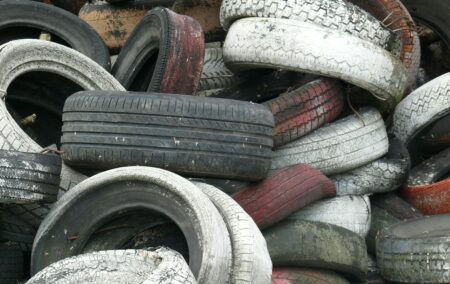
Just last month, the department put out tenders for another 32 waste tyre depots, totalling a million square metres – space enough for over a million tonnes of waste tyres; and this month they went to tender to auction off some R100 million worth of equipment that was “intended” to be used for pre-processing tyres and “intended” to generate revenue for the Waste Bureau, but is not being used. This is bluntly an admission of failure: they can’t deal with the tyres and spent tens of million on equipment that they can’t put to use. Government is busy with waste tyre storage, not tyre recycling. The current depots are overfull and have become massive fire hazards that are leaking toxins into the groundwater.
Eight years ago, South Africa was a leader in waste tyre management. Its established system was a proof-of-concept for applying circular solutions to diverse waste streams. But rather than expand the concept, the then Zuma government moved the whole of waste tyre management under the Waste Management Bureau – from which the department could hand out contracts.
Innovation and responsiveness
Waste tyre management is a complex, logistics-heavy, market-driven process that demands innovation and responsiveness. These are the strengths of the private sector, not a public service that lacks the capacity to effectively deliver.
Between 2013 and 2017 the Recycling and Economic Development Initiative of South Africa (REDISA) – a Public Benefit Organisation – was in charge of waste tyre management. As a private player, we diverted over 300 000 tons of tyres through a program that created thousands of jobs and empowered hundreds of small and medium enterprises. The Zuma government put an end to that through a process the Supreme Court of Appeals found unlawful. And yet, REDISA was never reinstated.
Returning to a proven way of handling waste tyres should be a priority. The waste sector – while not as eye-catching and fashionable as other sectors – is where environmental concern meets economic opportunity. Research shows that a functional waste management plan applied to just 13 of South Africa’s 38 waste streams could boost GDP growth by 1.5 percentage points. Tyres alone could be a catalyst for green jobs and industrial innovation. Through focussed collection, management and recycling, the crisis can be ended, while thousands of collectors and transporters are helped into a budding recycling economy.
The establishment of a circular economy for waste tyres requires significant investment, innovation, and operational efficiency – elements that the private sector is uniquely positioned to provide. Government-led initiatives often face constraints and slower implementation timelines, whereas private companies can mobilise resources quickly and bring specialised expertise in logistics, processing, and technology.
Minimal lead time
REDISA retains critical assets and infrastructure from its previous operations. These include established collection networks, testing facilities, machinery, and data systems that can be reactivated with minimal lead time. Rather than starting from scratch, REDISA offers a proven model that has already demonstrated success. This readiness can translate into faster implementation, reduced costs, and immediate impact.
The principle of using private companies through long-term contracts to establish lasting public infrastructure and systems is well-founded and widely practiced globally.
The REDISA model does not cost government a cent – it is funded by the waste tyre levy, which is currently still being collected, but isn’t having impact. Less than half of the levies collected have been applied to managing waste tyres – an example of government inefficiency and, quite frankly, duplicity: the levies are not being used for the purpose they are collected for.
South Africa doesn’t need more tyre dumps, it needs a functioning circular economy. The solution is ready, proven and funded. One hopes the change of leadership in the environmental portfolio brings with it a focus on ground-level impact. We must stop hoarding toxic tyres, and enable smart partnerships that offer real solutions.
The views of the writer are not necessarily the views of the Daily Friend or the IRR.
If you like what you have just read, support the Daily Friend