

South Africa likes to present itself as a diplomatic heavyweight: a bridge between North and South, a principled voice in global forums, and a stabilising force on the African continent. Hosting the G20, advocating reform of global governance, and maintaining a visible presence in UN peacekeeping all reinforce that self-image.
Yet beneath the rhetoric lies an increasingly stark contradiction. South Africa’s diplomatic ambition is no longer matched by its security capability. This is not the product of misfortune or temporary fiscal stress. It is the result of deliberate, sustained policy choices, clearly reflected in how the state allocates money, authority, and political attention between policing and defence.
That gap is now too wide to ignore.
Sidelined by design
On paper, the South African National Defence Force (SANDF) remains a core instrument of national power. In practice, it has been politically marginalised, operationally hollowed out, and increasingly insulated from democratic scrutiny.
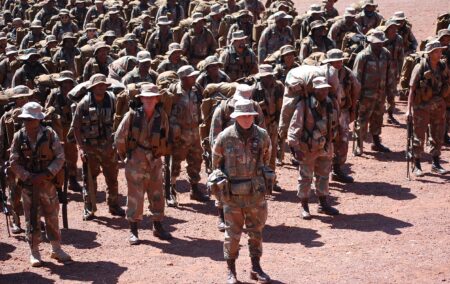
For more than two decades, defence has steadily slipped down the list of government priorities. Budgets have declined in real terms. Personnel costs consume most of what remains, leaving inadequate funding for training, maintenance, and modernisation. The result is a force that deploys and absorbs risk, but struggles to regenerate, deter, or sustain complex operations.
The SANDF is no longer treated as a strategic instrument. Instead, it functions as a general-purpose utility force. Border safeguarding, disaster relief, infrastructure protection, and election support dominate its tasking. These missions are politically convenient and publicly visible, but strategically corrosive. They consume scarce resources while doing nothing to restore combat readiness. The force is constantly busy, yet increasingly brittle.
This is not accidental neglect. It reflects an implicit political judgement that military power is awkward, electorally unrewarding, and strategically secondary. Defence is tolerated as a symbol of sovereignty, not invested in as a capability.
The contradiction between ambition and capability is clearest in South Africa’s role in the Democratic Republic of the Congo.
On 19 December 2025, the United Nations Security Council unanimously renewed the mandate of the United Nations Organization Stabilization Mission in the Democratic Republic of the Congo for a further year, extending it until 19 December 2026. South Africa remains committed to the mission and has already executed a troop rotation, allegedly having deployed a new contingent on 13 December 2025, without the knowledge of the Joint Standing Committee on Defence.
The renewed mandate for the RSA Battalion proceeds without the Quick Reaction Force and Composite Helicopter Unit. These were not symbolic contributions, but were high-value combat and mobility assets. What remains are specialist elements, notably tactical intelligence and medical evacuation.
This is a quiet retrenchment driven by necessity rather than strategy. The SANDF simply cannot sustain high-end deployments without further hollowing out the force at home. Yet, diplomatically, South Africa continues to present itself as a reliable security contributor.
That disconnect erodes credibility. Soft power unsupported by hard capability may generate goodwill, but it does not translate into durable influence or strategic leverage.
Hosting the G20 sharpened this imbalance. Pretoria has emphasised dialogue, inclusion, and representation of the Global South. The optics were strong. The messaging was confident and polished.
Leadership, however, brings expectations. States that claim influence are judged not only by what they say, but by what they can do when conditions deteriorate.
South Africa is not expected to rival major powers militarily but it is expected to be coherent. A country that struggles to secure its borders, cannot sustain demanding peacekeeping capabilities, and presides over a visibly declining defence force will inevitably find that diplomatic platforms have limits.
What emerges instead is performative leadership: presence without leverage, voice without weight.
The G20, and budget policy
If speeches obscure priorities, budgets reveal them. Nowhere is this clearer than in the contrast between policing and defence in the medium-term budget framework.
The South African Police Service (SAPS) is a protected priority. Its budget grows steadily over the medium term. Personnel numbers are expanded. Salary pressures are accommodated. Visible policing, detective services, and crime prevention are framed as non-negotiable state functions, even as the Mandlanga Commission’s interim report is shielded from the public.
This reflects political reality. Crime is immediate, visible, and electorally costly. Underfunding policing carries direct political risk. As a result, SAPS is treated as essential to social order and regime legitimacy, and the safety of government. Look no further than the budget for VIP Protection, which is larger than the budget for all combat aviation, combined.
The SANDF’s allocation is effectively capped. Once inflation and rising operational costs are accounted for, it declines in real terms. There is no serious provision for force regeneration, equipment replacement, or restoring readiness. Defence is expected to absorb pressure internally, despite already operating beyond sustainable limits.
The message is unmistakable. Internal order will be funded, regardless of the cost and associated corruption within policing, but strategic capability will not get another cent.
A narrow and risky view of security
The budgetary imbalance encodes a narrow conception of national security. Threats are assumed to be domestic, criminal, and manageable through policing. External risk, strategic deterrence, and military credibility are treated as theoretical or residual concerns.
That assumption may have appeared reasonable in a benign international environment. It looks increasingly fragile in a world defined by instability, contested norms, and renewed great-power competition.
Policing cannot secure maritime approaches, enforce borders, evacuate citizens from crisis zones, or underpin regional stability. Yet the SANDF is still expected to perform these functions without the resources required to do so credibly.
The state wants the benefits of military capability without paying the costs. Defence has become an insurance policy that no one wants to pay for, but everyone expects to provide cover when something goes wrong.
More troubling still is the deterioration in civil–military relations. Recent engagements between the SANDF and Parliament’s Joint Standing Committee on Defence suggest a serious breakdown in trust. Briefings on South Africa’s MONUSCO contribution were widely described by Members of Parliament as superficial, evasive, and dismissive. Key information was withheld. Legitimate questions were deflected. Some MPs walked out in frustration.
This is not a procedural irritation. It is a constitutional warning sign. A military that treats oversight with disdain, shielded by political leadership, risks drifting away from democratic norms. Budget neglect and accountability failure often reinforce one another.
Taken together, these trends point to strategic denial.
South Africa wants diplomatic stature, peacekeeping credibility, and global visibility. But it funds and governs its defence force like a state that believes military power is optional. That is a choice, not an inevitability.
It is also a risky one. International goodwill is not a substitute for capability. Institutions falter under pressure. Norms weaken when challenged. States that neglect strategic capacity often discover too late that diplomacy without leverage has sharp limits.
South Africa now faces a decision it has postponed for years.
Either it aligns ambition with capability by rebuilding the SANDF, restoring accountability, and funding defence as a serious instrument of national power, or it scales back its foreign policy ambitions honestly, including peacekeeping commitments and leadership postures.
What it cannot continue to do is pretend that policing budgets and diplomatic rhetoric can substitute for military capability.
Power follows capacity. Ignoring that reality is not principled foreign policy. It is strategic self-deception.
[Image: Ricardo Teixeira]
If you like what you have just read, support the Daily Friend