

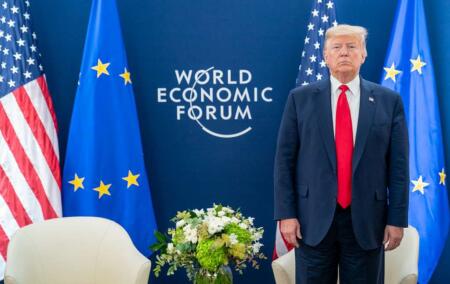
A lot changed for the Presidency of Donald Trump over the past week.
There is a strong negative domestic backlash against his administration’s hardline defence of the Immigration and Customs Enforcement (ICE) agents shooting dead two protesting citizens on the streets of Minneapolis. And Trump’s remarks that NATO allies “stayed a little back, a little off the front lines” in Afghanistan drew massive criticism from European leaders as a reflection of deep ignorance.
We have not yet seen such a strong domestic backlash against Trump, nor such tough words from Europe over his untrue remarks about NATO allies in Afghanistan.
And last week Trump backed down on his plans to take Greenland from Denmark, an ally. We do not yet know what is in the Greenland deal, but it might involve an infinite lease arrangement with Denmark, allowing the stationing of US troops. Stationing of troops has long been allowed under existing arrangements, but Trump likes the crisis, although there was no real reason for the crisis.
The strong domestic backlash and the forthright reaction from allies make for a changed and more difficult environment. Last week was a significant turning point for Trump.
He is likely to face a lot more domestic opposition, including from within his own party. And abroad, allies might defer to him a lot less, go ahead with plans to rely a lot less on the US, and just seek to ride out the next three years in the hope that something better lies ahead.
By far the most damage has been done to Trump by the latest shooting on the streets of Minneapolis. What people saw on their screens was very different from the claims of Trump administration officials.
Trump’s Homeland Security Secretary made the incorrect claim that Pretti was “brandishing” a weapon. He had a weapon on him but there is no sign on video of him brandishing it. Pretti was shot ten times in his back, while on the ground. A Trump administration official accused Pretti of being a “domestic terrorist.” That is untrue war talk.
The administration is desperately trying to save itself on this one.
Hence Trump saying earlier this week that the administration will be “reviewing everything” about the shooting. Many in Trump’s support-base favour tough action, but probably not the shooting of people taking videos. And no one likes to hear blatant untruths from government officials.
Even a number of Republican politicians expressed outrage at the administration’s claims, and the National Rifle Association (NRA), a strong supporter of candidates on the right, has expressed deep concern over Pretti’s shooting. He was carrying a licensed gun, and the NRA called a suggestion by a federal government prosecutor that people who carry guns risked being shot, “dangerous and wrong.”
Withdrawing the tough-talking Border Patrol Commander, Gregory Bovino, from Minneapolis is a sign that Trump wants to give a new face to an immigration-enforcement operation that has gone horribly wrong.
The Trump Administration was intent on a showdown in Minneapolis. As a solidly Democratic party state with a Governor, Tim Walz, who was Kamala Harris’s Vice-Presidential candidate, it provided the perfect place for a Trump show of force. The extensive social welfare fraud in the state amongst the Somali community sealed the target on the state for tough immigration enforcement, the central plank of the Trump project.
So ICE agents flooded into Minneapolis and activists have sought to hamper their work. That laid the basis for the showdown, which the Trump administration and Minnesota’s political leadership wanted. ICE wanted to show that it would not tolerate activist interference, and many in the state were keen to stand up to Trump.
If Trump has a single great fault, it is that he inflames a crisis. His supporters love this, and he outrages his opponents, which in turn seems to build his support. He often tries to calm things at the last moment, but there is always a deep uncertainty about what he will do.
The episode in Minnesota shows the US at its worst and creates visions of continuing violent confrontations.
In one worst-case scenario, imagine that the Governor calls up the National Guard, and the President then deploys troops under his command to a troubled area in the same state. The orders to each force are to stop the other. In the current febrile political environment, neither force might wish to back down, as they each try to provide a lesson to the other.
Then the conflict spreads to other states. Trump has deployed federal troops to the big Democrat-controlled cities he considers badly managed and crime-ridden, like Chicago and Washington DC.
If one were to add tough talk, threats from both sides and an armed citizenry, the unimaginable, such as civil war, might happen in the US: a place where political stability is assumed to be constantly present.
We will find out in the November US mid-term elections whether or not the Trump magic still holds. Republicans are increasingly worried that the great Trump wave might have passed. Early polling shows that overall, the Democrats have an advantage, but a lot can happen before November. US economic growth is strong, but the rise in tariffs might yet result in an inflationary burst and contribute to a cost-of-living crisis, which would steer voters away from the Republicans.
For the rest of the world, Trump’s sheer unpredictability and love of a crisis calls for not relying on the US and making other plans to the extent possible. There has always been a strong strand of isolationism in US politics. It is just that we have not seen it in the post-War era, as Presidents, both Republican and Democrat, have been strong internationalists.
Trump has changed the US and given a voice to those who believe they lost out due to globalisation and immigration, and what they perceive as the rejection of their interests by the elites of the Democratic Party. Few politicians before Trump saw the rage of the rust-belt and south at immigration, the elites, and the US humiliation in Iraq and Afghanistan.
As planks in the conservative agenda, all these will remain for years to come. But the conservative base in America might just be after a very different leadership style.
Where does all this leave those who seek Trump as an ally?
Will Afrikaner groups be served well by having Trump as an ally in these changed times?
Towards the end of the Biden administration, Democrats as well as Republicans were concerned about SA’s naval exercises with the Russians and the Chinese. While the Democrats might not push for an end to Black Economic Empowerment, they would still be very worried about SA’s ties to Iran, Russia and China.
But as Trump peaks, having him as an ally might undermine one’s future standing in the US.
[Image: https://picryl.com/media/president-trump-at-davos-49419286023-ac6fed]
The views of the writer are not necessarily the views of the Daily Friend or the IRR.
If you like what you have just read, support the Daily Friend