

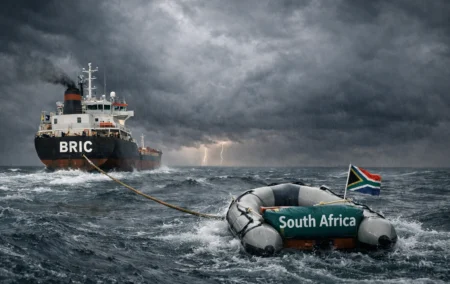
South Africa, as a member of BRICS, is a tiny fish in a small pond. And the pondwater is toxic. It should get out.
BRICS+, the 10-nation club of emerging economies, was founded not upon shared values, but upon a shared belief that the rules-based international order and multilateral finance institutions are out-dated, being based on a post-war balance of power that no longer exists, and that they are not in the interests of the people of the developing world.
There’s a great irony in the fact that this is the exact same view that Donald Trump’s America takes of the rules-based international order and multilateral institutions.
As the world splinters into competing spheres of influence, and the US becomes far more aggressive towards countries that appear to threaten its interests, the question arises of how South Africa ought to align (or re-align) itself.
Non-aligned
Historically, the ANC always viewed itself as non-aligned, and South Africa joined the Non-Aligned Movement (NAM) – the largest multinational forum outside the United Nations – shortly after the democratic elections of 1994.
Although founded as a counter-weight to the emerging polarisation between the two superpowers, the US and the Soviet Union, many members of the NAM – notably Cuba, Venezuela, Vietnam, Mozambique, Angola, North Korea and Belarus – were very much aligned with the communist east. So was the ANC, of course.
The NAM used to be influential in the “struggle against imperialism, colonialism, neo-colonialism, racism, and all forms of foreign aggression, occupation, domination, interference or hegemony as well as against great power and bloc politics,” as Fidel Castro put it in 1979.
As colonialism gave way to liberation, and the Cold War gave way to the victory of the liberal democratic world order 35 years ago, the relevance and influence of the NAM faded, despite counting 121 countries among its members.
At the same time, the Group of Seven (G7) advanced economies, which was formed in 1973 upon the principles of pluralism, liberal democracy and representative government, sought to create a forum that included major developing countries in the wake of a series of financial crises, such as the Mexican peso crisis in 1994, the Asian financial crisis in 1997, and the Russian financial crisis of 1998. The G7 formed the G20 in 1999.
(The G7 actually had eight members, the US, the UK, France, Germany, Japan, Italy, Canada and the EU – the latter not being counted. In 1999, it was formally the G8, having co-opted Russia in 1997, before expelling it again in 2014 in response to its annexation of the Crimean Peninsula from sovereign Ukraine. The G20 likewise does not have 20 members, but 21, namely Argentina, Australia, Brazil, Canada, China, France, Germany, India, Indonesia, Italy, Japan, Mexico, Russia, Saudi Arabia, South Africa, South Korea, Turkey, the United Kingdom, the United States, the European Union and the African Union. It also has five “guest invitees” in the Netherlands, Spain, the United Nations, the World Bank, and the Association of South-East Asian Nations.)
From BRIC to BRICS+
In 2009, in the wake of the global financial crisis of 2008, the group of emerging nations that Goldman Sachs economist Jim O’Neill had described as BRIC – Brazil, Russia, India and China – formalised their own club, which they called, well, BRIC. South Africa, despite having an economy one fifth the size of the smallest member of BRIC, Brazil, which itself is only one eight the size of the Chinese juggernaut, petitioned to join. It was accepted in 2010, and BRIC became BRICS (or more accurately, BRICS).
At the time, this seemed like a good idea: emerging market dynamics and challenges are different from those of developed countries, and diversifying trade partnerships seemed like sensible economics.
Another, similar group, MIKTA, was formed between Mexico, Indonesia, South Korea, Turkey and Australia. Like BRICS, it is notable more for its diversity than its shared cultural, economic or political values.
In practice BRICS has largely gone the same way as the NAM. In 2001, 20 years after he coined the original BRIC acronym, O’Neill wrote of his disappointment that the group had not lived up to his expectations of influence. He wrote: “Given today’s global challenges and the enormous issues facing the BRICS … the bloc’s ongoing failure to develop substantive policies through its annual summitry has become increasingly glaring.”
Its only substantial achievement was the creation of the New Development Bank, described by one Chinese academic as “a symbolic gesture to create a sort of IMF clone writ small”.
It is telling that no BRICS members have given up their memberships of the IMF and World Bank.
On the occasion of its most recent summit, in 2024, after the admission of Egypt, Ethiopia, Indonesia, Iran, Saudi Arabia and the United Arab Emirates, bringing BRICS+ (as it has been dubbed) membership up to 11, O’Neill wrote: “The annual BRICS summit is an ideal occasion for political leaders like Vladimir Putin to promote a vision of a world that the United States does not lead. But each year also brings further confirmation that the grouping serves no real purpose beyond generating symbolic gestures and lofty rhetoric.”
Since then, BRICS+ has been making eyes at such paragons of probity, democracy and economic vitality as Belarus, Bolivia, Cuba, Kazakhstan, Malaysia, Nigeria, Thailand, Uganda, Uzbekistan and Vietnam.
Refurbished NAM
In 2023, when South Africa chaired the BRICS summit in Johannesburg, Jonathan Katzenellenbogen quoted Nkosazana Dlamini-Zuma, who said the summit would be “anti-imperialist”: “The history of BRICS is fundamentally a history of resistance against colonial conquest and imperial abuse.”
So, it is really just a refurbished NAM, complete with a largely communist-aligned membership, fighting the 20th century’s battles all over again.
No wonder it hasn’t achieved much of anything. No wonder it represents almost half the world’s population, but only just over a quarter of its economic output.
Imports and exports
The US alone rivals BRICS+ in economic size. The US and Europe together, despite representing less than 10% of the world’s population, produce far more (43.6% versus 28.3% of global GDP). The US and Europe also represent twice the export volume of the entire BRICS+ bloc (40.8% versus 20.9% of the world’s total).
All of which suggests that South Africa, as a member of BRICS+, is a tiny fish in a small pond.
“If our elected leaders were focused on creating jobs, they would be looking to the North and the West, not the East and the Global South,” wrote Shawn Hagedoorn of the “vacuous pageantry” of the 2023 BRICS summit.
While China is South Africa’s biggest single export market, worth just over R200 billion in the first 11 months of 2025, we export three times as much to the US and Europe combined (minus Russia, which at R6 billion is a drop in the bucket). India represents just over a third of our exports to China, or 12% of our exports to the US and Europe. Brazil, like Russia, hardly moves the needle.
For imports, China is more important, at R384 billion. Still, Europe alone is a bigger source of imports, and Europe and the US together account for 50% more than China does. Again, Russia is insignificant, imports from India are worth about a third of those from China, and Brazil is not insignificant, but small.
Africa is getting close to rivalling our exports to Europe and the US combined, at R517 billion compared to R608 billion. It is also a substantial source of imports, at R168 billion, exceeding both the US and India, respectively, but falling far short of both China and Europe.
Paper tiger
In summary, then, BRICS+ is a paper tiger, and South Africa’s trading relations with BRICS+ member states pales by comparison with our trade with Europe and the US.
Given that the US is feeling its oats, and is getting rather punitive towards countries that trade with its enemies, pure economic considerations suggest that South Africa should choose the better part of valour, and leave BRICS. If Argentina under Javier Milei decided that joining BRICS was a bad idea, then the same is true of South Africa.
Which brings us to the non-economic considerations.
Anti-imperialism
Let’s start with the “anti-imperialism” that Dlamini-Zuma mentioned. If we want nothing to do with conquest and imperialism, then that immediately disqualifies both China and Russia.
Russia’s Empire reached its greatest extent towards the end of the 19th century, when it was second only to the British Empire. Third was the Qing Dynasty Empire of the late 18th century.
Both Russia and China once had empires – land-based empires, by contrast to Europe’s maritime empires – that extended far beyond their present borders. Both have recently been aggressive about recovering those “lost territories”.
China annexed Tibet, continues to claim dominion over Taiwan, and has made overt claims to various islands that don’t belong to it in the South China Sea, as well as to Japan’s Ryukyu Islands.
China reportedly still teaches a “Map of National Shame”, depicting a wide range of imperial territories it considers to have a right to recover, in all directions from modern China. Reconquering these lost colonial properties would double its present geographical extent.
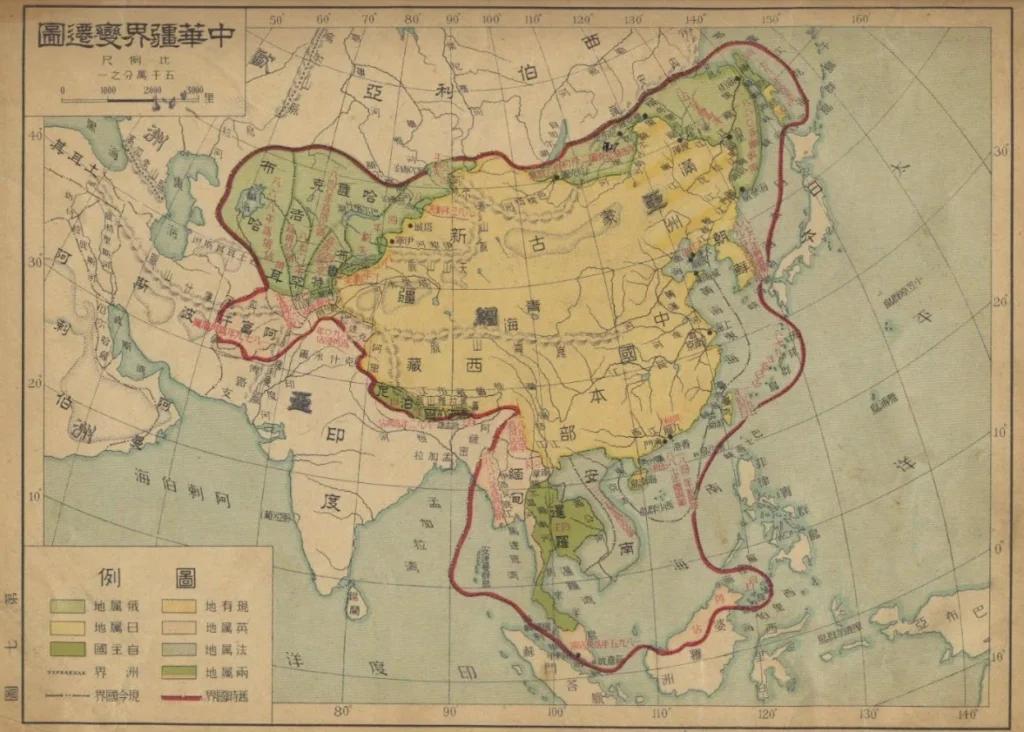
China still routinely oppresses minority populations, such as the majority-Muslim Uyghurs of the Xinjiang region, which its conquered and incorporated in 1949.
Likewise, Vladimir Putin considers the dissolution of the Soviet Union to be Russia’s greatest modern tragedy. He views himself as a sort of reincarnation of Peter the Great, and is ambitious to build a new Russian Empire. This Empire once extended deep into Europe, including Finland, the Baltic States and much of modern-day Eastern Europe. It also extended south and east from present-day Russia, and once included the US state of Alaska.

So, the argument that the BRICS partnership is all about anti-imperialism and anti-colonialism is, historically speaking, nonsense. The US never had an empire, and Europe abandoned the last of its colonies half a century or more ago, but both Russia and China are aggressively seeking to expand their territories (they’re “irredentist”, as the wonks would say) today.
Principles and values
What about other values? Unlike the United Nations, or the G7, BRICS is not founded upon any values at all. This is why South Africa finds itself on the wrong side of the fence with respect to the Ukraine conflict, with respect to Taiwan’s ambition to be free of China’s domination, and with respect to Iran.
South Africa’s Department of International Relations and Cooperation (DIRCO) has had a lot to say about Palestine – and even permits Hamas to maintain an office in Cape Town. It has had a lot to say about the recent US operation in Venezuela. It has been absolutely silent on the dramatic scenes of popular anti-authoritarian uprising in Iran.
It isn’t non-aligned at all. It is always opposed to the US in particular and the West in general, and always defends assorted autocracies, military despots and communist dictators.
If South Africa truly wishes to be non-aligned, and to trade with all potential trading partners on an equal footing, it should dissociate itself from China, Russia, Iran and the other unfree nations of the world. It should declare that it stands always in defence of its founding values and principles, namely freedom, social justice and fundamental human rights in a democratic and open society in which government is based on the will of the people and every citizen is equally protected by law.
Those words come straight out of South Africa’s constitution, but one would think DIRCO has never read it, if the country’s foreign policy is anything to go by.
Non-aligned, values-based foreign policy
South Africa routinely sacrifices these values and principles on the altar of political expediency, and of ancient loyalties to repressive regimes.
If those loyalties proved to be profitable, an unprincipled state might overlook those moral failings, but they’re not even where the country’s economic bread is buttered.
As Dr. Christopher Sabatini, Senior Research Fellow at Chatham House once said: “…one should ask what sort of world order are some of these democracies that participate in the BRICS seeking to create that they’re willing to align themselves with blatant autocracies, and autocracies that even in the case of Russia invaded a democratic country, or China, which is rattling its sabre to invade Taiwan. Are these the sorts of partners you want to hook your global ambitions to?”
He continued: “I’m not sure that Brazilian citizens, Indian citizens, or even South African citizens are always asking that question. The need for global rebalancing is indeed absolutely true. But the question is, is that better done by reforming the existing system or even recreating some element of the former system, but more in favour of development? Or do you do it by making alliances with, in some cases, effectively a rogue’s gallery of countries?”
Now that global alliances are rapidly being reconsidered, thanks to the US going rogue, it is high time for South Africa to ask this question.
If it adopts a truly non-aligned, values-based foreign policy, it could recover much of its moral standing in the world, and play a role in the reform of international institutions that is so clearly necessary.
That would also be its best bet to keep potential trading partners eager to do business with South African importers and exporters.
If South Africa continues to tie its painter to the stern of BRICS+, with what moral authority can it speak on any international matter? And what benefit does it get from surrendering that moral authority?
The answers are none, and not much at all. Remaining a member of BRICS+ is, frankly, stupid, and not at all in the best interests of the people of South Africa.
[Image: BRICS.webp]
The views of the writer are not necessarily the views of the Daily Friend or the IRR.
If you like what you have just read, support the Daily Friend