

Adam Cruise does not like trophy hunting. Neither do I. But unlike him, I don’t conceal important statistics to try to denounce it.
Another day, another plaintive, emotional tirade against trophy hunting in Daily Maverick.
In it, the author, Adam Cruise – who claims to be “a doctor of philosophy, specialising in animal and environmental ethics” – provides a slew of “hunting statistics”, and says: “What these numbers document is not conservation under pressure, but extraction at scale. They expose trophy hunting not as a people-centred conservation model, but as a market-driven industry serving a narrow, global elite.”
Money bad, see? Killing animals bad. Therefore, stop killing for money.
That’s about as sophisticated as the argument gets.
I’d have ignored this article, if it wasn’t for the fact that the editors at Daily Maverick (allegedly) refused to publish a letter from one of their readers, comprehensively rebutting the article.
Clearly, they’re not interested in hearing both sides of the story, which might explain why an obviously flawed and one-sided “op-ed” made it past the editors in the first place.
Context-free big numbers
Cruise’s article is long and reaches some very elaborate conclusions, but all of it is premised on a simple set of data: numbers of various species that were hunted in 2024 according to official registers submitted to the government, along with prices for various trophy hunts, and the number of foreign trophy hunters.
That’s it. Cruise has numerators, but no denominators. He discloses the number of animals hunted, but not the number of animals of that species in the wild or on hunting ranches. He offers no data about population trends of various species.
Are their populations big? Are they small? Are they increasing? Are they decreasing? If so, why?
You’d think that an academic would know that numbers mean nothing without context. His entire argument hinges upon context-free – and therefore meaningless – numbers.
That thousands of hunts take place is presumed to be bad simply because big numbers sound scary. But thousands of hunts do not reflect “extraction at scale” if they occur among populations of millions, as they do.
These hunts are not a crisis if the private wildlife ranching industry revived many of South Africa’s iconic species, increasing their population from almost zero outside of national parks in the 1960s to 20 million head of game today, three times the number of animals officially protected in national parks.
Cruise is misleading his readers by omitting the denominator – the context – for the numerator that he claims is problematic.
Sustainable use
Cruise takes as given that any number of animals hunted is, ipso facto, “extraction at scale”.
He gives the game away early on, when he says: “This is not subsistence use, cultural practice or emergency population control. It is a market-driven killing economy.”
Of course it’s not subsistence use. Nobody ever said anything about subsistence use. The term, in international conservation treaties, the South African Constitution, and domestic environmental law, is sustainable use.
That means using natural resources, including wildlife, in such a way that the economic activity is sustainable into the future. Any activity that would threaten population numbers would not be sustainable. Any activity that does not threaten population numbers, or serves to increase them, is sustainable.
So not only is the data on which Cruise premises his argument insufficient, but the underlying principle on which he bases his view is inconsistent with South African law and conservation strategy.
By the end of his article, his position becomes clear: “Once the numbers are seen clearly – lion by lion, elephant by elephant, baboon by baboon – they become difficult to explain away. And impossible to unsee.”
This is the animal rights extremist’s view: that any animal hunted is one animal too many. The animal rights lobby rejects sustainable use, as does Cruise.
Revenue is good
Cruise cites the high prices for hunting certain iconic species, like buffalo or lion, saying that “this represents a multibillion-rand killing economy”.
It’s as if any large monetary amount automatically taints an activity. He doesn’t stop to realise that if lions didn’t cost R250,000 to hunt, but instead cost, say, R2,500, then a lot more lions would likely get shot. Prices for keystone species should be high, and the rarer they are, the more expensive they should be.
“South Africa’s trophy-hunting industry is overwhelmingly a foreign, elite market, dominated by clients from the US and Europe,” he says, with evident distaste.
He offers no evidence to that effect, other than to say that there were 7,756 foreign hunting clients in 2024. Again, there’s no denominator. How many hunting clients were there in total?
Perhaps foreign hunters do make up a majority of the revenue of trophy hunting farms, although I’d be surprised if they outnumber domestic hunters who shoot for the pot, for biltong, or for small businesses selling venison meat and other products.
But that is equally plausible for the tourism industry. Foreign tourists bring in far more revenue than domestic tourists. Upmarket tourism venues are really only affordable to people who bring dollars and euros.
Likewise, foreign trophy hunters pay more per visit than a typical domestic hunter will spend in an entire season.
Should we shut down our tourism destinations and luxury lodges because they aren’t targeted at poor South Africans, but cater largely to rich foreigners? Of course not.
Catering to the poor
Cruise implies that because trophy hunting doesn’t cater for poor South Africans that it therefore does not benefit poor South Africans. But that is a fallacy. South Africa’s government documents the wildlife economy in considerable detail, and it shows that hunting-focused game ranches – which typically exist where eco-tourism is not viable – employ more people, at higher pay, than livestock farms.
And that’s not counting the fact that much of the money spent on trophy hunting gets ploughed back into the surrounding economy, to buy provisions, clothing, maintenance services, and equipment to sustain the hunting ranch.
Revenue from foreign trophy hunters is a good thing for wildlife ranches. The entire reason why South Africa has thriving wildlife numbers on private game farms is because wildlife and land under game are protected by private property rights, which gives individual landowners profitable assets to protect, trade and develop.
Wildlife survives where it has economic value. If it pays, it stays. Reduce that value, and a great deal of land now under natural vegetation and game will end up under livestock or crops.
The letter
I’ve written at length about the role of hunting in conservation in southern Africa. SeeGive hunting a chancefrom 2012, or Hunting bans would condemn a lot of game from 2018, or European eco-colonialists subvert African conservation from 2023.
But I’ll let one R. Westraat, who knows someone who knows a conservation-minded friend of mine, and who wrote a letter to Daily Maverick that they allegedly refused to publish, take the word:
The assertion that regulated hunting in South Africa is merely an “industrial slaughter” serving a narrow elite ignores both conservation science and on-the-ground results. The IUCN and its Sustainable Use and Livelihoods Specialist Group explicitly recognise that legal, well-regulated hunting can be an important conservation tool because it creates economic incentives for landowners and communities to conserve wildlife and habitat.
South Africa is a prime example. In the 1960s, the country had roughly 575,000 head of game; today there are an estimated 18 million to 24 million wild animals, largely due to a policy framework that made wildlife on private land economically valuable through sustainable use, including hunting. Private wildlife ranches now conserve 17 million to 21 million hectares (three times the area of state parks) and research shows they host higher species richness and more threatened species per hectare than government reserves.
This model has brought several species back from the brink. White rhinos recovered from 20 to 50 animals around 1900 to roughly 20,000 today, with more than half of Africa’s rhinos now on private and communal land where hunting and live sales help finance security and habitat management.
Black wildebeest rose from about 300 animals in the 1930s to over 18,000, about 80% on private land, while bontebok climbed from a remnant of 17 animals to about 10,000, with around 87% on private land – recoveries explicitly linked to the financial incentives created by game ranching and hunting. Cape mountain zebra numbers similarly increased from fewer than 80 or 90 in the 1950s to well over 3,000 today under a mixed state–private model.
Economically, hunting is far from a niche luxury. Peer-reviewed work shows hunting tourism generates roughly $2.5 billion (about R45 billion) a year for South Africa, supporting about 95,000 jobs across hunting, hospitality, meat production and related sectors. Wildlife ranching as a whole provides 65,000 to 68,000 permanent jobs – more than 16 times SANParks’ permanent employment – and creates more jobs per hectare, at higher average wages, than conventional livestock farming in the same regions.
At community level, southern Africa’s best-documented conservation successes are built on sustainable use, not donor funding alone. Namibia’s communal conservancies, which rely heavily on conservation hunting, now benefit over 300,000 rural people and generated N$155.7 million in 2019, with hunting contributing a quarter of that income and funding hundreds of community game guards and years of zero rhino poaching on conservancy land.
Zimbabwe’s CAMPFIRE program has channelled tens of millions of US dollars from hunting back to rural districts for schools, clinics, water, roads and household dividends, with over 90% of community wildlife income coming from hunting.
Crucially, recent global research in Nature Sustainability found that species subject to regulated sport hunting are more likely to have stable or increasing populations and are less likely to be threatened than non-hunted species – because hunting systems often come with quotas, monitoring, and reinvestment in management and anti-poaching.
By contrast, Kenya’s 1977 hunting ban removed economic incentives for landholders to keep wildlife, and long-term monitoring shows average wildlife numbers there have fallen by about 68%, with severe declines (over 70%) in many iconic species.
The real question is not whether hunting is good or bad in the abstract, but whether specific systems are scientifically regulated, transparently governed and equitable in sharing benefits. South Africa’s experience – with a forty-fold increase in wildlife, species rescued from near extinction, millions of hectares conserved on private land and tens of thousands of rural livelihoods supported – shows that when these conditions are met, regulated hunting is not the enemy of conservation, but one of its most effective and locally grounded tools.
Last word
I don’t know Westraat, and cannot vouch for his or her expertise. I cannot even guarantee that this letter wasn’t produced by an AI.
What I can do is confirm that I would have made the same arguments (and have done so in the past). I can also confirm that all of the data points are consistent with numbers that I know from various credible sources, including the Department of Forestry, Fisheries and the Environment, reports by the Endangered Wildlife Trust and other environmental and conservation groups, and scientific papers.
I cannot imagine ever shooting an animal, and do not understand the desire to do so. However, that is an emotional response.
Clear-eyed consideration of the reality of wildlife ranching in South Africa, the revenue sources of game farms, the population trends in both iconic and lesser-known species, and the likely fate of game farms should they be denied a critical source of revenue, makes it clear to me that hunting – both for the pot and trophy hunting – plays a critical role in conservation in Southern Africa.
I am well aware of the animal welfare concerns raised about a minority of game ranches, and am all for regulation to raise standards and weed out bad actors.
However, without hunters, far less land would be protected in something resembling its natural state. Animal populations would be far lower, and communities would be deprived of an important source of spending into local economies as well as decent employment.
I don’t need to like hunting, or like foreign big game hunters, to recognise this reality. One-sided context-free numbers from a supposed academic aren’t going to change my mind.
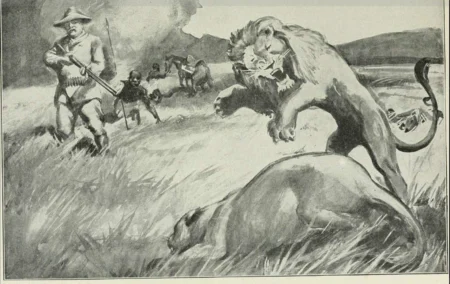
[Image: Teddy Roosevelt in Africa.webp]
The views of the writer are not necessarily the views of the Daily Friend or the IRR.
If you like what you have just read, support the Daily Friend