


The following is the text of my address yesterday to the Adopting Bitcoin Cape Town conference.
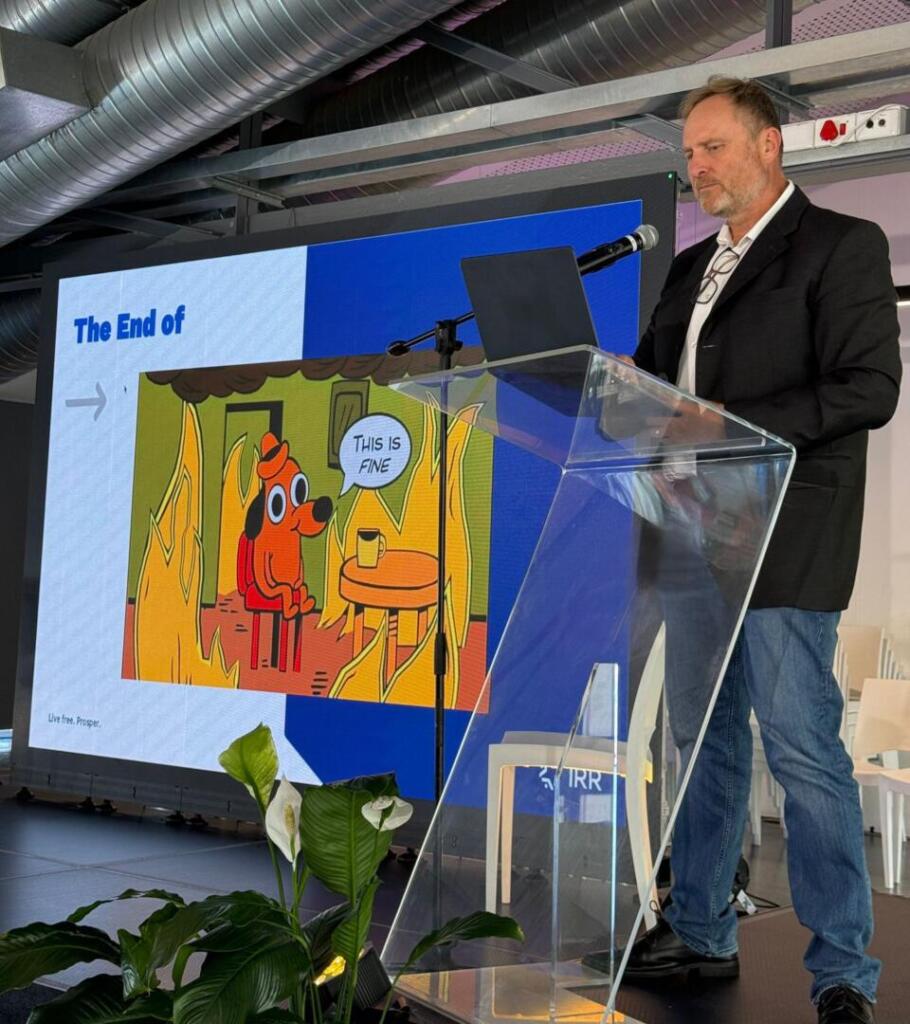
John Endres [Image: supplied]
We live in unsettling times. The US under Donald Trump is shaking up the global order. AI is inserting itself into the economy and our daily lives at breathtaking pace. Commodities are running hot, liquidity is pumping. What’s going on?
The world is currently being forced to shed some comfortable delusions and confront some hard truths. Among the most important is the delusion that talk is as good as action and that if you just wish for something hard enough you will get it – visualise something and you will manifest it. Or, in government language, legislate for it and it will happen. Or, more specifically: if you want something to happen, you can just create the money to make it happen.
It turns out that there is a lot that’s wrong with this worldview. There are many things you can wish for that you will never get. And many outcomes you as a government wish to regulate for but which you are not going to get. You can create money but you cannot do so without trade-offs, some of which governments are having to confront now.
We are at the end of an era which – certainly in the West – was marked by the idea that confrontation and head-to-head competition are bad for people, bad for countries, and bad for the world.
Coming out of the devastating first and second world wars it was understandable that the appetite for more conflict was limited. But it has led to a situation where it became received wisdom that eternal peace and development can be obtained through regulation, bureaucracy and global forums such as the United Nations and the G20.
The notion was that progress to be achieved through cooperation rather than confrontation. It was an attractive proposition.
Disrupted
But guess what? Cooperative equilibria can be disrupted. As Mike Tyson put it, everybody’s got a plan until you punch them in the face. The world is currently in the phase of getting repeatedly punched in the face – mugged by reality, and, it might be said, by Donald Trump. Whatever his motives, Trump’s aggression and brazenness have had the effect of rousing counterparts from their torpor, provoking a reaction, and – in the best case – surfacing hard facts about reality.
But it is not just Donald Trump doing it. Geopolitical events in recent years have forced many countries to challenge their own beliefs.
For example, if you’re a sovereign state that holds some of its reserves overseas, guess what? They can be immobilised and made unusable, as Russia experienced after it invaded Ukraine in 2022. If you think that the US Treasuries you hold are as good as gold, guess what? The US government’s fiscal and monetary choices can reduce the real value of Treasury claims through inflation. And they can swing their market value through interest rates. If you think, as the US did, that the mighty greenback will let you buy anything you need, anytime you need it, guess what? If a geopolitical rival like China is dominant in critical areas like rare earths processing and magnets, it can throttle your access to those resources if you don’t play nicely, for example through export controls and licensing.
Nations are now adjusting to these realisations. China is bulking up its gold reserves to reduce its exposure to the dollar, the value of which China is beginning to question. Russia will think twice about letting another country hold its reserves, and so will many other countries. In Germany, there are calls to repatriate over 1,200 tonnes of gold currently held on Germany’s behalf in the Federal Reserve Bank of New York. Self-custody, in other words. The US is scrambling to reduce its vulnerabilities in rare earths and other critical minerals. Europe is rearming and beginning to debate uncomfortable questions about regulation, competitiveness and immigration.
Less trust means higher transaction costs. The formation of trade blocs and trade barriers means lower benefits from specialisation, the division of labour and comparative advantage. We are entering a world that will be economically less efficient and costlier. And what do we get in exchange?
Greater self-reliance
On the upside, perhaps greater self-reliance and less exposure to the risks of dependency. We might also see a greater variety of governance approaches as countries feel pressed to deviate from the consensus to improve their own position. El Salvador springs to mind as an example. One very big downside is the risk of more repression and less freedom – and more wars as countries seek to assert their dominance over rivals.
Throw AI into the mix and it gets even wilder. It seems likely that AI will be a decisive factor in the competition between countries. All things being equal, countries that make it work for themselves will have faster-growing economies and more powerful militaries than those that don’t.
Those that control their own AI systems – including the physical infrastructure on which those systems run – will have more autonomy than those that don’t. Countries that don’t control their own AI resources will become dependent, forever at risk of having their access cut off.
That is why the US and China are scrambling to control the entire AI value chain – from raw materials to chip manufacturing, from data centre construction to creating the power supply to run the data centres.
The sense of panicky urgency emanating from the White House is not without cause. It also means that we should expect strategic considerations to be one of the drivers of low interest rates and expansion of the money supply in the US.
Shaken up
What does this mean for us as individuals? We must expect enormous disruptions of our expectations and daily lives in the decade ahead. Nation states form the substrate on which we build our lives. But that substrate is being shaken up. Many of our expectations of how we play a role in the economy and in society are going to be overturned.
It appears increasingly likely that AI will be able to perform many of the knowledge tasks we currently do. It may be that humanoid robots, imbued with AI, will be able to do the same for physical tasks. What role then remains for us as humans? What role will money play? If we are entering an age of material abundance, how will that abundance be distributed? How will it be measured – with money, as it is now?
The end of this… is fine?
The crystal ball is cloudy and it is hard to know how to prepare for this uncertain future. It holds enormous opportunities and enormous risks, with no telling whether the outcomes will be positive or negative on balance.
As much as possible, put yourself in a position where you can take care of yourself and your family even in an environment that is certain to confront you with new challenges. Here are four practical things you can do.
Start by ensuring that you are well informed. Keep up with developments, especially in AI, geopolitics and global finance.
Hedge that risk
Secondly, diversify. Keep learning, improving your skills and broadening your knowledge. If you have a narrow skill set this represents a point risk for replacement by AI. You can hedge that risk by having multiple skills. In doing so, lean into AI – learn to use it and leverage its power, but avoid becoming dependent on it.
Thirdly, keep it real. Recognise the value of authenticity in a world that is already starting to be deluged in AI-generated content. Realise that authentic human-to-human connections could be one of the most valuable assets that AI cannot replace.
Fourthly, be mindful of the risks of being highly leveraged. If AI has a deflationary effect on asset values, as some expect, this can expose you to loss of your collateral. If your income drops because you lose your job to AI you could also find it hard to keep up with your debt repayments.
This brings me to Bitcoin. It may be that we’re entering an era of disruption that places in question the very notion of money. But if money survives, then there’s a good chance that Bitcoin will occupy a central role in the system. It is well set up to retain its value – and appreciate.
This is because the energy that must be spent to create and maintain Bitcoin creates a direct link to hard, physical reality. At present, there is no way of faking that. It creates an anchor of truth in a world of uncertainty. This feature, plus its programmed scarcity, mean that it can serve as a reliable, mutually intelligible representation of value. And that, ultimately, is what money is.
This view is beginning to be more widely adopted, as shown by the more widespread institutional adoption of Bitcoin by mainstream financial and investment companies, especially in the US.
“Newest, coolest software”
A potential next chairman of the US Federal reserve, Kevin Warsh, recently expressed his support for Bitcoin in an interview. He said: “It could provide market discipline. Or it could tell the world that things need to be fixed. … Bitcoin does not make me nervous. It’s just the newest, coolest software that will provide us with the ability to do things that we could never have done before.”
This brings me to South Africa. In my view South Africa is an interesting market globally. It is performing well below its potential – but unlocking that potential is far easier in South Africa than it would be in many other countries in the world.
Let’s look at our starting position. South Africa is blessed with innumerable advantages. It has a long coastline, a benign climate, a large mineral endowment, plentiful energy resources from petrochemicals to solar, is geologically stable and free of volcanoes and earthquakes, hurricanes and tornadoes.
It is blessed with extraordinary natural beauty, as you can see when you look out the window. It has a well-developed infrastructure, a highly advanced agriculture sector, strong linkages to global markets, uses English as its main language, and a highly innovative and stress-tested private sector.
But more importantly, it also has a very strongly rooted social preference for freedom, born out of experiences like the liberation struggle against apartheid and before that the fight of the Boers against the British. I am struck by a section in Deneys Reitz’s book “Commando”, where he describes the efforts of the Boers to organise an army – and how impossible it was to do because the men were so individualistic and resistant to doing what they were told. That spirit remains strong in South Africa – a healthy distrust of authority is a feature of life in South Africa.
Our mission
The word “liberty” derives from the Latin word “liber”, which means “free”. That is also the common root of words like liberalism and libertarianism. My organisation, the Institute of Race Relations, is a classically liberal policy think tank. Our mission is to promote individual freedom, market freedom and non-racialism.
This is also where the key for unlocking South Africa’s prosperity lies. It lies in removing many of the restrictions that currently inhibit economic freedom – like government threats to property rights and the freedom to make hiring and procurement decisions on a commercial basis. That is a large part of the work that we do at the IRR.
Ultimately the most powerful force that shapes our world is ideas. Our mission is to make good ideas stronger in the world.
One of the best ideas is that of sound money and of controlling your own property – which Bitcoin allows you to do.
Many South Africans support us in this mission. We invite you to join them.
Thank you.
[Image: Supplied]
If you like what you have just read, support the Daily Friend