

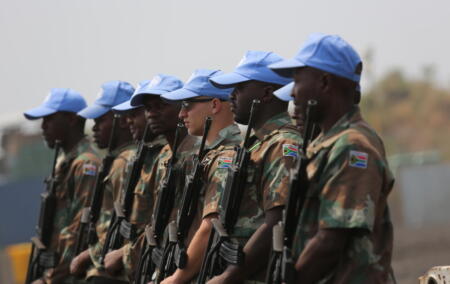
After nearly three decades, South Africa is preparing to withdraw its troops from eastern Democratic Republic of the Congo (DRC). By the end of 2026, the South African National Defence Force will no longer contribute forces to the United Nations peacekeeping mission there.
The decision has been framed as a rational realignment of scarce military resources. That explanation is accurate, but incomplete. The deeper reality is that South Africa is disengaging from a mission whose strategic purpose steadily eroded, even as its risks, costs and human toll grew.
South Africa’s involvement in Congo began in 1999, under a UN mandate intended to stabilise a country emerging from regional war. Over time, that mandate expanded and hardened. Observation gave way to enforcement. Neutrality blurred under pressure. South African troops were no longer merely present; they were fighting. Yet throughout this evolution, one element remained conspicuously absent: a clearly defined end state.
The UN mission itself began in 1999 as the United Nations Mission in the Democratic Republic of the Congo (MONUC), created in the aftermath of the Second Congo War. Its mandate was narrow and conservative: to observe ceasefires, monitor disengagement between foreign armies, and support peace agreements negotiated among regional powers. MONUC was conceived as a classic peacekeeping operation, premised on consent, neutrality and the assumption that the principal belligerents had already decided to stop fighting. That assumption proved fragile. Although the war formally ended, violence persisted, particularly in the east. MONUC found itself deployed into a fragmented conflict characterised by militias, weak state authority and continued regional interference, conditions for which it was neither designed nor equipped.
In 2010 the mission was reconfigured and renamed the United Nations Organization Stabilization Mission in the Democratic Republic of the Congo (MONUSCO) to reflect a more ambitious and permanent role. The change was substantive rather than cosmetic. MONUSCO was given an expanded mandate centred on civilian protection, support to Congolese state institutions and, eventually, the authority to use force against armed groups. The transition acknowledged that the DRC was no longer in a post-war phase, but trapped in chronic instability. It also marked a strategic gamble. MONUSCO inherited MONUC’s structural limitations while being asked to do more with them. The mission evolved from monitoring peace to managing conflict, increasingly reliant on military force to compensate for the absence of political settlement, and vulnerable to being judged against expectations it was never designed to meet.
MONUSCO endured not because it was succeeding, but because withdrawing appeared harder than staying.
MONUSCO’s original flaw
MONUSCO was never designed to end the DRC’s conflict. It was designed to manage it.
Its core tasks, civilian protection, support to state institutions and the creation of political space, assumed that time and presence would allow Congolese and regional actors to resolve the underlying causes of violence. In eastern DRC, those causes proved stubbornly immune to delay. Armed groups were sustained by weak governance, contested land, mineral economies and regional interference. A peacekeeping mission could blunt violence episodically, but it could not dismantle the system that produced it.
As conditions worsened, MONUSCO’s mandate expanded. Its political leverage did not. Military force increasingly became a substitute for political progress.
Kibati and the illusion of decisive force
The high point of MONUSCO’s coercive turn came in 2013–14, during operations against the M23 rebel movement.
As part of the Force Intervention Brigade, South African troops were authorised to conduct offensive operations against designated armed groups. At Kibati, north of Goma, they fought M23 in conventional engagements involving artillery, coordinated infantry assaults and sustained pressure on fortified positions. The operation succeeded militarily. M23 was expelled from the outskirts of Goma and its leadership fled.
At the time, Kibati was presented as proof that robust peacekeeping worked. It demonstrated that force, properly applied, could deliver results where passive monitoring had failed.
That conclusion was only partially true. Kibati was a tactical victory, not a strategic one. M23 was defeated on the battlefield, but not politically neutralised. No durable settlement followed. The Congolese state did not consolidate authority in retaken areas. Regional dynamics remained unresolved. The victory created the appearance of momentum without altering the conditions that had produced the rebellion.
MONUSCO had reached the outer limit of what force could achieve within its mandate. The illusion was that this limit did not exist.
After Kibati, the mission settled into a prolonged holding pattern. Armed groups fragmented and re-emerged. Violence ebbed and surged. MONUSCO remained deployed, absorbing criticism from local communities and risk to its troops, while being judged against expectations it was never designed to meet.
For South Africa, this meant sustained exposure without strategic movement. SANDF troops continued to operate in hostile terrain under restrictive rules of engagement, within a mission architecture that diffused responsibility and blurred accountability. Casualties accumulated gradually over years, largely unnoticed at home.
Peacekeeping deaths tend to disappear into statistics. They become visible only when something breaks.
SAMIDRC enters, and the fault lines widen
By 2024, frustration with MONUSCO’s limitations had hardened into action. The Southern African Development Community deployed SAMIDRC, a regional force explicitly aligned with the DRC government and intended to counter M23 through direct military pressure.
SAMIDRC was not peacekeeping. It was intervention. Its purpose was to do what MONUSCO could not: confront armed groups without the constraints of UN neutrality.
The problem was not the intent, but the overlap. MONUSCO and SAMIDRC operated side by side with different mandates, command structures and political logics. Coordination was uneven. Responsibility blurred. MONUSCO, already stretched, was effectively asked to manage the environment while a parallel force attempted to reshape it.
When M23 launched its renewed offensive in early 2025, this ambiguity proved fatal. SAMIDRC forces failed to hold around Goma. The city fell. The rebel group expelled a decade earlier under MONUSCO’s most forceful phase returned stronger and more confident.
Fourteen South African soldiers were killed in the fighting. Their deaths were not the result of an isolated incident, but of a broader collapse in deterrence. A mission that had once claimed credit for neutralising M23 could neither prevent its return nor protect its own troops when it did.
Left behind in the aftermath
What followed compounded the damage. SAMIDRC was terminated soon after the defeat, its withdrawal abrupt and politically unavoidable. MONUSCO remained.
Peacekeepers were left to manage the consequences of an intervention they did not design, control or command. They faced emboldened armed groups, anger from local populations and a collapsing security environment, all while being blamed for failures that stemmed from a wider regional breakdown.
For South African troops, distinctions between mandates mattered little on the ground. Whether under UN command or operating alongside a regional force, they faced the same risks. Yet accountability remained diffuse. Bodies were repatriated late. Families waited months for answers. No public inquiry was convened to examine how decisions were taken, what intelligence informed them, or why soldiers were exposed repeatedly to escalating danger without a credible endgame.
More than a year later, those questions remain unanswered.
Staying without an end state
By the mid-2020s, South Africa’s participation in MONUSCO had become strategically hollow. The mission neither delivered stability nor offered a path to disengagement. Its objectives expanded elastically; its duration became indefinite.
Official justifications for staying shifted with circumstances: regional responsibility, multilateral credibility, civilian protection. What never emerged was a clear articulation of what success would look like or how it would be achieved.
Without an end state, persistence became policy. Troops stayed because they were already there. Losses were absorbed because withdrawal seemed politically awkward. The SANDF remained committed even as its capacity at home eroded under chronic underfunding.
The arc from Kibati to Goma tells the story. Force can suppress armed groups temporarily. It cannot substitute for political settlement. MONUSCO was asked to do more than it was built for, and kept in place when it inevitably failed.
South Africa’s decision to withdraw from MONUSCO is therefore not abrupt. It is overdue.
The official explanation emphasises resource constraints. That is real. But it also acknowledges, implicitly, that MONUSCO has reached the point of diminishing returns. The mission has lost local legitimacy, deterrent credibility and strategic coherence.
Staying longer would not reverse these trends. It would merely extend a cycle in which tactical action substitutes for political progress, and soldiers pay the price for that substitution.
Withdrawal carries risks. Security vacuums are real. Armed groups exploit transitions. But permanence is not a strategy, and fear of deterioration cannot justify endless deployment in a mission that has already failed to deliver its core promise.
A necessary ending
South Africa’s withdrawal from MONUSCO closes a chapter defined by endurance, professionalism and strategic drift. South African soldiers performed their duties under increasingly dangerous and ambiguous conditions. Dozens of SANDF members are estimated to have died during South Africa’s long participation in MONUSCO, a toll accumulated quietly over years of patrols, clashes and deteriorating security. The first casualty occurred on 15 July 2003, with the death of Corporal NM Matshavha. A further 24 South African soldiers were killed during the short-lived deployment under SAMIDRC, largely concentrated around the fighting for Goma. Approximately 53 SANDF members died in the DRC.
The failure lies not with the soldiers, but with a mission stretched beyond its design, crowded by parallel interventions, and left to absorb the consequences when those interventions collapsed.
Leaving now will not bring peace to eastern DRC. Staying longer would not have done so either. What matters is whether South Africa learns from the full trajectory of its involvement: from the apparent success at Kibati, through years of managed instability, to the defeat around Goma and the chaos that followed SAMIDRC’s exit.
Wars without end goals do not end. They fragment, overlap and return. South Africa has chosen to step away from that cycle. The reckoning will be whether it also steps away from the illusion that force alone can resolve what politics has long failed to settle.
[Image: https://commons.wikimedia.org/wiki/File:South_African_troops_MONUSCO.jpg]
If you like what you have just read, support the Daily Friend