

Some of the arguments of the modern right echo those of the far left of not so long ago.
I can understand right-wingers.
I can understand nativists who think they’re special because of where they were born, and who think foreigners are dangerous interlopers. I think their thinking is medieval and demonstrably wrong, but I get it.
I can understand theonomists who think they’re special because of what they believe, and who think non-believers are dangerous to the morals of the state. I think their thinking is delusional and demonstrably wrong, but I get it.
I can understand socialists who think they’re special because they’re workers, and who think their employers and investors only exist to keep them poor. I think their thinking is very mid-century and demonstrably wrong, but I get it.
I can understand progressives who think they’re special because they’re victims of discrimination, and who think they should have special rights denied to other people. I think their thinking is needlessly divisive and demonstrably wrong, but I get it.
I can understand conservatives who think the world was once a better place than it is now, and that progressives are destroying the moral fabric of society. I think their thinking is hide-bound and demonstrably wrong, but I get it.
I can even understand racists, who, much like nativists, fear and loathe people who are not like them. I think their thinking is reprehensible and demonstrably wrong, but I get it.
What I don’t get is how people who once claimed to be libertarian now say they hate globalists and support the robust exercise of coercive state power in defence of “their side”.
Enemy of my enemy
These people seem to have a very simplistic view of the world: anyone who is an enemy of socialists or progressives, they think, is their friend.
They see the rise of right-wing populism, and think yeah, that’s a bandwagon I want to join, because **** the left.
After all, if right-wing populists are winning elections, and laying waste to the left, then that must be worth supporting, right?
So far, it’s quite comprehensible.
The belief that the enemy of my enemy must be my friend is seductive, albeit often wrong. The communists and the Nazis opposed each other; that didn’t mean either side had the moral high ground.
What is much less comprehensible is the vocal support these people are willing to give to policies and ideas that are in direct conflict with the libertarian world view.
Libertarian thought is diverse, ranging from anarchism to limited-government classical liberalism, but it is largely based on the view that individual liberty is the highest political value, since self-ownership and ownership of the fruit of one’s labour is axiomatic. Free trade, property rights, equality before the law, and small government all follow from individual liberty.
Libertarians assume tax is theft and coercion is illegitimate, so both should be limited as far as is practically possible while still protecting life, liberty and private property. In practice, that means opposing policy changes that needlessly increase regulation, interfere with the economy, or increase the size or scope of government. It means favouring policy changes that restrict government power, reduce interventionism in industry, business and trade, and limit abuse of power.
What logic?
By what logic, then, can formerly self-proclaimed libertarians look at massive interventions in international trade and domestic industrial policy, and even taking stakes in private companies, and think, yeah, that’s what I had in mind?
By what logic can they see masked, unidentifiable and often un-uniformed paramilitary forces deployed against civilians, and think yeah, state violence is what I always wanted?
By what logic can they look at a government that uses lawsuits as leverage at home, and tariffs as leverage abroad, and think yeah, that’s what a “small government with strictly limited powers” look like?
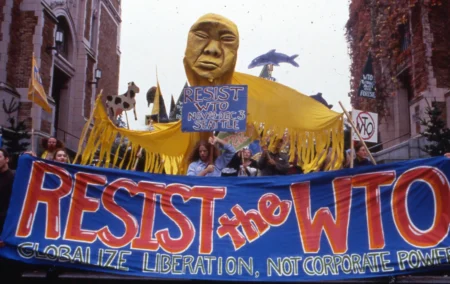
When they rail against “globalists” and supra-national organisations, including the World Trade Organisation, do they realise they sound just like the socialist anti-globalisation protesters against globalisation that protested the WTO during the Battle in Seattle in 1999? Or the unwashed hippies of Occupy Wall Street 15 years ago?
When they praise the state’s promotion of “God and country” (or “blood and soil”) patriotism, do they realise that they sound just like old-school conservatives, imposing moral constraints upon the very individuals that libertarians axiomatically consider free?
When they join the chorus of anti-immigration sentiment, do they realise they sound just like the Economic Freedom Fighters, the MK Party, the Patriotic Alliance, and the avowedly socialist ANC – all of whom have pledged to shutter foreign-owned shops or deny healthcare to immigrants?
Do they realise how anti-libertarian all of this is?
Highest ideals
If you claim to be libertarian, then surely you believe that a government cannot deny people the right to own legitimately-acquired or self-produced property, simply on the basis of characteristics such as race, gender, home language, religion or place of birth, unless they have committed a crime against the life, person or property of someone else.
If you claim to be libertarian, then surely you can’t abide a police state in which masked goons can barge into private homes, without a judicial warrant, and assault the occupants merely on the suspicion that they’re not legal immigrants?
If you’re a libertarian, then surely you must agree that it is illegitimate for a government to interfere in voluntary trade by taxing it, or worse, taxing some transactions more than others.
If you’re a libertarian, global free trade should be among your highest ideals, and yet here these former libertarians are, cheering tariffs and denouncing the WTO.
All the world’s ills
There’s a lot to be critical about in the current world order. The ineffective and often counter-productive United Nations routinely fails at keeping world peace, and often props up the most vicious autocracies. Nothing can excuse a UN where Iran can chair a women’s rights body, or Venezuela can chair a human rights council.
I have written extensively about the problems with the World Health Organisation, the Intergovernmental Panel on Climate Change, and the Framework Convention on Tobacco Control. I’m certainly not defending the status quo.
Capitalism suffers from an unhealthy proximity between big business and political power, which inevitably generates corruption and a lack of economic freedom for those who do not have access to unscrupulous political power.
Socialism is riding high, being popular both among old-school liberation movement types (like in South Africa) and among disaffected youth who think being less wealthy than a 60-yeear-old at 30 is a great injustice.
Euphemism
But it’s one thing to demand principled reform, and quite another to toss the very ideas of small government, free markets, peaceful coexistence, free international trade and rules-based multilateralism to the wind, in favour of isolationism, strong-man populism and authoritarian nationalism.
I can see the appeal of such populism, but libertarian, it ain’t.
It saddens me to learn just how many people – and friends – that I once thought were principled libertarians, committed to individual freedom, free markets and limited government, ended up as full-throated supporters of neo-mercantilism, police brutality, open corruption at the highest levels, global re-armament, great power rivalry, and incivility in public discourse.
Turns out they never had any principles to begin with, and just used “libertarian” as a euphemism for national, racial, cultural or religious chauvinism and the freedom to bash whoever they didn’t like.
[Image: WTO Protests.webp]
The views of the writer are not necessarily the views of the Daily Friend or the IRR.
If you like what you have just read, support the Daily Friend