

Online privacy is important. So is fun. Lawyers and legislators will destroy both, and the companies they target secretly won’t mind.
With numerous legislative and court processes going on around the world that essentially sacrifice online privacy in the push for mandatory age verification, one would think the companies against which these campaigns are being waged – Google, Meta, and so on – would push back on principle.
They don’t.
What internet platform companies and the marketing budgets that fund them care about is how much they know about their customers or potential customers. Any additional data point is greedily gobbled up by the automated, AI-driven targeted marketing engines.
Exploiting moral panics to enforce online identity and age verification plays into the hands of our corporate overlords just as much as it plays into the hands of surveillance state bureaucrats, and criminals who are after stolen identities.
Zuckerberg’s testimony
Mark Zuckerberg recently testified as a defendant in a lawsuit brought by a 20-year-old plaintiff who claims to have been harmed as a child by her “addiction” to Instagram, YouTube, Snapchat and TikTok.
The latter two have settled, for undisclosed but undoubtedly large amounts, in what is described as the first of many such lawsuits.
She was no doubt egged on by her highly experienced tort lawyer, working on a generous contingency fee basis.
That lawyer, Mark Tanier, is described as an “attorney, author, teacher, pastor and expert story teller”. He founded the Texas-based Christian Trial Lawyers Association, which “[hopes] to prove conventional wisdom wrong in its typical view of trial lawyers as greedy, selfish and prideful”.
He has many cases under his belt, several of which produced settlements or awards involving hundreds of millions, or even billions, of dollars. That he makes a habit of going after huge companies with deep pockets might not make him greedy, but it certainly made him rich enough to want to know what “eye of the needle” might actually mean.
Zuckerberg argues that his firm shouldn’t be held liable, but he didn’t push back against the need for age verification. Instead, he just didn’t want to do it himself, and suggested that Apple and Google should do it at an operating system level. (Apparently, social media addiction requires a mobile phone: he doesn’t name Microsoft and Linux.)
He also said that his company did not direct its employees to increase user engagement, and did not “target” specific user groups like teens.
Don’t lie!
What a moron! Of course they’re trying to increase user engagement!
Don’t lie about it! Just say, “Yes, that’s what companies do. They try to sell more stuff to more people. We try to make our product engaging, and try to make it so good that people will want to spend more time on our site, and come back again and again, so that we can show them more advertising, which is how we make money. Of course we do. It would be daft to expect us to do anything else.
“Your supermarket also tries to increase your engagement with it. Ever seen the specials at the gondola ends, or the endless impulse-purchase channel leading up to the cashier? Ever notice how those displays always include soft toys and sweets aimed at children? They’re manipulating you into doing something that is good for them, and are happy to target your children to get you to loosen your purse strings.
“And of course we’re targeting teens. For a start, we try hard not to show them adult content. More generally, our algorithms use everything we know about users to tailor content to what they might find interesting and with which they might engage. That includes their estimated age.
“There’s no point flogging divorce lawyers, car repair tips, menopause advice or medieval linguistics to a teen. And there’s no point flogging whatever teens watch these days to someone our age.”
That’s what he should have said.
Giving customers what they want
He should have said figuring out exactly what customers want and then giving it to them is not evil. On the contrary: given that capability, it would be bad form to do otherwise.
If you know how to make a brilliant TV series, it is not right to make a mediocre one, just in case people enjoy it too much and start binge-watching it to the detriment of their job or family obligations.
If you know how to make good coffee, it would be criminal to serve your customers day-old swill, just in case they end up liking it too much and get addicted to caffeine.
If you know how to make an exhilarating fun-fair ride, it makes no sense to sell tickets to a pretty mid roller coaster, just in case people have too much fun and get addicted to the adrenalin.
What these lawyers (and legislators) are demanding of tech companies is exactly the opposite of what their customers really want.
Serenity
If Zuck had user interests at heart, he’d fight back heavily against the claim that social media is “addictive”, in any legal or medical sense of the word. Causing effects like “body dysmorphia” cannot rationally be laid at the door of social media companies.
He should point out that glossy magazines have been causing “body dysmorphia” (also known as “jealousy”) forever, with their depictions of the bold and the beautiful, the young and the restless.
A mentally well-adjusted response to seeing beautiful people on TV or in magazines, or being able to remove zits and blemishes from selfies, isn’t to rail against magazines or to regulate photo filters.
It is to teach children to be confident in who they are and what they look like, and to teach them that what they see in movies, advertisements and online is not real; it is a fake idealisation, and normal people don’t look like that.
Basic parenting is not hard. I get the idea that the plaintiff in this case wasn’t parented very well, and never had boundaries set for them. But bad parenting is no excuse to blame corporations, or to regulate content.
Teach kids a version of The Serenity Prayer, by Reinhold Niebuhr: “Give me the serenity to accept the things I cannot change, the courage to change the things I can, and the wisdom to know the difference.”
Whether you believe in a god or not, that is a recipe for mental calmness and contentment.
When we were young, we had to be told we couldn’t watch TV all day. We had to be told to drop the comics and go play outside so we don’t get fat and lazy. We had to be told we couldn’t have snacks whenever we wanted. We had to be told that dinner was to be eaten at the table, except on Saturdays. We had to be told that playtime was restricted by prioritising homework.
If parents aren’t doing this, and children get “addicted” to smartphones, by what logic is that the fault of smartphones or the social media apps that run on them? That’s like blaming people who produce children’s cartoons for causing children to fail at school.
There are tools to control what children get to do on their smartphones, and there are ways to limit their use of the things. Use them.
Anything can be “addictive”
Zuck should point out that social media is no more “addictive” than comics, or daytime soap operas, or even books.
A teenager could be “addicted” to pulp romance novels, and develop crushing depression, unreasonable expectations about love, “body dysmorphia” and a romantic view of suicide.
That doesn’t mean romance novels are an evil that must be regulated by the state.
People can get “addicted” to games. That doesn’t mean game developers should make games less interesting or engaging, or refuse to sell them to children. That doesn’t mean that restricting gaming time isn’t up to personal discipline and parental boundaries.
People can be “addicted” to outdoor, adrenaline-pumping adventure. That doesn’t mean outdoor activities should be regulated.
People can be “addicted” to sex. “Addicted” to shopping. “Addicted” to work. “Addicted” to gym. “Addicted” to dieting. “Addicted” to The Walking Dead.
The term addiction, when used in any context other than substance abuse, is way over-used, and the blame for addiction is way too easy to place on the makers of whatever is being abused, instead of on the personal responsibility of the addict.
Zuck should point out that behavioural “addictions” are not the responsibility of people who try to convince people to do business with them.
If that were to become a principle, the entire practice of marketing and advertising would have to be banned, and products would have to be regulated so they’re not dangerously fun.
Physical vs psychological “addiction”
It is simply wrong to equate behavioural obsessions with substance abuse, which is a physical addiction and a medical problem (and even then, the risk of addiction shouldn’t preclude people from using substances, rather than abusing them).
Doing things that are pleasant too much, to the detriment of domestic obligations, financial responsibility, schoolwork or a job, isn’t an “addiction”.
The idea of being “addicted” to dopamine is nonsense. We all like and seek out pleasurable things. We all have responsibilities that limit our freedom to do so.
Being irresponsible in the pursuit of pleasure isn’t an addiction that one should blame on whoever provides the pleasurable pursuit. It is an abdication of personal responsibility. In adults, that is their own responsibility. In children, it is the responsibility of parents to set boundaries and teach them responsibility.
Moral busybodies
Nanny-state authoritarians and moral busybodies have always whined that things that are overtly pleasurable are actually tools of the devil, or that they are ruining an entire generation of teenagers.
They might even be right! God knows the current generation of global leaders are psychologically deranged. Perhaps it was comic books, or the Mods and Rockers, or the devil’s music, or weed, or free love, that did it.
But that doesn’t qualify these deranged authoritarians to decide what modern pastimes are evil, and how they should be suppressed or regulated because…

Big Tech is in on it
Corporate marketing types would love for everyone to be personally identifiable online, which is what age verification essentially means.
They know that age verification won’t stop determined kids, but will expose vast troves of user data.
Even if you construct an elaborate third-party scheme that hides someone’s actual identity from the site that is required to verify age, that is only safe until their database gets hacked, and it will get hacked. Here’s a list of 42 major data breaches that occurred between 1 and 14 January of 2026. Big breaches that make headlines happen multiple times per day.
And that data will be abused by criminals, recorded by governments, and hoovered up by corporations to add to their surveillance profiles.
Being better able to identify you is a boon to corporations, criminals and governments. Sometimes, these entities are one and the same. And if you think any of them has your best interests at heart, I have news for you.
The only way to keep your online identity private is by not giving out your online identity in the first place.
Nobody is going to do it for you – the companies getting sued over it least of all.
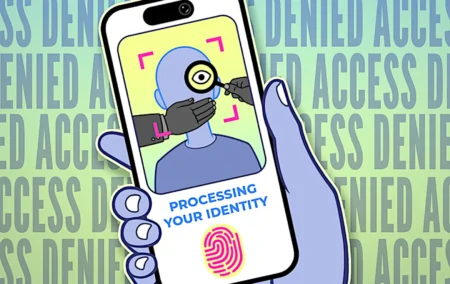
[Image: Neither governments nor big corporations will protect you from the consequences of losing control of your personal information. Image courtesy of the Electronic Frontier Foundation under CC BY-SA 4.0 licence]
The views of the writer are not necessarily the views of the Daily Friend or the IRR.
If you like what you have just read, support the Daily Friend