

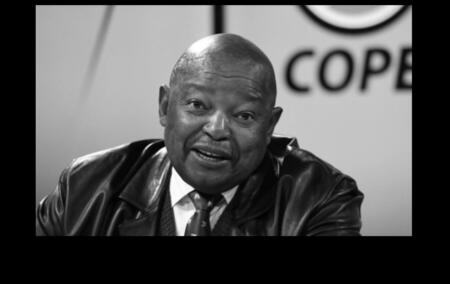
At an event in Pretoria in December 2003 unveiling a most unusual co-operation pact between American institutions and the Department of Defence relating to the provision of antiretroviral medication to SANDF personnel (reports at the time suggested a considerable number of personnel were HIV+), Mosiuoa Lekota joined a small group I was in, discussing student politics. I knew nothing about the subject; just pretended to sound interested.
Later, after he’d finished talking to another group, he returned and seized my arm. “Muntu,” he said to me.
I gulped. “I beg your pardon?” He looked at me sternly, and I looked back at him, a bit terrified, before he smiled. “Muntu Myeza,” he said, “he was a friend.” I had no idea who he was talking about, but left the short conversation thinking that Muntu – a notable student activist – was probably a good guy, and also thinking that the Minister of Defence at the time was probably very good at prompting awkward encounters, possibly because he maintained control of them.
That theory aligns with the experiences of South Africa’s industrialists who negotiated with Lekota before 1994’s elections. Smart, handsomely remunerated white executives, many Oxbridge-educated, hosted Lekota at a game reserve, where he reportedly drank a bottle of scotch a day – which didn’t appear to touch sides. Those men found in Lekota an intransigent customer unwilling to concede an inch.
But he wasn’t tricky, unlike some of his colleagues – unlike other white “liberals” parachuted in to aid the ANC in drafting its economic policies. (One of these white men now leads a Western country).
One of the least-studied features of South Africa’s post-1994 rising looks to the appointment made in 1999 of Mosiuoa Lekota as Minister of Defence, succeeding the late Joe Modise – under whose watch the arms deal unfolded, injecting a poison into the country’s veins that has proved impossible to flush.
Then-President Thabo Mbeki will have seen and heard about the nests of proliferating corruption, initiated by major European companies, embedding themselves within the public and private sectors and worst of all, the public consciousness. To control as much as it could – which admittedly wasn’t much given how corruption accelerates – the ANC needed a hard character, but a fair one too. Mbeki chose Lekota.
Torch its own legacy
The ANC’s decision to torch its own legacy made in the teens came with the risk of torching the lives and contributions of good men. Lekota was one of these; Penuell Maduna, former Minister of Justice, of Energy and of Home Affairs, another.
In 2014 I took Maduna, then vice-chair of Bowman Gillfillan, out to lunch, and was struck with the deep turmoil he evidently entertained about the party: in particular, the challenges facing Jacob Zuma’s Minister of Justice, Michael Masutha, as they related to complex, highly charged paroles and prosecutions, and the culture the ANC had established in its unwillingness to punish its own.
An issue for the ANC during Lekota’s first term as Minister of Defence, inevitably aggravated by the revelations of the arms deal, was an examination of the ANC to the point of conviction: how do you describe a few good individuals involved in a bad group?
Acquiring that conviction was an active pursuit – South Africans were exhausted from trying to accommodate genuinely good people in the context of a genuinely untrustworthy – and failing – organisation, so wanted finality, eventually settling at bad. Everything was bad. Nobody and nothing good could now make it otherwise. South Africans have always been obsessed by classification – the scale and granular detail of documents required to be completed for various government departments is one example – and we did the same for the ANC. This was perhaps unfair, but at the same time necessary.
But to consider the ANC exclusive to such classification is reckless, even stupid. In the UK’s case, the same pursuit of conviction is leading to a broader view that all politicians, from all parties, are bad. Every single one. This was not the environment the ANC was classified in, where alternatives and choice existed.
The feeling in the UK, evidenced by hostile sentiment, jarring polling revelations that resign the two main parties in Parliament to three and four in current levels of support and acts of blatant democratic infraction that go unpunished, is that politicians – as both individuals and as a class – are willing agents of bad.
That’s because they probably are. Just yesterday three people were arrested on suspicion of spying for China – one of them being the husband of a sitting Labour MP. This woman will claim she didn’t know what her husband was up to, and she’ll be hated more for doing so. While the parliamentary expenses scandal of 2009 was arguably the point at which politicians, the media and the public were no longer able to sneer at corruption in other countries, the nature of subsequent scandals and their frequency – ketamine, homosexual rape, rent-seeking, headbutting in SW1’s bars, assault, the culture of scheming and the almost proven theory that today’s political class genuinely loathes the people who elect it – have contributed to the formation of a much more piercing examination than the ANC of Lekota had to endure.
The route just appeared
I suppose that when succeeding generations cast their judgement upon this present class, analyzing perhaps the last 30 years, most will be living outside the UK, some possibly in remote villages with little or no access to electricity, too terrified to read what is being said about them. In their defence, they will argue that they did not intentionally set out to become so irredeemable – the route just appeared.
So Lekota departs with rare admiration, as will Maduna, and others such as Bantu Holomisa. Former contemporaries in the ANC will not be so lucky, but I suspect that worst of all will be today’s UK political class. Gen Z will excavate bones only to smash them up; any venue – a library or community centre – named after any of today’s class could do worse than exploring – right now – some comprehensive arson insurance policies.
We were lucky to have Lekota. I wish that a man or woman of the same qualities had featured in UK politics over the last two, nearly three decades. Alas, they have not.
[Image: https://www.instagram.com/p/DVdJpICDUed/]
The views of the writer are not necessarily the views of the Daily Friend or the IRR.
If you like what you have just read, support the Daily Friend