

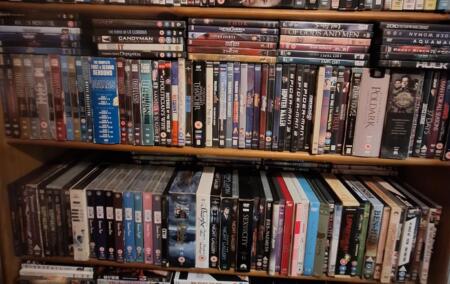
I remember the first “video machine” I ever encountered: a Sony Betamax with a gun-metal-grey-and-faux-wood finish.
As I recall, my father brought it home after work one day in 1982, and together with my older brother set about stripping it out of its box and packing habits, scoured the manuals and connected it to the television. It came with a self-assembly stand, which allowed the television to be placed at the level of a coffee table, and the VCR on a shelf below. This transformed the aesthetic of the lounge.
I was about eight at the time, and ours was the first household in my peer group to get a VCR.
This device was not only novel, it was game changing. All of a sudden, TV shows could be kept for later – and watched again and again. TV entertainment thus became a became a staple of afternoons, where previously it had been reserved for the hours following dusk. And since my bedtime was around 7 in the evening, it ensured that I could still get to see some of the good stuff the following day.
In fact, my mother took a firm interest in my cultural development and insisted I watch “quality” shows: I’d often come home from school to discover that an hour of viewing was not only available but mandatory. For a period, I was terrified of Wednesday afternoons, as it meant watching the Australian historical drama Against the Wind: I found the combination of (off screen) floggings and the sinister presence of the central villain, Ensign Morris Greville, to be deeply disturbing. But my mother was right about quality, and when I encountered it a few years later, I was fascinated by the depiction of history and beguiled by the production values.
In one’s own lounge
And then, of course, there were “videos”: renting a title of one’s choosing to have something like a simulated cinema experience in one’s own lounge. In my case, this was a rarity, since the Betamax format declined rapidly in popularity and was essentially unavailable in the rental market by the mid-1980s.
Still, once in a while I managed to borrow a VHS format player, and was able to binge on things: some of its “quality” (thanks again to my mother, I remember adaptations of Wuthering Heights and Les Miserables), and some of it appealing to a particular interest of mine (Clash of the Titans, Platoon, the North and South mini-series). Good times.
Fun fact: the VCR preserved some entertaining pieces of cultural arcana.
In 1978, hoping to capitalise on the success of the movie the previous year, a Star Wars special was produced as a holiday special. It was a disaster, and an element of the franchise that has never been rebroadcast or released on home media. Indeed, it’s one the Star Wars mandarins would rather be forgotten. However, a number of home recordings exist, thanks to the nascent video culture. These circulated among fans, sometimes interspersed with adverts and TV station logos. (Those wanting to see it can find it here).
Our household was one of the first that I knew to own a VCR; still considered a new technology in South Africa at the time, VCRs had entered the consumer market globally in the mid-1970s. Those that went to market – from Sony and JVC – represented the culmination of a technology whose origins went back to the 1950s. There had been a long chain of investment and innovation in producing systems that could store and replay audio-visual material, for both commercial and domestic purposes.
Initially something of a luxury, the VCR was functional and increasingly affordable, and rapidly became a staple item in middle-class households. In 1980, between 5% and 10% of households in the world’s affluent countries owned a VCR; by end of the decade, ownership in these societies was above 70%. By the mid-1990s, the household VCR ownership rate in the US was estimated at above 95%. Much the same was true for Japan and probably for many other countries.
Soviet Union
One place where this was not the case was the Soviet Union.
This is a fascinating footnote of history. For close to a decade after its introduction, the VCR remained a curiosity in that society. No less than for people anywhere else, citizens of the Soviet Union were entranced by the entertainment value of these devices. The government less so. In January 1984, the journal Sovetskaya Kultura commented: “Contamination of the mind with the help of the video stuff of the bourgeois mass culture is becoming an ever more acute problem in the West.”
From the official Soviet perspective, video content could push inappropriate (anti-socialist) messaging. More to the point, probably, it was a platform that enabled people to get hold of things outside state control. This was a perpetual issue in the Soviet Union: a population that had become relatively well educated and that knew it played an extensive role in the world also understood that the range of things to be experienced were larger than what official policy would concede. For decades, the challenge had been prohibited books and journals. The VCR opened the way for illicit films.
This is not to say that VCRs were entirely unavailable in the Soviet Union. By the early 1980s, an unknown number had made their way in, some smuggled, some brought back by Soviet citizens who had been able to travel abroad – these included diplomats, tourists who could get to Hungary, Poland or more rarely to the West (and who had accumulated the necessary money) and those working on aid projects in countries where they might be available. Even Soviet military personnel in Afghanistan were known to have obtained VCRs that came in from elsewhere in South Asia.
Some were more or less legally imported, typically from Japan, and sold in so-called “used goods” stores, perhaps with an accompanying television set. But this was prohibitively expensive. Such items went for as much as the equivalent of over $9 000 in a Moscow store, against an (official) average monthly salary that converted to around $200.
Perennial frustration
So, in 1984, the Soviet Union commenced production of its own VCR model. A lack of consumer goods was a perennial frustration in Soviet society, and a major index of its failure to compete with the West. Besides, the VCR offered the possibilities as a state propaganda tool, and a recreational utility in small communities that had no movie theatres.
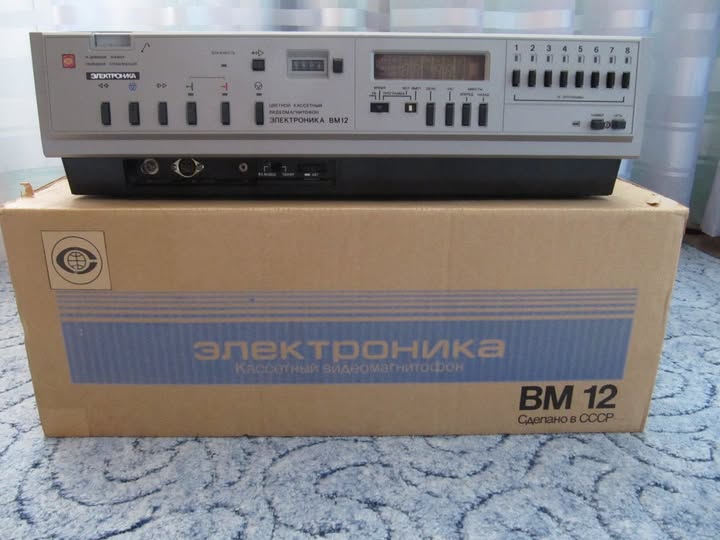
The first VCR intended for mass use was the Elektronika VM-12.
[Image: Instagram]
Designed to closely resemble a Panasonic model, though without some of the features of the original, it was produced at a factory in Voronezh. This rolled off the production line with price tag of some $1 450, better than the “used goods” imports, but still multiples of what Soviet households earned (in the US, VCRs were retailing at between $300 to $500, with prices rapidly becoming ever more competitive).
What was more, initially at least, the Elektronika store in Voronezh was the only place to make the purchase. And if it was faulty or broke down, a buyer had a written agreement to bring it back, a journey by car from Moscow of six hours or more (apparently, this was to identify and work out defects in the early models).
The Soviet authorities hoped to step up production to meet the growing consumer demand. Ultimately, this didn’t work out. Demand, even at the hefty cost, existed, but it could never be met.
As with so much else in the Soviet economy, attempts to buy an item like this meant placing an order and waiting, and waiting some more. Those able would turn to fixers and speculators who could connect a customer with a product. Others would look to the underground economy. Still others would find a VCR through the cooperatives that sprang up in the later 1980s and imported discounted consumer goods that Soviets struggled to get hold of – as the 1980s progressed, VCRs from the West or from East Asia were falling in price, improving in reliability, and just looking a lot cooler.
In the event, the last Elektronika-VM 12 is thought to have been produced in 1995.
Small venue
Actually, during the 1980s, entrepreneurial Soviets set up small video parlours: get hold of a video machine, and a collection of films – particularly foreign titles, often with a Russian voiceover rather than a professional dub – and a small venue.
Run the video machine from the morning until late at night, charging one rouble per person per film. The machine would invariably break down through protracted use, but over course of its life, it could bring in enough to pay for an apartment.
Perhaps the most revealing thing of all this was that the Soviet authorities had planned the U’SR’s VCR rollout. The idea was that after 1984, production would rise to around 60 000 a year by 1990 – the Soviet population was about 280 million – rising to some 120 000 a year by the end of the century. But by that time, the age of the VCR was rapidly coming to an end; optical disks and digital systems were rapidly taking market share, and in the early 2000s, DVD players and rentals had overtaken their VCR counterparts worldwide.
In 2006, A History of Violence became the last major Hollywood release to be put on videotape in the US, and in 2016, the last VCR manufacturer discontinued production.
Incidentally, the optical disk transition is an interesting and related story in itself.
VCRs had done well in Asian countries like Japan and South Korea. They had obviously found fewer takers in less affluent countries. Even in jurisdictions like Hong Kong and Singapore, VCRs were vulnerable to humidity. Optical disks had offered a possible alternative since the LaserDisc system was introduced in the late 1970s by Pioneer and Philips (although it was too expensive for widespread uptake, and lacked the VCR’s ability to record).
By 1993, technological advances – by Philips, Sony, Panasonic and JVC – led to the development of the Video CD (VCD). This was a step change technology that allowed movies and television content to be reproduced on compact disks.
Although never achieving a huge market in areas with widespread established VCR ownership, they were enormously popular in China and in South-East Asia. They were cheaper than videotapes, the quality was comparable and they were more resilient to the climate. They could be played on inexpensive dedicated VCD players (by the early 2000s, half of Chinese households were said to have one), or on computers with a CD drive.
Perhaps more importantly, they responded to a changing market: economic growth was accelerating across Asia; its people were becoming wealthier, fuelling demand for the consumer products that had previously been beyond their reach.
Entertainment was an important part of this. VCD products proliferated in music and movie dealerships, at street markets, at convenience stores, in catalogues stuffed in post-boxes by informal dealers. They had a special application in the region in karaoke bars, providing background visuals and music tracks for performers, and being cheap enough to keep inventories current.
As it happens, I had my own (happy) experience with VCDs during my time in Taiwan.
Subtitles
They were pretty much everywhere, the range of titles endless and the costs often matching the change in my pocket. They tended to have subtitles embedded in the footage – though after a while, I barely noticed, and since most of their viewing audience would watch foreign movies with subtitles anyway (even those fluent in English – call it a force of cultural habit), it made sense.
More annoyingly, the quality was wildly variable. Genuine, official productions, were well transferred and reminiscent of a videotape hired from a rental outlet, although a movie would often be split over two disks. In other instances, not so much: to accommodate a movie onto a disk, a section of the film may have been hacked off; in more extreme cases, what one found was literal camcorder footage of a movie in a theatre, with all the ridiculousness that one can imagine built into it (there was still a market for that; I never understood it.)
Although VCDs continue to exist in that part of the world, the format went into decline for much the same reason as the VCR: a more attractive option came along. This was, of course, DVD – which offered superior viewing quality and features, and was becoming ever more cost attractive.
DVD in turn has taken a severe hit from streaming services. No DVDs are manufactured in South Africa, and the brick-and-mortar stores that once carried them – Musica, Look and Listen, or the smaller outfits like Phase 2 – have closed down. Those that are available are brought in from abroad, and this is why a new DVD bought online from somewhere like Loot or Takealot will typically cost more than R300, and a series, something north of R500. Some titles are simply not making it onto that format anymore. Even DVD players are becoming a rarity in the inventories of electronics retailers.
Unfortunately, the decline in South Africa’s DVD market hints at something beyond the inexorable march of technology. It denotes also the loss of discretionary purchasing power that sustains complex and niche markets. DVDs retain a market share in prosperous societies, catering to those who see value in holding the physical item. Indeed, there is even a small market for used video tapes, leaning heavily on nostalgia and aesthetic. Occasionally (rarely) boutique studios release films on video tape as a homage to a bygone time – the video tape era being particularly linked to the horror genre. An example of this is the found-footage film V/H/S, whose theme is a home filled with eponymous video records of supernatural phenomena.
The history of the VCR also illustrates certain truths about the management of an economy and responses to it. The Soviet experience describes the folly of prescriptive state planning and ideological control. It operated a system that denied the fundamental premise of economics: that people have unlimited wants and limited means to satisfy them.
Dynamic economy
Its alternative was to attempt to regulate wants and satisfy them according to a politically driven schedule. A dynamic economy can’t operate like that. It is inimical to innovation and insensitive to the desires of actual people, consumers. It also assumes the capacity of a state to understand long-term trends and manipulate their fulfilment.
Consider this: had Elektronika reached the outer limits of its production goals by 2000, it would have produced around 1 560 000 VCRs. That would have amounted to about 10% of the number in the US in 1984. And by then, the technology was being superseded anyway.
Asia demonstrates something different.
It’s no surprise that the VCR was a product of Japan – a country which rewarded innovation and revered the engineering skills that made it possible. It was also an economy that understood the incentives of consumer demand, both domestically and globally. Its firms responded, and changed the way we did home entertainment.
Incidentally, this is not an indictment of state involvement: Japan’s post-World War II success was linked to an activist state and industrial policy: but it was one that enabled and supported its firms in their efforts, that ensured a skills base, and was staffed with the best and brightest who understood the intricacies of economic strategy.
Much the same applies to those other Asian economies when VCD came around. They were growing and, above all, liberalising. No matter how repressive the political climate in places like China and Vietnam remained, these countries appreciated the importance of placing markets at the centre of economic activity.
Access to VCD-based entertainment was part of what proceeded from letting people and firms get on with the business of making money. And their people and entrepreneurs took advantage of it. Given the space to do so, people change their circumstances as is suitable for them. As PJ O’Rourke put it in the title of an account of a visit to Vietnam, To Hell with Everything, let’s get Rich.
There is a lesson for South Africa here. We are at base a market economy, but one overlain with state intrusion and unmerited confidence in the ability of our under-capacitated authorities to actually get things done. There is a fondness for pointing to the wonders of the East Asian growth story, but drawing very selective conclusions from it. From this we get the “developmental state”, but it is interventionism without the technocratic competence, and a profound suspicion of anything that looks as if it might escape the regulatory net. The thinking is more Soviet than Japanese – or even Chinese.
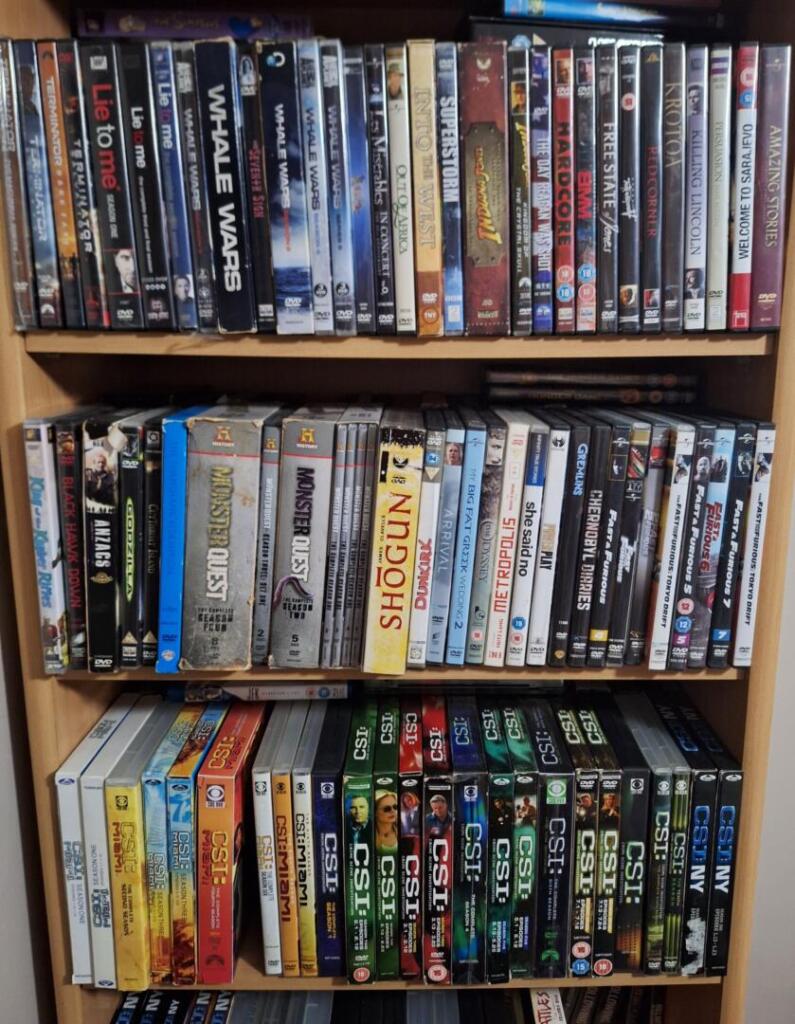
For myself, from my childhood, I’d always wanted a video library – a large collection of films and V shows to entertain and educate; I’ve been able to assemble one on DVD.
[Image: Terence Corrigan]
Some awesome stuff there, good quality and I still get that tingly feeling of anticipation when I slip a disk into the player and hear its faint whirr. When Netflix removes a favourite title, it has, well, a limited impact on me. It’s sad for me to see the DVD age heading into its twilight, but I have a taken the precaution of storing a few extra players for the eventuality that they might one day be hard to replace.
I am, however, pleased that this was an area that the government didn’t try to help, back in the mid-1990s. We might still be stuck on VCR and video tapes.
[Image: A fraction of Terence Corrigan’s extensive collection. Supplied by the author]
If you like what you have just read, support the Daily Friend