

One of the more unsettling aspects of the US-Israeli attack on Iran is the gamification, or trivialisation, of war by the Trump administration.
Trump is not a Napoleon. He is not a Clausewitz. He is not a Patton. He is not Sun Tzu. And I mean that in the most sarcastic way possible.
He may be the Commander in Chief of the US armed forces, but his grasp of military strategy and tactics is as feeble as his geriatric constitution. He has no experience of military command, or even ordinary combat, and it shows.
This may explain why the Trump administration gravely underestimated Iran’s motivation and resiliance, and why Iran seems to have the upper hand in a war Trump has been claiming to have won since day one, almost four weeks ago.
Trump may say he is “not afraid of anything”, as he did in response to a question on whether he feared Iran turning into another Vietnam, but he sure was afraid of the real Vietnam war when – according to his doctor’s daughters – he was diagnosed with bone spurs as a favour to his father Fred.
He also does not need to fear that his son, Barron, will be shipped off to risk his life in Iran. Barron, like his father, has a medical exemption; in this case, because at 6’9”, he is too tall to serve.
Reality TV
What Trump does understand, however, is entertainment. He had his own reality television show for over a decade, and has a star on the Hollywood Walk of Fame.
He is in the World Wrestling Entertainment Hall of Fame despite never having been in the ring (allegedly for dubious reasons), and is bringing the made-for-television macho posturing of mixed martial arts to the White House.
As a real estate developer, Trump has a great deal of experience of boastful exaggeration and bombastic self-promotion, which he frequently displays on the public stage.
For his “Secretary of War”, the “President of Peace” appointed Pete Hegseth, a television personality who sports a tattoo of “Deus Vult” on his right bicep and a large Jerusalem cross on his chest. This motto and cross are widely associated with the white nationalist right; both date from the First Crusade, which pitted Christians against Muslims over control of what would later become Israel.
Unlike Trump, Hegseth has seen war (in Iraq and Afghanistan), and has earned medals. Despite starting out as second lieutenant, however, he never made it further up the chain of command than major, in almost a decade of on-off service.
One wonders what America’s assembled career generals thought of his rah-rah pep talk about the warrior ethos and grooming standards in front of the world’s media.
4chan memes
The MAGA movement that Trump rode into the White House back in 2016 owes much of its style – and its electoral victory – to the “meme wars” and “weaponised autism” of anonymous image boards like 4chan’s /pol/.
These boards are populated with posters who are mostly (but not exclusively) far-right, white, male, involuntarily celibate, pornographilic, video game and anime fans.
These boards are a perfect illustration of Poe’s Law: it is impossible to tell whether the overt racism and misogyny of their users are genuine, performed “for the lulz”, or a bit of both. I’d bet on the latter.
From these dank corners of the internet emerged influential conspiracy theories like Pizzagate and QAnon, which lined up squarely behind the MAGA movement. News of the death of Jeffrey Epstein was broken on 4chan, more than half an hour before anyone else reported it.
“We elected a meme,” 4chan exulted back in the day.
The Trump administration has embraced the style established by the anonymous army from the image boards, and routinely posts such memes and videos on its social media accounts. It isn’t a stretch to say that it sometimes actually governs by meme.
Usually, this just comes across as immature and unserious. When this communication style clashes with the extremely grave business of war, however, the dissonance becomes quite disturbing.
The gamification of war
On 4 March, four days into the war on Iran, the White House shocked the world with a video that interleaved infrared footage of missile strikes with clips from the video game Call of Duty, set to a soundtrack of Childish Gambino’s song Bonfire.
Other videos used clips from films like Braveheart, Top Gun, Iron Man and Gladiator, scenes from games like Grand Theft Auto V (complete with “Wasted” captions), and songs such as Macarena.
On 5 March, the White House posted a clip of missile strikes, punctuated with a clip of Spongebob Squarepants saying, “You wanna see me do it again?”
A day later, it unveiled a longer video, including clips from many famous films and television shows (including Top Gun, Better Call Saul, Gladiator, Deadpool, Breaking Bad, John Wick, and Braveheart). It opens with a scene from Iron Man, and the line, “Wake up, daddy’s home”. It includes a shot of Beerus, the God of Destruction, from the anime series Dragon Ball Super. It ends with an audio clip from the video game Mortal Kombat: “Flawless Victory!”
On 7 March, the White House posted a video clip portraying strikes on Iran as touchdowns in a gridiron football game, to the tune of Thunderstruck by AC/DC. Another one does the same with baseball. Yet another features an AI-generated parody of ten pin bowling, with the pins representing Iranian regime officials, set to a cover of Free Bird by some rip-off artist named MOONLGHT.
In another clip, two days later, missile impacts were synchronised with Here comes the boom, by rapper Nelly. This one overlays the words “kaplow, kaboom” over footage of explosions.
On 12 March, the White House posted a video likening the war to a Wii game.
Gamer attitude
The attitude of Trump and his staff is that of video game players, too. They talk boastfully about “raining death and destruction from the sky all day”, “bombing our little hearts out”, and “we’re playing for keeps”.
They declare that the enemy is crushed, completely destroyed and 100% defeated, and have been using those words for a month, even as the enemy keeps raining missiles and drones on American assets, Israeli targets and neighbouring countries, far and wide.
When the media asked questions about the deaths of American servicemen and -women, both Trump and Hegseth treated them like a routine annoyance.
“Before it ends, that’s the way it is,” said Trump, shrugging. “Likely be more.”
“Every once in a while, you might have a squirter that makes its way through,” said Hegseth, adding “When a few drones get through or tragic things happen, it’s front-page news. I get it – the press only wants to make the president look bad, but try for once to report the reality.”
The reality is that soldiers have died in pursuit of the Trump administration’s war on Iran. The reality is that their families are grieving. And here is the chief bootlicker, Hegseth, treating it like a public relations problem for Donald Trump, caused by spiteful journalists.
It took an actual general, Dan Caine, chairman of the Joint Chiefs of Staff, to prioritise the families of the fallen: “To our Gold Star families, to our wounded warriors and their loved ones, we will never forget your sacrifice.”
Objections
Actor Ben Stiller publicly objected: “Hey White House, please remove the Tropic Thunder clip. We never gave you permission and have no interest in being a part of your propaganda machine. War is not a movie.”
Jon Favreau, a former speechwriter for Barack Obama, posted: “Hundreds of people are dead. Little girls are dead. Six Americans are dead. Others are risking their lives. Millions across the Middle East are terrified. It’s not a video game. It’s not a meme. It’s not another chance to troll the libs. It’s fucking war.”
Kristopher Purcell, a former aide in the George W. Bush administration, said: “Call of Duty is not real life. It’s a game.And war has very, very real consequences, not just for our service members, but for Iranian civilians. And this gamification of war is really appalling, especially when you consider the administration’s typical response to mass shootings, which is to blame violent video games and movies.”
Retired US Army colonel Joe Buccino, a 27-year veteran of four tours in Afghanistan and Iraq, and a former spokesman for US Central Command, said the White House communications team decided to treat the Iran conflict like a big joke. In response, he felt only disgust.
“They’re completely diminishing what they’re asking the nation to do in Iran,” Buccino told the Washington Post. “It seems almost obscene relative to the actual violence and suffering that’s involved with this.”
John Vick, representing a conservative veterans advocacy group, told the Post that while the military’s success deserves to be celebrated, “gamifying or making light of war also undermines the sacrifice of the Americans who have died, and obfuscates the cost of open-ended conflict.”
“It takes a really complicated and important situation – armed conflict – and boils it down to a little cartoon image,” said Peter Loge, a political scientist at the George Washington University, in an interview with The Hill. “By making war like a game or cartoon, that removes the reality of war from people’s minds.”
He continued by comparing the approach to professional wrestling: “The sport matters, pro wrestling is hard, people really could get hurt. But the point isn’t the sport, the point is the spectacle. … What we’re seeing out of the White House is the spectacle of war rather than the reality of war.”
Nicholas Cull, a historian of the role of mass communication in foreign policy at the University of Southern California, calls it “the memeification of foreign policy”.
“The message it’s sending is ‘we don’t care, we’re America, get out of our way,’” Cull added.
“2 billion impressions”
The White House is not apologising, however. On the contrary. It is doubling down. For the administration, it’s all about the hits.
“This is another example of our non-traditional and traditional media strategy, which has proven highly successful,” press secretary Karoline Leavitt – an eagerly obsequious, performatively pious and demonstratively cruel 28-year-old – said in a statement.
“Over the past few days, the White House videos have generated more than 2 billion impressions. People are talking about the tremendous success of the war and the U.S. Military’s obliteration of Iranian terrorists – and that’s exactly the point.”
Two billion impressions. That’s exactly the point.
Not the 165 girls killed in a mistaken strike on a school. Not the more than a thousand Iranians killed by the war. Not the more than a thousand people killed by Israeli strikes in Lebanon. Not the 17 Israeli fatalities, of which only two were soldiers, and the 5,000 Israeli injured. Not the 13 US service members that have been killed, or the nearly 300 that have been wounded.
I’m not sure that people talking about what heartless bastards Trump and Hegseth are is really what Leavitt had in mind when she said “that’s exactly the point”.
Valkyries
That the White House has turned war into entertainment for the masses is a profoundly dystopian development that exposes the moral bankruptcy of the Trump administration.
It is an expected progression from the US government’s performative cruelty towards protesters, LGBTQ+ people, undocumented immigrants, and civilian bystanders. It is unsurprising in light of Trump’s rhetorical disdain for foreign countries, and especially those occupied by people of a less-than-Aryan persuasion. It is a predictable manifestation of the 4chan-style weaponisation of memes.
That it doesn’t come as much of a surprise makes it all the more disturbing, however. It isn’t a faux pas. It’s policy.
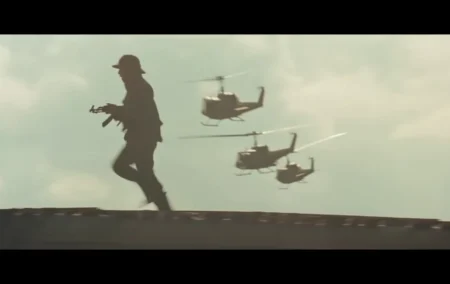
Movies such as Apocalypse Now warned us against turning war into grandiose entertainment.
The unforgettable scene in which helicopters rise over the horizon, blasting Wagner’s Ride of the Valkyries from loudspeakers, evokes exactly the sort of mythic heroism that Trump and his minions are trying to whip up.
Yet it behooves us to remember that Francis Ford Coppola did not intend for that scene to glorify war. On the contrary: it presages a massacre of civilians with doubtful links to the enemy, and a loss of life that was intended to horrify viewers.
Grave undertaking
War – even justified war against evil enemies – ought to horrify us. Taking human lives is a profoundly grave undertaking. Sending soldiers to risk their lives in war places a heavy burden of responsibility on the shoulders of political leaders.
That we have to train soldiers to kill; to hate the enemy sufficiently to do so; is an awful reality. It is not a movie. It is not sport. It is not entertainment.
Dwight D. Eisenhower, a former US president who actually was a victorious general in a very momentous war, said, in his Chance for Peace speech in 1953: “Every gun that is made, every warship launched, every rocket fired signifies, in the final sense, a theft from those who hunger and are not fed, those who are cold and are not clothed. This world in arms is not spending money alone. It is spending the sweat of its laborers, the genius of its scientists, the hopes of its children.”
War has real human costs, measured in real human lives. For those who order war to joke about it is disgraceful. War is not a video game, and a pox on those who treat it as one.
[Image: A still from the ‘Ride of the Valkyries’ scene in Francis Ford Coppola’s film, Apocalypse Now, released in 1979.]
The views of the writer are not necessarily the views of the Daily Friend or the IRR.
If you like what you have just read, support the Daily Friend