
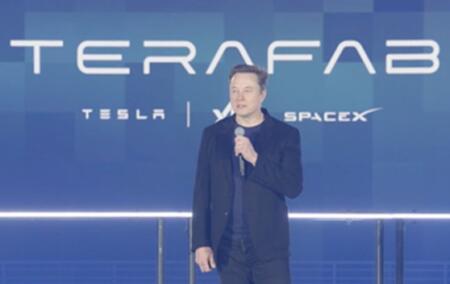
On 21 March Elon Musk took the stage at the Seaholm Historic Power Plant in Austin, Texas and announced the most dauntless bet in the history of private enterprise. The prize, if he wins, is incalculable. The cost, if he loses, will be huge (but probably not incalculable).
The project is called Terafab. It is a joint venture between Tesla, SpaceX and xAI and it is designed to do something no company has ever done – consolidate every stage of semiconductor production under a single roof, at the leading edge of process technology, for captive use by its owner. Why has no one ever done it before? Simple – it has been too difficult.
Chip design, lithography, fabrication, memory production, advanced packaging, testing. All of it will be done under one roof in Austin. The production target is one terawatt of AI compute capacity per year (Compute used to be measured in speed; one of the consequences of AI demand is that it is now simply measured by power consumed). The initial cost estimate is $20–25 billion.
The full ambition, as we shall see, will cost considerably more.
Musk’s framing was characteristically, um, galactic. “We either build the Terafab, or we don’t have the chips,” he said. “And we need the chips, so we build the Terafab.” To understand Terafab, you have to understand what Musk is actually trying to build, and it is not a chip factory. It is a space-based compute network that would dwarf anything on Earth. In January 2026, SpaceX filed an application with the Federal Communications Commission requesting a licence to launch up to one million data centre satellites into low Earth orbit. Terafab is the chip supply chain for that constellation.
The physics are genuinely compelling. Extractable solar power in orbit is approximately five times greater than at Earth’s surface. The vacuum of space eliminates the heat rejection problem that makes terrestrial data centres so expensive to run (on the ground, roughly 40 per cent of a data centre’s energy budget goes to cooling). Musk’s argument is that within two to three years, running AI workloads in orbit will be cheaper per watt than doing so on the ground. If he is right, the implications are profound.
What Musk is constructing is a “vertically integrated” stack via his considerable empire. Tesla makes solar panels and robots. SpaceX launches the infrastructure. xAI runs the intelligence layer. And Terafab makes the chips that everything else runs on. It is either visionary-systems thinking or the most expensive exercise in circular self-justification in corporate history.
Space applications
Musk has allocated 80 per cent of Terafab’s projected chip output to space applications. Only 20 per cent is destined for terrestrial chips: inference processors for Tesla vehicles and Optimus humanoid robots.
Most people who use the phrase vertically integrated in the context of semiconductors do not fully appreciate what it implies. The modern chip industry is organised around an extreme division of labour. Companies like Nvidia and Apple design chips but manufacture nothing – they are called fabless. Foundries like TSMC and Samsung manufacture chips but design nothing of their own. Equipment companies like ASML build the machines that TMSC uses to make the chips but neither design nor fabricate them. Memory companies like Micron and SK Hynix that are required as fast storage for CPU chip operations are yet another layer.
This fragmentation exists because each stage is so technically demanding, so capital-intensive, and so knowledge-dependent that no single company has managed to master all of them at the frontier simultaneously. Conceiving, designing, manufacturing and deploying a leading-edge CPU is about the most complex engineering process humans have yet undertaken. Even the famed Intel tried for decades and failed.
Terafab proposes to not only enter all of these disciplines at once, but to do so using the most advanced techniques available (measured in distance) – 2 nanometres, where transistors are separated by distances approximately 20,000 times smaller than a human hair. And then there is a category that does not yet exist at commercial scale: space-hardened processors that can survive cosmic radiation, extreme temperature cycling (a still unsolved technical problem), and years of operation in vacuum.
A single leading-edge logic fab – the kind capable of producing chips at 2nm – currently costs between $25 and $35 billion to build, takes approximately 38 months to construct in the United States, requires extreme ultraviolet lithography machines that only one company on Earth manufactures (ASML, in the Netherlands, with a five-year order backlog), and must be staffed by engineers who have spent their careers in an industry where knowledge is accumulated in incremental steps over generations. TSMC, the world’s most advanced foundry, has spent $165 billion and decades of relentless process development to get where it is today.
Untested at scale
The space-hardened variant adds another layer of complexity that has no commercially proven template. Standard 2nm chips are designed to operate within tight temperature bands in climate-controlled environments. Space chips must withstand thermal swings of 200 degrees Celsius between the sun-facing and shadow sides of an orbit, tolerate high-energy particle bombardment that flips individual bits in memory, and operate for years without maintenance. The radiation-hardening techniques required are not simply add-ons to a terrestrial process flow. They are a different manufacturing discipline entirely, mostly untested at scale.
Musk’s $20–25 billion figure has not survived contact with semiconductor analysts. Investing,com reports that Bernstein, a premier research firm in the sector, put a number on the full ambition at $5 – 13 trillion. The $20 billion initial investment, noted Bernstein, is barely sufficient to build a single 7nm-class logic fab, two full generations behind the 2nm target.
Tesla’s CFO confirmed at the launch event that the $20–25 billion is not yet incorporated into Tesla’s 2026 capital expenditure plan, which already exceeds $20 billion. The full-scale facility location has not been announced. No construction timeline was provided. No firm production schedule was given. What was given was a vision, one that was met with scepticism – Morgan Stanley’s Andrew Percoco politely called Terafab a “Herculean task”.
The analyst community’s scepticism is not unfounded. It has a specific historical referent – September 2020, when Musk stood on a different stage and promised a revolution in battery manufacturing. The 4680 cell – named for its 46mm diameter and 80mm length – was going to slash battery costs by 50 per cent using a dry electrode process that eliminated expensive liquid solvents. Tesla would reach 10 gigawatt-hours of production within a year and 3 terawatt-hours by 2030, enough to power 20 million cars annually. The technology, Musk said, was transformative.
Five and a half years later, the dry electrode process has been revised at least six times. Yields remained stubbornly poor. Tesla’s own top battery supplier stated publicly that Musk does not know how to make battery cells.
Without precedent
The asymmetry of outcomes here is wide. If Terafab succeeds – even partially, even a decade late – Musk will have achieved something without precedent in industrial history – a single private entity controlling the full stack of the AI age, from the chip to the model to the satellite to the robot. The compute advantages alone would be structural and durable. A space-based AI compute network powered by proprietary chips, launched on proprietary rockets, at costs no competitor can match, would be as close to a monopoly position as the technology industry has ever produced.
If it fails, the damage will be substantial, but not necessarily fatal. A $25 billion capital commitment that yields neither chips nor strategic advantage would sink most companies. But SpaceX is approaching an IPO at a reported $1.25 trillion valuation. The question is whether Tesla investors – already watching their company’s core business erode – will fund a semiconductor moonshot on the strength of Musk’s reputation alone.
And yet. The sceptics said reusable orbital rockets were physically and economically impossible. They were wrong. They said a US electric vehicle start-up could not become a global automaker. They were wrong. The pattern of Musk’s career is not a pattern of steady incrementalism but of targeting bottlenecks that the incumbent industry has decided are intractable – launch costs, battery prices, chip supply – and attacking them with a directness and a risk tolerance that only a private company could manage.
No other figure in contemporary business has the sheer chutzpah to attempt this.
Whether that is a reason for confidence or alarm depends on how you feel about Musk and the height of the mountain he has set out to climb.
[Image: X broadcast]
The views of the writer are not necessarily the views of the Daily Friend or the IRR.
If you like what you have just read, support the Daily Friend