

The United Nations (UN) General Assembly’s newest resolution condemning the trans-Atlantic slave trade as “the gravest crime against humanity” and demanding reparations is highly presumptuous and opportunistic. It misconstrues the justice of reparations and invents fictional legal history that condemns Europe while sanitising African participation.
As the UN’s relevance swiftly collapses in our modern day, let us see how this august body has chosen to discredit itself now.
Ghana’s UN resolution
Spearheaded by Ghana, on 25 March the UN General Assembly adopted Resolution A/80/L48.
The resolution unequivocally declares the trafficking of enslaved Africans and the system of racialised chattel enslavement during the trans-Atlantic slave trade as “the gravest crime against humanity”. It condemns these practices in strong terms and calls on member states to engage in “good-faith dialogue” on reparatory justice.
This includes formal apologies, restitution of cultural artefacts, compensation, rehabilitation, guarantees of non-repetition, and broader measures to address the enduring legacies of racism, inequality, and underdevelopment said to stem from slavery.
The text was adopted with 123 votes in favour, three against (United States, Israel, and Argentina), and 52 abstentions, including all European Union member states and the United Kingdom.
Though non-binding, the resolution carries political and symbolic weight.
Supporters, including Ghana’s president, John Dramani Mahama (acting as “African Union Champion for Reparations”), hailed it as a long-overdue step toward truth, healing, and (non-reciprocal) moral accountability for the estimated 12-15 million Africans trafficked between the fifteenth and nineteenth centuries.
Critics and abstaining states expressed concern over the sweeping designation of the trade as the single “gravest” crime against humanity, potential implications for legal or financial liability, and the selective historical framing that focuses almost exclusively on the trans-Atlantic trade while downplaying other major slave systems in world history (not to mention the present day!).
Creating a hierarchy among crimes against humanity – in which hitherto unrecognised socialism must surely rank at the pinnacle – is also quite the can of worms.
Reparations
To be sure, it is difficult to object to the notion of reparations per se from a liberal perspective.
The great Murray Rothbard supported targeted, individual reparations for American slavery on strict liberal property rights grounds.
He argued that slavery was a massive rights violation and that its abolition in 1865 was incomplete. The slaves had mixed their labour with the Southern plantations (under the Lockean homesteading principle), so they – not their supposed owners – had the rightful claim to that land. The plantations should have been immediately transferred to the former slaves as partial restitution, without compensation to the masters, whom Rothbard viewed as criminals. He also favoured additional reparations or damages paid by the former slave-owning class to their victims for the years of oppression and forced labour.
But Rothbard, like any good liberal, emphasised specificity.
Reparations should go only to identifiable descendants of slaves who could trace their lineage to particular plantations, not as a collective transfer from all whites (or all taxpayers) to all blacks.
He criticised both blanket all-whites-owe-all-blacks proposals and the complete denial of any rectification. Failing to grant the land and reparations left the injustice unresolved and turned later demands into rentseeking welfare politics.
Another great liberal, Walter Block, takes a closely related but more narrowly focused position.
Block supports reparations only on an individual, traceable basis rooted in liberal property theory: stolen or improperly acquired property (including plantation lands improved by slave labour) must be returned to the rightful owners or their heirs. He explicitly rejects broad race-based payments from all whites (or all taxpayers) to all blacks, calling such schemes unjust, racist in effect, and a form of collective punishment. Block stresses that some blacks owned slaves and many current Americans (white or black) arrived after 1865 and have no connection to the crime.
Like Rothbard, he invokes the homesteading principle: slaves who worked and improved the land earned a claim to it. Block frames proper reparations as the rectification of specific title injustices (returning stolen goods across generations), not as welfare, apology theatre, or wealth redistribution. Indiscriminate reparations, however, violate basic individual liberty, property rights, and the rule of law.
There is a burden of proof that is individualised – just as in any lawful claim for damages in any respectable court system today – meaning that an aggrieved party must show that they actually (the truth is not a matter of mere declaration) do have a claim. This is a legal question, grounded in due process, not a political one grounded in retribution.
These principles all apply to the land reform debate in South Africa today as well, as I have long argued. Restitution is an imperative of justice.
The UN resolution makes quite a mockery of justice, however, in its brazen political opportunism.
Slavery was a horrible institution and the unquestioned low-water mark of human civilisation before the advent of socialism. In this, Ghana and the United Nations are right to condemn its brutality. European participation in the trans-Atlantic slave trade, including Dutch complicity through its quasi-commercial fronts, deserves unflinching condemnation.
The suffering inflicted on millions of Africans was real, and colonial powers bear heavy responsibility for the scale and racialised character the trade eventually assumed. These facts are not in dispute.
As someone with a particular interest in the Roman-Dutch tradition – it is after all the foundation of South African common law – however, one specific claim in the UN resolution caught my attention and demands correction.
The resolution condemns “the Charter of the Dutch West India Company of 3 June 1621, which applied Roman-Dutch law to categorise Africans as res mobiles (movable furniture/property)”.
This phrasing is historically and legally misleading. It implies that Roman-Dutch law somehow uniquely invented or foisted chattel slavery upon Africans as a novel European imposition.
The truth is significantly more nuanced. Understanding that nuance should temper some of the emotional absolutism that surrounds debates over European colonialism.
Recognition of universal reality
Roman law, the foundation of the Roman-Dutch ius commune (common law), did not invent slavery. The classical Roman jurists explicitly recognised it as an institution of the ius gentium – the law of peoples – which in many notable respects is indistinguishable from the ius naturale (natural law).
But slavery in particular was an exception to this rule.
Gaius, in his Institutes (mid-second century), stated the fundamental division in the law of persons: “all men are either free or slaves”. This is not law that Gaius made, to be sure. These were his observations of law-in-practice.
Florentinus however, noted clearly: “Slavery is an institution of the ius gentium, by which someone is subjected to the dominion of another contrary to nature” (contra naturam).
As WW Buckland explains, “Slavery is the only case in which, in the extant sources of Roman law, a conflict is declared to exist between the Ius Gentium and the Ius Naturale. It is of course inconsistent with that universal equality of man which Roman speculations on the Law of Nature assume”.
Ulpian and other jurists echoed that under natural law, humans are born free and in a sense equal, yet the positive framework of the ius gentium and civil law regulated the reality of ownership over persons. Ulpian (and others) rightly applied the Roman law principle of favor libertatis in cases of genuine ambiguity over whether a person was free or enslaved: in the presence of doubt, the law of nature demands that they are to be regarded as free.
So, why did Roman law integrate this abhorrent institution in the first place?
It was not because Roman jurists celebrated it as ideal, but because they observed it as a near-universal phenomenon in Rome’s own prehistory (that period of proto-Roman law for which there is scant written legal testimony today) and across the peoples or gentes that Rome encountered.
Slavery arose primarily from war (captives spared rather than killed), birth to a slave mother (partus sequitur ventrem), debt, and other causes common to human societies. The Romans systematised a legal-regulatory framework for these practices in private law: slaves (servi) were classified as res corporales – things, treated in practice as movable property (res mobiles) – lacking independent legal personality.
This was pragmatic legal realism, not ideological invention. The law had to reckon with power realities as they existed everywhere.
A universal institution, even in Africa
The Romans encountered slavery throughout the Mediterranean and beyond, including in North Africa (Carthage, Numidia, and Ptolemaic Egypt). Had they engaged more directly with societies deeper in the African interior, they would have recognised the same pattern.
Pre-colonial West African societies – the region associated with modern Ghana and its neighbours – practiced forms of slavery and servitude long before European contact. The ancient Ghana Empire (Wagadou), Mali Empire, and Songhai Empire all featured slavery and slave trading.
Captives from wars and raids were enslaved for labour, domestic service, military roles, or export via the trans-Saharan trade.
In the Mali Empire, Mansa Musa’s famous fourteenth century pilgrimage reportedly included hundreds of slaves. Songhai relied on slave labour in agriculture and administration, with slaves sometimes holding trusted positions. Later powers such as the Ashanti Empire in what is now Ghana were major slave-owning and slave-trading states – they conducted wars explicitly to acquire captives for internal use or sale to European traders on the coast. The neighbouring Kingdom of Dahomey, too, operated as an efficient machine for warfare and enslavement.
These systems were not identical to the hereditary, race-based chattel slavery that developed in the Americas. African slavery often involved elements of dependency, pawnship, or potential integration over generations, and treatment varied.
But the core reality was widespread: control and ownership of persons taken from outside the group, used for labour or status.
The UN resolution invokes the Manden Charter (Kouroukan Fouga) of 1235 as shining African jurisprudence affirming human dignity and the primacy of life over property in contrast to the brutalities of the much later trans-Atlantic slave trade.
But that very charter did precisely what the Romans did. It recognised universal, ideal principles, which the UN resolution notes, but at the same time recognised slavery as an existing legal phenomenon to be regulated, which the resolution conveniently omits.
The charter did not abolish slavery but instructed masters to not ill-treat slaves and listed slaves as a recognised social group with a particular role, while prohibiting predatory raids.
Roman law, too, regulated the ill-treatment of slaves.
From the second century onwards, killing (your own) slaves without legal cause was prohibited. Forcing slaves into prostitution enabled intervention by provincial governors. Castrating slaves was heavily penalised. Slaves were even allowed a so-called peculium – a quasi-separate estate in the slave’s name allowing them limited economic freedom.
Slavery was an indigenous institution that predated and coexisted with the Atlantic trade. African kingdoms frequently supplied captives to European buyers, exchanging them for goods.
Roman jurists would have classified this under the ius gentium, just as they did with practices among European barbarian tribes, Asian peoples, or any other group encountered.
Slavery was not a uniquely Roman, European, or Dutch invention. It was a regrettable but near-universal feature of pre-modern human societies wherever surplus production, warfare, and social hierarchy allowed the exploitation of outsiders.
The UN resolution’s misattribution
The 1621 Charter of the Dutch West India Company itself contains no provision applying Roman-Dutch law to categorise Africans as res mobiles, nor does it mention slavery, Africans, or private law rules on status.
It is a corporate monopoly and governance instrument granting trade rights and administrative powers. The background Roman-Dutch common law did treat established slaves as movable property by default (inheriting the above Roman ius gentium framework), but this was a subsidiary application of long-standing rules to a pre-existing global institution, not a novel imposition invented in Amsterdam and exported to “free” Africa.
The resolution’s claim creates the impression of a one-way European legal innovation inflicted upon innocent Africans. In reality, Roman-Dutch law – like African proto-jurisprudence – merely recognised and regulated a practice that was already present among the very societies from which many captives came.
Condemning European complicity is fair, because they were complicit.
But it cannot be done non-reciprocally while ignoring the broader context. Slavery has been practiced across civilisations for millennia, including in parts of Africa and the Middle East into modern times.
Estimates from the Global Slavery Index indicate millions still live in forms of modern slavery today – forced labour, forced marriage, and descent-based servitude – particularly in parts of Africa and Arab states. The condemned West is almost entirely free of slavery, while the condemning accusers still practice it at intolerable rates.
What distinguishes the West is not the original sin of participation (shared by many societies), but the fact that Western civilisation, drawing on the initial Roman note on slavery’s tension with natural freedom, became the first civilisation to abolish it systematically and by force.
Britain’s Slave Trade Act of 1807 and Slavery Abolition Act of 1833 were followed by the Royal Navy’s West Africa Squadron, which patrolled the coast for decades, intercepting slave ships and freeing tens of thousands at considerable cost in lives and treasure. This was an unprecedented use of naval power in the name of a universal moral principle aligned with the natural law ideals the Roman jurists had acknowledged but not fully realised.
The fine Roman-Dutch tradition
Roman-Dutch law, as received and applied in the Dutch colonies, operated within the pragmatic framework of its time. It did not create the institution – it regulated it.
But it also did not remain frozen in the pragmatic compromises of antiquity.
Over centuries, and in large part thanks to thinkers like Hugo Grotius, Roman-Dutch law developed in closer alignment with ius naturale. While Grotius was a realist and continued to recognise slavery as a legal phenomenon, he explained that the relationship between owners and slaves was one of power, not ownership in any true sense. Slaves are persons, not things, and though they remain slaves, they are entitled to a basic measure of just treatment.
The received Roman law, tempered by Dutch practice and later influences, thus increasingly gave expression to principles of individual liberty, equality before the law, and human dignity. In this sense, the tradition fulfilled the deeper insight of the classical jurists: slavery was a regrettable reality to be regulated, not an ideal to be celebrated.
As South African jurist John Dugard observed in a more sober period of his career, the Roman-Dutch common law heritage embedded principles protective of individual liberty and equality.
He explained that repressive statutes under Apartheid had to be tempered and judged in the context of the “liberal” Roman-Dutch law, which supplied rich resources for safeguarding civil liberties, freedom of speech, and considerations of human dignity. Far from being an authoritarian imposition, the tradition carried within it the seeds of Enlightenment values – property rights, freedom of expression, and respect for the person – that later generations could invoke against statutory distortions.
This is why Roman-Dutch law should be celebrated rather than condemned.
The early Roman jurists – just as the African jurists in their Manden Charter – saw slavery as contrary to nature yet pragmatically recognised its existence under the ius gentium as a universal human reality with which the law had to contend.
Roman-Dutch law inherited that honest tension without losing sight of the evil within.
In time, the tradition moved decisively toward the natural law ideal of universal freedom and dignity. It forms part of a legal heritage that acknowledged human failing while preserving the aspiration towards something higher – one that ultimately helped equip societies to reject slavery and other forms of repression outright.
That capacity for pragmatic realism coupled with moral foresight is a strength, not a stain.
If the Manden Charter is to be given credit, as must Roman law and particularly the more openly natural law-inspired later Roman-Dutch law, presenting it as a pure contrast, rather than a parallel example of societies reckoning with the same reality, distorts the shared history of human legal systems.
Fair reckoning
A fair reckoning with history requires acknowledging that slavery was a human tragedy with deep roots everywhere, not a singular Western legal invention projected onto Africa.
The UN resolution would be stronger if it reflected this fuller picture rather than misattributing a universal practice to a seventeenth century Dutch charter. A nuanced appreciation of legal history does not excuse brutality – it prevents the distortion that fuels one-sided, extractive narratives usually dragooned in favour of authoritarian agendas by authoritarian actors.
Only by understanding common human failings – and the eventual forceful Western-led overcoming of them – can we move toward genuine moral clarity.
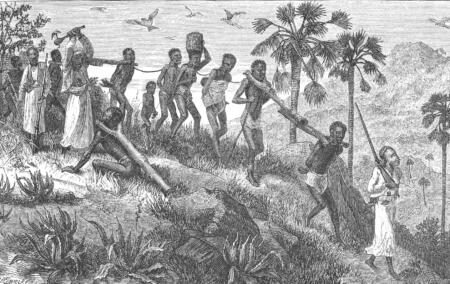
[Image: Arab-Swahili slave traders and their captives on the Ruvuma River in East Africa, 19th century https://en.wikipedia.org/wiki/Slavery#/media/File:Slaves_ruvuma.jpg]

The views of the writer are not necessarily the views of the Daily Friend or the IRR.
If you like what you have just read, support the Daily Friend