

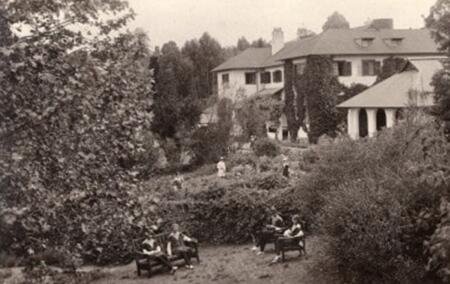
The recent controversy at Roedean School in Johannesburg, which arose following the boycotting of a tennis fixture with King David, Linksfield, generated intense public debate concerning anti-Semitism and the politicisation of schools.
Much of the discussion focused on the immediate circumstances surrounding the cancelled tennis match. In my opinion, the incident is best understood not as an isolated event, but as the latest episode in a much more prolonged and deeper institutional crisis that affects not only Roedean but schools and universities across the country.
Over the past four years I have become deeply involved in researching and writing about a phenomenon which I describe as “School Capture”. School Capture refers to the growing and toxic influence of Critical Race Theory and, to a lesser extent, Gender Ideology, on all aspects of education. Typically, sensational allegations of racism, fuelled by social media and amplified in the press, lead to teachers being hounded out of their jobs in highly dubious and obscure circumstances. What then follows can be described as “whole of school transformation” in which every aspect of the school is “decolonised” or transformed according to Marxist principles.
Dozens of schools have been affected by these developments. Over the past few years, I have spoken with roughly two hundred teachers and parents across South Africa who have experienced what can be described as “Woke Hell”. It would be difficult to identify a single institution that best illustrates the problem, but Roedean would certainly be a strong contender.
This essay, which is the thirtieth that I have published, aims to answer two questions. Firstly, how did Roedean decline to its present condition? And, secondly, how might the school be restored to being a happy, welcoming and successful institution once again?
What went wrong?
The central problem, in essence, is Roedean’s total capitulation to the ideology of Critical Race Theory since, at least, May 2020.
Following the rise of the Black Lives Matter movement in the United States, a wave of “anti-racism” activism swept through schools across the English-speaking world. South African schools were among the hardest hit. Governance structures were increasingly dominated by activists who practised a virulent form of racial nationalism, ironically often presented under the banners of “anti-racism”, “decolonisation” or “Diversity, Equity and Inclusion”. In practice, these initiatives frequently operated as mechanisms for bullying and intimidation, particularly of white teachers, white pupils and anyone else who resisted the prevailing ideology.
In many institutions no one proved willing or able to stop this noxious takeover.
A revealing example at Roedean lay in a new disciplinary framework which the school implemented in February 2022. The following year, I published an article entitled The Trouble with Roedean’s Woke ‘Anti-Discrimination’ Policy in which I critiqued this document. The fundamental problem with the policy was its expansion of the definition of racism to include so-called “micro-aggressions”, a concept derived directly from Critical Race Theory. Because the concept of “microaggressions” is so broad and subjective, ordinary interactions between teachers and pupils could easily be interpreted as misconduct. In a school environment – where teachers must correct, praise, guide, affirm and discipline children – this creates an atmosphere in which routine educational activities could trigger accusations of racism.
The disciplinary procedures created by the policy also raised serious concerns about fairness and due process. Teachers were not permitted legal representation in disciplinary hearings and were prohibited from discussing their matters publicly. They were not entitled to know the identity of their accusers. Cases were heard by panels of volunteers. In effect, the school had constructed a parallel disciplinary system, stripped of the basic procedural protections normally associated with justice and fairness.
It remains unclear how many teachers were formally subjected to these processes, but I am aware of at least three cases in which staff were forced out or hounded out of the school in deeply troubling circumstances. Most concerningly, one staff member was retrenched, purportedly in terms of section 189 of the Labour Relations Act – a provision ordinarily invoked where an employer claims operational necessity, often linked to financial distress or structural pressures.
This raises serious concerns. On the face of it, reliance on section 189 suggests that the school had been so poorly managed that it was approaching financial distress that would jeopardise its operations. If that was not the case, then on what lawful and defensible basis was section 189 invoked in retrenching this staff member? The answer has not been publicised – but neither of these two possibilities inspires confidence.
Those who objected to this inquisition were typically treated with smug indifference or were told that they required further diversity training. The pattern was certainly not unique to Roedean. At St Mary’s School in Waverley, for example, a number of teachers were effectively fired after being found guilty of having committed “micro-aggressions”. I described these events in an earlier essay, entitled The Woke Witch-Hunt at St Mary’s Waverley.
Around the same time Roedean brought in an anti-racism activist, Asanda Ngoasheng, to draft a new “diversity and social justice” curriculum for the junior school.
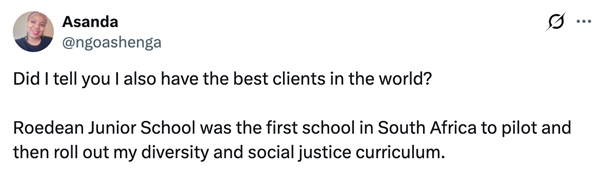
The precise contents of that curriculum remain mysterious but, for a number of reasons, Ms Ngoasheng’s involvement at the school is highly concerning.
A self-described specialist in “decolonising the curriculum”, Ms Ngoasheng helped to drive the “decolonisation” of a wide variety of subjects at the Cape Peninsula University of Technology (CPUT) including journalism, architecture, and horticulture.[1] According to Ms Ngoasheng herself, her “decolonised” course at CPUT was so unpopular that a number of parents complained about her teaching to the programme co-ordinator, stating that she was “divisive, racist and not fit to teach.”[2] Her intervention at Fish Hoek High School in 2022 – where she ran a “diversity seminar” – was so disturbing and caused such a public uproar that the Western Cape Minister of Education, David Maynier, apologised to parents and requested legal advice on whether the Department could sue her for civil damages.[3]
Chillingly, Ms Ngoasheng has stated quite openly that “it’s important to note that when developing a curriculum for much younger students the emotional aspect needs to be considered. When I run my workshops, some of the things that young people tell me is (sic) that they really feel guilty – especially the white ones.”[4] Ms Ngoasheng’s apparent public endorsement of violence during the Fees Must Fall protests – as expressed in this article that she wrote and published in News24 – raises further concerns about whether she is suitable to be influencing Roedean.[5]
The anti-racism policy and the social justice curriculum initiative are two developments that can be identified through publicly available sources. But schools are by nature closed institutions, and it is likely that similar ideological influences extended into other areas, such as hiring practices, admissions, performance reviews and procurement decisions.
Yet, the most destabilising development of all was the arrival of external diversity consultants at Roedean, most notably a young consultant named Lovelyn Nwadeyi. Ms Nwadeyi and Ms Ngoasheng are both protégés of the American academic Robin DiAngelo who is the author of the books White Fragility and Nice Racism. DiAngelo’s work once enjoyed enormous influence in popular culture, but has since been widely criticised and discredited. For further details about DiAngelo’s influence in South Africa, I suggest reading an essay that I wrote, entitled The Long Sinister Shadow of Robin DiAngelo in South Africa’s Schools.
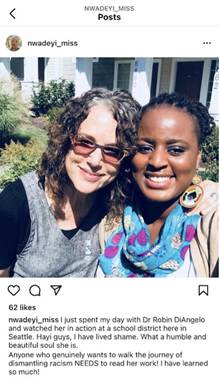
After Roedean was labelled a “racist institution”, both staff and entire year groups of pupils were required to attend compulsory anti-discrimination workshops led by external diversity consultants. These sessions included exposure to material on concepts such as “racial literacy” and “gender, sexuality and intersectionality”. Several pupils who attended later described the experience to me as being deeply uncomfortable.
Once this process of ideological training had taken place, a new pattern of confrontation emerged within the school. According to people who have spoken to me:
- In one incident, teachers were required to sit in the school hall while a group of Grade 11 students shouted at them about the alleged racism which they had suffered.
- In another incident, the headmistress at the time read out a scripted apology to the school for the racism which had allegedly taken place. Thereafter, a senior student responded by informing the headmistress that she did not accept her “white apology”.
- In a separate incident, a pupil pointed to portraits of the school’s founders – Theresa Lawrence and Katherine Margaret Earle – and declared: “You see these white faces on the wall? We want them gone and we want them gone now.”
The psychological toll on staff during this period was severe. Several teachers suffered nervous breakdowns or endured serious emotional distress. Some resigned overnight. Others left the country entirely. Importantly, this was not confined to white teachers. Staff of all backgrounds found the atmosphere increasingly intolerable. Roedean has enjoyed the privilege of educating a number of families for several generations. I understand that, very sadly, many alumni have also removed their daughters from the school.
I have dealt with parents and teachers at schools across South Africa, but at no other institution has there been fear of the kind exhibited by those who went through Woke Hell at Roedean. One individual who experienced this period described it vividly: it felt, she said, “like facing down a truck with its bright lights on, accelerating towards you.”
The King David tennis match
All of this forms the backdrop to the King David tennis controversy of February 2026. Regular readers of my articles would have known that the warning signs were there long before.
In December 2023, I published an article in which I revealed that Roedean had appointed a madrassah called Ummah Heart as an external service provider which would offer a “tailor-made curriculum for Roedean pupils which includes holistic Islamic enrichment.” Essentially, Muslim students would opt out of a large part of the daily academic timetable and receive classes supervised by Ummah Heart.
The principal problem with this lies in Ummah Heart’s public endorsement of the October 7 attacks, complete with Instagram posts featuring paragliders and calls for Jihad.

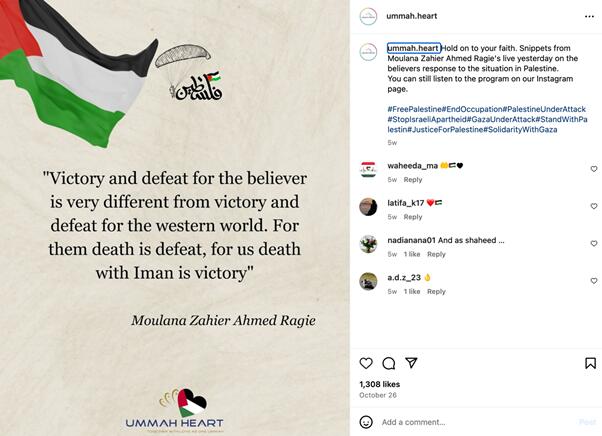
It is not difficult to understand why this would make many Jewish families (and, indeed, many non-Jewish families) feel very uncomfortable.
An interesting question concerns the extent to which these trends – anti-racism activism and anti-Zionism activism – overlap with each other. A similar pattern could be observed at the University of Cape Town, where the Rhodes Must Fall movement unleashed a wave of anti-white hostility that later developed into explicit anti-Semitism that has been well documented by Professor David Benatar in his book, The Fall of the University of Cape Town.
Whatever the case, by February 2026, South Africa’s Jewish community had discovered that Roedean had become hostile to Jews. Yet this was simply an extension of an earlier development: the school had already become intensely hostile to white people. In my opinion, the underlying problem was the adoption of Critical Theory in general – and Critical Race Theory in particular – which divides the world into rigid categories of oppressors and victims. If you belong to one of the designated “oppressor groups”, activism will eventually target you. If you happen to be both white and Jewish, the hostility is likely to be compounded.
How Woke activism destroys governance
There now exists a very troubling tendency in schools and universities: in the wake of Woke activism comes the collapse of systems of governance. Inevitably, this leads to falling standards across the board. This dynamic was illustrated particularly starkly last month when Roedean’s leadership issued a letter attributing the cancellation of the King David tennis match to timetable clashes – an explanation that was later directly contradicted by recordings of a telephone conversation between the respective school principals.
For most of its history, Roedean has been led by long-serving and highly respected headmistresses who often remained in the post for many years. Then, beginning in 2020, this stability gave way to turbulence with the school now set to appoint its sixth head in seven years.
A key question then arises – who is in control of governance at the school? This is not an easy question to answer. The Chairman of the Board, Dale Quaker, resigned a few weeks ago along with several other Board members and the Board is now led by an Interim Chairperson.
Governance documents are also difficult to obtain. I understand that, a few years ago, an individual who requested these documents received a cease-and-desist letter from the school’s lawyers – a strange response considering that such documents are normally freely and publicly available. Nevertheless, a Memorandum of Incorporation which I have seen indicates that a majority of Board members are selected by the Board. And, so, the Board effectively elects itself – a curious feature which makes it difficult to determine how to reform the institution.
Complicating matters further is the fact that, during the height of the Woke activism, several staff members were reportedly required to sign non-disclosure agreements. Such agreements are ordinarily associated with highly sensitive industries – pharmaceuticals, defence or advanced technology – where genuine trade secrets must be protected. It is difficult to imagine what comparable secrets teachers at Roedean might possess. The use of non-disclosure agreements in this context, therefore, raises troubling questions about what, precisely, the school was seeking to keep out of public view.
Who not to blame
The past few weeks have generated enormous public anger. Much of it, however, may have been directed at the wrong targets.
Firstly, children should not be blamed. It is important to understand that an entire generation of children and young adults – at Roedean and elsewhere – has been educated within the framework of Critical Race Theory, and whatever troubling behaviour has occurred over the past seven years should be understood in the context of the ideological environment in which these pupils were trained. Their behaviour simply reflects what they have been taught. For many of them, exposure to the wider world and contact with reality will quickly lead them to revise these ideas. However, for the next few years, many (although not all) young women emerging from institutions like Roedean are likely to hold some worryingly confused ideas.
Secondly, I believe that the headmistress who resigned last month should not be treated as a scapegoat. Although not entirely blameless, as far as I can tell she is a decent person who tried to manage a terrible situation. The truth is that, by the time she arrived, the institutional crisis was already well advanced. I think that several of her predecessors discovered the same reality: that being the headmistress of Roedean, under present conditions, is an almost impossible job.
Indeed, this points to a larger problem, which is that the authority of the headmistress at Roedean has been usurped by a new official, known as the “Executive Director”. It is not entirely clear why this position exists, and presumably it must create considerable additional expense for the school. In any event, I strongly suspect that the headmistress of the school is no longer a person who has any real authority, at least not when it comes to important or sensitive topics. Nevertheless, the headmistress does seem to be the first to be thrown under the bus, when required.
Incidentally, in July 2022, 81 staff members – out of a total complement of 99 – endorsed a letter to the Board expressing dissatisfaction with the appointment of the Executive Director who, in their view, had little prior experience in school leadership.
How to begin to restore Roedean
I hope that I have demonstrated that what has happened at Roedean is far greater than a boycotted tennis match. I mean no disrespect to the King David community when I say that if one were to compile a highlights reel of the most disturbing incidents to have occurred at Roedean over the past seven years, the tennis fixture from February 2026 would not make the top ten. Not even close. What makes the King David tennis fixture notable is that the incident was documented and publicised by a community that is alert, organised and prepared to fight back quite effectively.
But while the trouble at Roedean is far greater than most people realise, I also think that it can be resolved more quickly than many may believe. The school does not require new buildings, additional staff or large financial investments. What it requires is serious governance and brave leadership.
The following steps would begin restoring the institution:
- Announce the withdrawal of the 2022 anti-discrimination policy and acknowledge that “micro-aggressions” should not be regarded as instances of racism.
- Waive all non-disclosure agreements entered into during the past seven years.
- Review the social justice curriculum introduced in 2021 along with any other initiatives that may have been undertaken as part of a programme of “decolonisation”.
- End the use of external diversity consultants.
- Adopt an identity-blind approach to appointments, admissions and procurement.
- Restore teacher authority and reinforce student discipline.
- Reaffirm the school’s Christian ethos which, I understand, is based on the principles of the Anglican Church.
These steps could be implemented through a set of resolutions adopted at the next meeting of the governing Board. At the very least, the Board could immediately signal its seriousness by withdrawing the anti-discrimination policy and releasing former employees from non-disclosure agreements. If that happens, then the school will clearly be moving in the right direction. If it does not happen, then those who care about Roedean must focus on securing a majority on the governing Board.
Put simply, Roedean should return to its founding values: Truth, Honour, Freedom and Courtesy. It should focus on its core business of being a high quality school that aims to act with honesty and authenticity.
Carpe Diem
A recent development makes this moment especially significant. Roedean announced a recruitment process for additional Board members, inviting interested individuals to submit applications to the Interim Chair and Interim Vice Chair by the end of March.
This presented a vital opportunity for those who care about the school’s future to help secure a majority on the Board in favour of meaningful reform. I encouraged serious candidates to organise themselves and apply without delay.
I have learnt two things in the course of my fight against School Capture. Firstly, you cannot stand back and expect or hope that others will step forward. They never do. Secondly, when an institution is under threat, the difference between victory and defeat – between recovery and decline – is often measured in millimetres. Invariably, the side that wins is the side that simply cares the most and gets organised.
And so, I can confirm that I informed the Interim Chairperson and Interim Deputy Chairperson of my willingness to serve on the governing Board of Roedean. What will come of this, I do not know. At best, it may offer an opportunity to contribute to restoring an important institution to strength and stability. At the very least, it will be an instructive experience. Whatever the outcome, I am certain that it will be an adventure. I hope others who care about the school’s future will felt inclined to join me by submitting their own applications.
Over the past several years, numerous insiders have told me that Roedean “is gone”, captured by a political ideology and corporate ethos that have displaced genuine educational leadership. Yet the situation is not irreversible. On the contrary, the school could recover quickly if it chooses to do so. Encouragingly, by 2026 it appears increasingly likely that society has passed what might be described as “Peak Woke”.
It is not too late to restore Roedean to the excellent institution that it was just seven years ago. It is never too late – provided the day is seized.
[Image: Roedean in its early days, https://roedeanschool.co.za/about/]
The views of the writer are not necessarily the views of the Daily Friend or the IRR.
If you like what you have just read, support the Daily Friend
[1] https://www.thedailyvox.co.za/asanda-ngoasheng-why-racial-sensitivity-and-social-justice-training-must-begin-at-school/
[2] https://youtu.be/dNmSCLcM-kY?t=1175 at 19:35 to 20:00
[3] https://www.westerncape.gov.za/education/article/update-intervention-fish-hoek-high-school
[4] https://www.thedailyvox.co.za/asanda-ngoasheng-why-racial-sensitivity-and-social-justice-training-must-begin-at-school/
[5] https://www.news24.com/news24/opinions/columnists/guestcolumn/feesmustfall-understanding-the-current-shitstorm-20161020