

The Department of Basic Education has put a new draft history curriculum out for public comment. The window closes on 19 April. South Africans who care about what their children will learn have just a week to read the draft and make their views known.
Most commentary so far has focused on tone. Some welcome the proposed shift towards African empires and broader themes as a long-overdue correction. Others worry the result will be parochial. But both reactions miss what is at stake: a school history curriculum is a finite container. Anything you put in displaces something else.
The serious question is not whether the new content is good in itself, but what the new content pushes out, and whether the trade is worth it.
There is much to like about the broadening. Pre-colonial African kingdoms such as Mali and Great Zimbabwe, and the social history of African societies before the colonial encounter, are stories worth telling. South African children should learn them. Schools in this country have no business teaching the history of the world as if Africa were a footnote.
The lower grades survive mostly intact. The proposed curriculum keeps the Industrial Revolution in Grade 8 and the Second World War in Grade 9, where they already sit. The real displacement happens at the top, in Grades 10 to 12, the final years where students have the maturity to grapple with difficult material.
Under the current curriculum, Grade 11 covers the Russian Revolution, the rise of Nazi Germany, the Great Depression, and the ideological contest between capitalism, communism, and fascism that defined the twentieth century. Grade 12 covers the post-war world order, including the Cold War as a global phenomenon.
Under the proposed curriculum, all of this is gone. The entire Further Education and Training (FET) phase, which covers Grades 10 to 12, becomes a study of pre-colonial African civilisations, European colonisation of Africa, the liberation struggle, and the transition to democracy.
Some of those are essential topics, but the question is, what is lost? The French Revolution, which gave the world the language of rights and equality that the ANC itself drew on in 1994, appears nowhere in the proposed curriculum as a standalone subject. The Russian Revolution and the mass deaths under twentieth-century totalitarian systems, from Stalin’s purges to Pol Pot’s killing fields, are absent entirely.
Rising from the rubble
So are the postwar economic miracles: Germany and Japan rising from rubble, followed by South Korea, Singapore, and coastal China.
Those stories answer the question South Africa is still failing to answer: how does a poor society become a rich one? A child who finishes matric without ever engaging with any of this at a senior level lacks the basic mental furniture for understanding modern politics, including South African politics.
A subtler concern lies hidden in the fine print. The draft curriculum selects different content and frames it through a particular ideological lens. The Grade 4 to 6 preamble states that one of its goals is to “de-centre” and “provincialise” the histories of Europe and the global North. In Grade 10, every non-African civilisation studied, whether Chinese, Greek, Indian, or South American, comes packaged with the same assessment question: “What are the reasons that later led to the reasoning that [X] civilisation was inferior to Western civilisation? Who propagated these arguments and why?”
That is not an open question; it is a prompt with the answer built in. Elsewhere, the curriculum describes ubuntu as a philosophy that “challenges the ideals of individualism, greed and unhealthy competition, obscene self-enrichment and those destructive forms of human association that have brought the planet to the brink of extinction.”
Whatever one thinks of ubuntu, that passage is a political manifesto dressed up as a learning objective.
None of this proves that the drafters set out to indoctrinate. It does mean that the curriculum, as written, leans towards producing students who have absorbed a particular worldview rather than students trained to weigh evidence and reach their own conclusions. Parents and teachers should ask, while the consultation is still open, whether the curriculum’s framing leaves enough room for genuine critical inquiry.
There is a political twist worth noting. The draft on the table is largely the product of work commissioned under the previous Minister of Basic Education, Angie Motshekga, who said openly that she wanted a curriculum that was “Afro-centric” and not based on European history. It now lands on the desk of her successor, Siviwe Gwarube of the Democratic Alliance.
The way her department handles this consultation, and whether it is willing to push back on the more constricting choices in the draft, will tell us something about whether the DA’s presence in basic education amounts to more than caretaking another party’s blueprint.
Give all of us pause
And then there is the part that should give all of us pause. The most recent international reading study found that around eight in ten South African Grade 4 children cannot read for meaning in any language. Eight in ten. For those children, the question of which historical episodes appear in the matric syllabus is academic in the worst sense of the word. They will never sit that exam. They will leave school without the basic literacy needed to engage with any text, let alone a contested historical one.
A country in that position should be modest about how much it can fix through curriculum design. The history wars are real and worth fighting, but the deeper crisis is that most of our children are being denied the ability to read the textbook in the first place.
By all means broaden the curriculum. Bring in Mali and Great Zimbabwe. Just don’t let the broadening narrow the world a student can see.
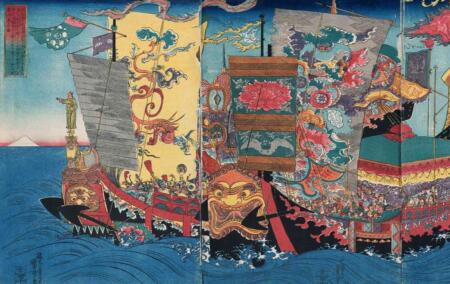
[Image: Detail from a 19th century ukiyo-e by Kuniyoshi depicting the ships of the great sea expedition sent around 219 BC by the first Chinese Emperor, Qin Shi Huang, to find the legendary home of the immortals, the Mount Penglai, and retrieve the elixir of immortality. https://en.wikipedia.org/wiki/Naval_history_of_China#/media/File:La_expedici%C3%B3n_de_Xu_Fu,_por_Utagawa_Kuniyoshi.jpg]

If you like what you have just read, support the Daily Friend