

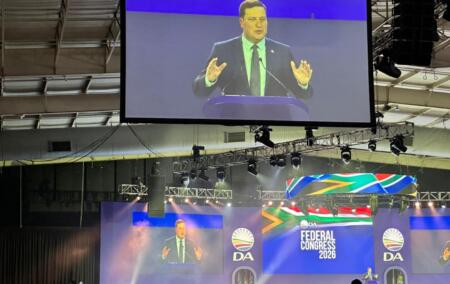
The DA has come out of its Federal Congress over the weekend strong and confident. It appears to be in a sound position to fight the local government elections that will probably take place in November this year, and the national elections in 2029. Its prospects have never appeared better since 1994.
The top leadership has been refreshed with a group that is all under the age of 45 and should have ideas and energy to make the DA the country’s largest party. With further steep declines in ANC support and a bit of luck, the DA could be the leading party in a national coalition government.
The word from some spin doctors at the Federal Congress is that Geordin Hill-Lewis, the Mayor of Cape Town who was elected party leader, could be a future president of the country. An Institute of Race Relations poll out this week shows that most South Africans care less about the race of the President and want competence. Even so, a white President might still be a big leap.
But there is a lot going for the new leader.
He is young, charismatic, seems able to engage easily with people, and he is battle-tested. Three years ago, he took on one of the toughest vested interest groups in the city: the taxi-owners and drivers, who had violently protested against the enforcement of traffic laws. He refused to negotiate until violence ended, and succeeded in ending a taxi strike.
While he is not widely known across the country, that could change within a year, as he campaigns nationally for the party in the local government elections.
There was good order at the Federal Congress. No chairs were thrown or elections disputed, and much looked good for the TV cameras. And Hill-Lewis has a clear four-point plan to grow the party into SA’s largest and to lead the national government. He would do this by showing that the DA governs well for all, connecting more deeply with non-DA voters, being a strong and principled partner in the national coalition, and leading with belief in the country.
That shows a strong sense of direction, and that the party is past tying itself in knots over whether it should adopt ANC-lite policies. A decade ago, the party under Zille was in a desperate search for a black leader to replace her.
Then a series of disasters struck. Six years ago, under its leader Mmusi Maimane, the DA rushed to condemn a primary-school teacher in Schweizer-Reneke after her reception-year pupils were photographed sitting at all-white and all-black tables. As it turned out, the teacher had nothing to do with where the pupils sat. By rushing to judgement, the DA lost the votes of many Afrikaans supporters, and many have not returned to the party.
Now the party seems happy to be a liberal party.
Liberal principles
Both Hill-Lewis, in his acceptance speech, and Helen Zille, in her final speech as the party’s Federal Council chair, gave strong commitments to liberal principles. That is done repeatedly by DA party leaders, but this time it was at the front and centre of their speeches.
There is an open question as to whether the DA can remain a liberal party and grow among black supporters.
When Henry Kissinger was in Cape Town for the World Cup in 2010, he told Zille that the DA was unique as a liberal party in a developing country. As it turns out, liberal parties are now a rarity even in developed countries.
With individual rather than group rights, a free market approach to the economy, and maintenance of the rule of law, the fundamentals of liberalism survive a lot better where there is a large middle class, a growing economy, and a more or less homogeneous society.
With the pressures of political expediency, there are likely to be constant demands for the DA not to take a liberal stand. That is often the reality of having to solve political crises and maintain support.
In SA, none of the other parties are liberal. The ANC, the Economic Freedom Fighters (EFF), and uMkhonto weSiswe (MK) are racial nationalist patronage parties that aim to gain power and position for the benefit of particular groups. Others are vehicles for their individual leaders, and live in hope that they can hold the power balance in coalition arrangements.
One thing that could allow the DA to grow as a liberal party is that its principles might just be seen by many voters as a means to fairness. After years of poor ANC service delivery, alternatives to statist solutions might just obtain a wider hearing.
Economic empowerment is now widely seen as not about justice, but more about favouring those who are well-connected. And after SA’s power cuts and water-delivery problems, the free market could be seen as better for service delivery. That might be too hopeful, but after years of communism in Eastern Europe, free markets were regarded as part of freedom.
A lot could go wrong for the DA.
Wrath of voters
As a partner of the ANC in the government of national unity, the DA is bound to face the wrath of voters for decisions made without its support or involvement.
Some property owners in Cape Town are now furious with the DA, which runs the city, for raising rates. Farmers are furious with former leader and Minister of Agriculture, John Steenhuisen, for what they say is a delayed response in ordering foot-and-mouth vaccines and, until a court order, not allowing farmers to vaccinate their herds. And many DA supporters are furious that the DA has not halted talk of the National Health Insurance project and the tightening and extension of Black Economic Empowerment.
The issue of the new history syllabus that was released in the Government Gazette last week for public comment might yet explode. Its heavy emphasis on the liberation struggle, to the exclusion of other areas of history such as the mass killings by Stalin and Pol Pot and subjects that do not fit the ANC narrative, is bound to hurt the DA. After all, it is the DA Minister of Basic Education, Siviwe Gwarube, who is in charge, but doing what the ANC wants.
And what if Panyaza Lesufi, the Gauteng Premier, manages to persuade a possible ANC presidential contender, Paul Mashatile, the current Deputy President, not to include the DA in a future government of national unity? In such a scenario, the DA, although one of the larger parties, might be excluded in favour of one of the radical comrades’ parties, as it is presently in Gauteng.
Toughest challenges
One of the party’s toughest challenges is mobilising the voters. Many whites have given up on local politics, and many black voters, even if they leave the ANC, simply do not vote. That is why the strapline for Helen Zille’s mayoral campaign is “Believe in Joburg”, and that is why Hill-Lewis sees instilling belief in the country as a priority.
Apart from sound principles, the DA will also require immense political skill.
[Image: John Endres]
The views of the writer are not necessarily the views of the Daily Friend or the IRR.
If you like what you have just read, support the Daily Friend