

If raw materials are becoming ever-more abundant, then why do we so often hear that we’re living beyond our means? Turns out that’s an economics question.
When I wrote an uncharitable obituary of Paul Ehrlich last month, I repeated the story of his ill-fated bet with the late economist Julian Simon.
In 1968, Ehrlich had predicted mass starvation in the next two decades, and even greater calamities by the turn of the century, on the grounds that geometric (exponential) population growth would inevitably, and rapidly, exceed the arithmetic (linear) growth in the availability of natural and agricultural resources.
He simply dressed up the classic Malthusian population-growth model equation, taught to every applied mathematics and environmental student, in alarmist terms suitable for a popular book. The book, entitled The Population Bomb, scared the bejesus out of the whole world.
Simon, in 1980, offered him a bet. Having agreed to consider price an adequate proxy for effective scarcity, Ehrlich was invited to choose any five commodities he thought would become more scarce (i.e. more expensive) over the next decade.
Ehrlich picked copper, chromium, nickel, tin, and tungsten, but lost the bet on every single commodity he chose. On average, his basket of mineral resources declined more than 50% in value.
Simon Abundance Index
I referred to the Simon Abundance Index, the 2026 edition of which has just been released by Human Progress, a Cato Institute project edited by Marian L. Tupy, who is also a council member of the Institute of Race Relations.
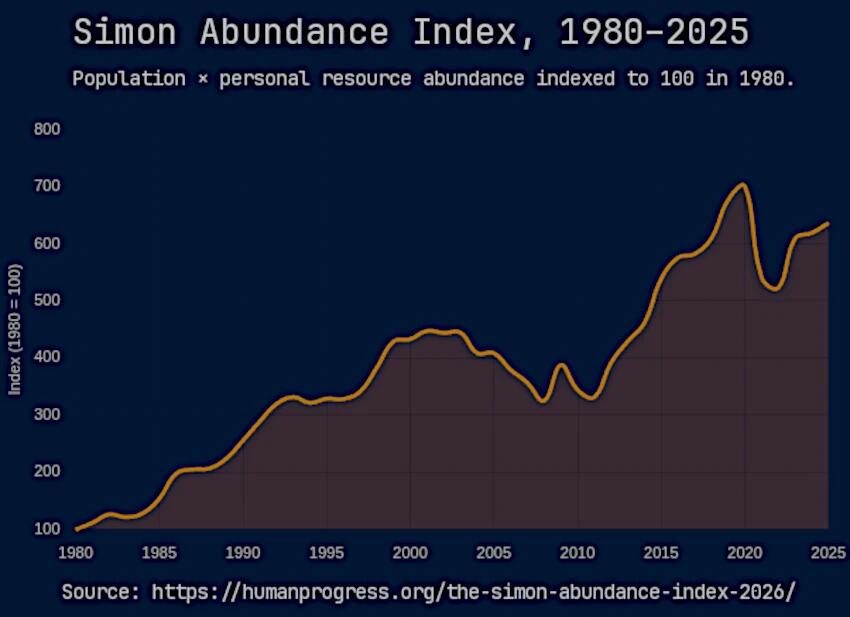
The index has increased more than six-fold since 1980, which indicates that resource abundance has increased by a factor of more than six for every new person added to the global population. Though the index does not always rise, as world events (like the pandemic) can and do affect it, the long-term trend remains strongly upwards.
I’ll let Tupy and his co-author, Gale L. Pooley, associate professor of economics at Brigham Young University, explain: “Simon understood that atoms without knowledge have no economic value. It is knowledge that transforms atoms into resources that benefit all of us. While the quantity of atoms on Earth is finite, the frontiers of undiscovered knowledge are infinite. He also understood that only human beings, especially those living under conditions of economic and political freedom, can create new knowledge. As he wrote, ‘The ultimate resource is people, especially skilled, spirited, and hopeful young people endowed with liberty, who will exert their wills and imaginations for their own benefit, and so inevitably they will benefit the rest of us as well.’”
This doesn’t mean that physical scarcity isn’t real. On average, it isn’t a problem, but in some specific cases, it certainly is, and that has significant implications for the global economy. Some critical mineral resources, like electronics-grade silicon, gallium, helium, lithium, uranium, and rare earths (lanthanides, scandium and yttrium) are the subject of great geostrategic rivalries.
However, the raison d’être of market economics is to bridge the gap between scarce resources and the potentially infinite needs and wants of people. Market mechanisms provide incentives for producers of scarce resources to increase production, and for consumers of scarce resources to economise, prioritise, and invent ways to switch to alternatives.
Kinds of resources
Among the many comments on my Ehrlich obit simply asserting that I was wrong, one raised an interesting point: “Ehrlich was wrong on scarcity and collapse, but that doesn’t automatically validate the opposite extreme. Human systems have become more efficient, but biodiversity and ecosystems are under real pressure. That suggests we’re solving some constraints while displacing others.”
That is a good point: you don’t hear many environmentalists go on about the finite supply of mineral resources these days, but they do complain about forests, fish, biodiversity and ecosystem services.
We often hear about how, on average, we’re living beyond our means – those means being the natural resources we use to produce the things we need and want.
There are many ways to try to quantify this, and different organisations reach different conclusions.
Earth Overshoot Day
Here’s one example: Earth Overshoot Day (EOD). It essentially calculates a quota of resources we’re entitled to use in a year, beyond which, they argue, we’re using resources faster than nature can regenerate them. The date on which we reach the quota is “Earth Overshoot Day”.

EOD is the brainchild of Andrew Simms, a British member of the Green Party, co-author of The Green New Deal, research associate with the Centre for Global Political Economy at the University of Sussex, and fellow at the progressive (read: left-wing) New Economics Foundation.
It is calculated every year by the Global Footprint Network (GFN), and these reports are used by some 70 global non-governmental organisations, including the influential Worldwide Fund for Nature (WWF).
The media – South African media included – loves these annual reports, and unquestioningly echoes the alarming messages of pending catastrophe.
In 2022, we were “living on borrowed ecological resources, running out of time”. Always predict calamity. People don’t donate to solve problems we’ll probably figure out in due course.
In 2023, it was “a devastating reminder about the severe imbalance between the current use of Earth’s natural resources and that which the planet can produce in a year.” Use scary words.
In 2024, “government action [was] needed to reduce our demands on Earth’s resources and sustain life”. Since greens are like watermelons – environmentalist on the outside but socialist on the inside – always promote the idea that government can and must discipline us.
In 2025, we had to respond by granting “Nature” (with a capital N) “rights”, which raises the awkward question: if a potato has not threatened your life, are you entitled to boil it?
“Each year ends with the Earth having less forest, less biodiversity, less healthy soil and water, fewer fish in the sea, more pollution of our fresh water and more greenhouse gases blanketing the Earth, heating it and destabilising the climate,” says one of these articles.
There are five points to make about such dire predictions.
Uncertainty about chaotic systems
Try to imagine how you would compile the necessary data to measure not only the rate of consumption of all the world’s natural resources, but also the potential regeneration rate of those resources, to arrive at a simple number you can put in the headline of a press release.
If this sounds like an impossibly complex task, that’s because it is.
The GFN claims to synthesise 15,000 data points from each of more than 200 countries, for every year since 1961 – which works out to 192 million data points – into a formula that divides the “world biocapacity” by the “world ecological footprint”, to produce a single number.
Even if we assume that it is possible to model both natural systems and global resource consumption in principle, this leaves so much scope for simplifying assumptions, estimates, measuring errors, and statistical voodoo that the single number spat out by their model black box cannot possibly have any substantial meaning.
And that assumption is, unfortunately, too generous. In reality, a significant share of natural ecosystems are chaotic (in the mathematical sense that a small variation in input parameters produces a large and unpredictable variation in outputs). The resource consumption of the global economy is only a little more amenable to being measured, but not to being summarised in a single number.
That means that a project such as calculating EOD is doomed, in principle, from the outset, since at least the numerator in their ratio is highly uncertain. How it is determined is essentially arbitrary and grossly over-simplified.
I have critiqued the WWF’s Living Planet Reports, which include data from the GFN, on several occasions, and don’t intend to go further into the methodological shortcomings of such ambitious environmental accounting projects here.
Exaggeration
I’ve written an entire book about environmental exaggeration, and how it harms emerging economies.
Nothing has changed since 1989, when the late doctor of climatology, Stephen Schneider said: “On the one hand, as scientists we are ethically bound to the scientific method. On the other hand, we are not just scientists but human beings as well. To do that we need to get some broad-based support, to capture the public’s imagination. That, of course, means getting loads of media coverage. So, we have to offer up scary scenarios, make simplified, dramatic statements, and make little mention of any doubts we might have. Each of us has to decide what the right balance is between being effective and being honest.”
Activist groups are strongly incentivised, not least by their operational need for raising funds, to cast whatever they’re campaigning for in the most alarming light possible. To create a sense of urgency, they need to create the belief that things are very bad and likely getting much worse, soon.
Not many people are likely to donate to a cause that is a bit of an issue, but isn’t really a proper crisis. Not many people donate to causes that don’t tug at primal emotions, like fear or compassion.
Ask advertisers: sex sells, but fear doesn’t do too badly, either. Entire multi-billion-dollar industries are built entirely upon fear.
The consequence of environmental exaggeration for all governments is that public anxiety is likely to lead to over-correction in public policy.
If something is a honking big crisis, then it must be addressed, by any means necessary, at any cost, as soon as possible. If something is a bit of a concern, well, there are potholes to be filled and free healthcare to be funded, first.
That sort of over-correction might be affordable in rich countries, but it is unconscionable in poor countries, where very limited resources should primarily be allocated to measures that promote economic growth and alleviate poverty.
Things are getting better
What environmental activists never put in the headline, is that many things are actually getting a lot better.
Deforestation peaked in the 1980s. In 1990, 33.5% of the world’s land area was covered by forest. In 2025, that was 31.9%, a decline of 1.6 percentage points, or 4.8%. If we split that period into two, forest cover at the midpoint was 32.45%. That means two thirds of the decline occurred in the first half of that period, and one third in the second half. Ergo, deforestation continues to decline.
That’s not to say that things are hunky-dory, everywhere, but the trend is going in the right direction.
If you look at the EOD chart, you’ll notice that the trend has flattened a lot in the last 15 years. Even if you believe their likely exaggerated numbers, things are clearly getting better – or at least, getting worse a lot more slowly than before.
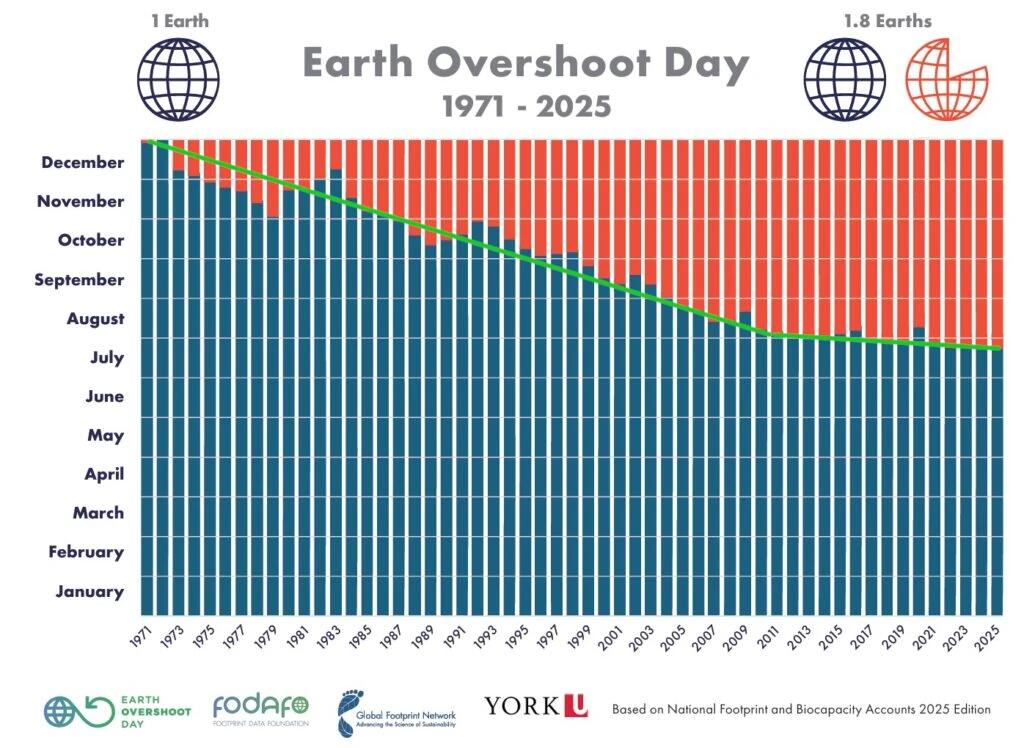
In South Africa, 2025’s EOD fell on 2 July. In 2024, it fell on 20 June, in 2023 on 1 June, and in 2022, it fell on 29 May. That’s is an improving trend (although one might argue that South Africa’s lack of economic growth has a lot to do with that apparent improvement.)
How about pollution? Everywhere except in high-income countries, indoor air pollution is bigger problem than outdoor air pollution, mostly because of a lack of electrification. Yet everywhere, deaths to indoor air pollution are declining.
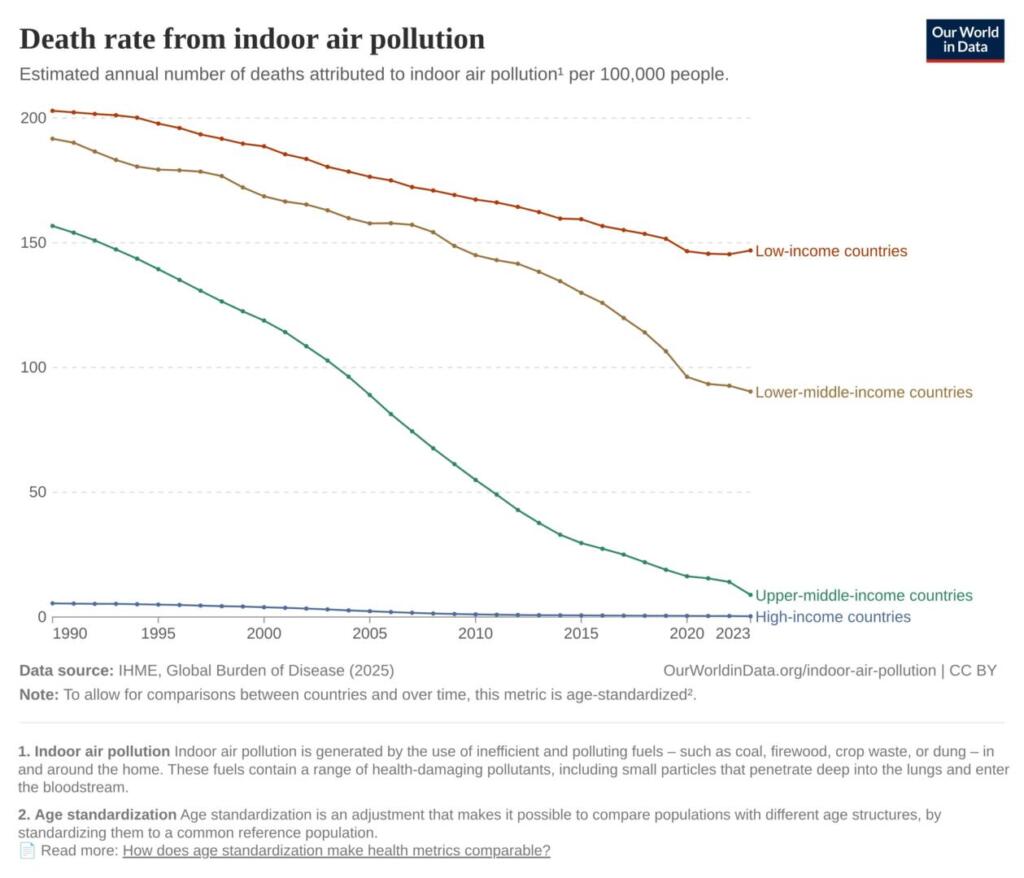
Comparable figures for outdoor air pollution aren’t as tidy: the industrialisation of lower-middle income countries creates an upward trend that is not ideal.
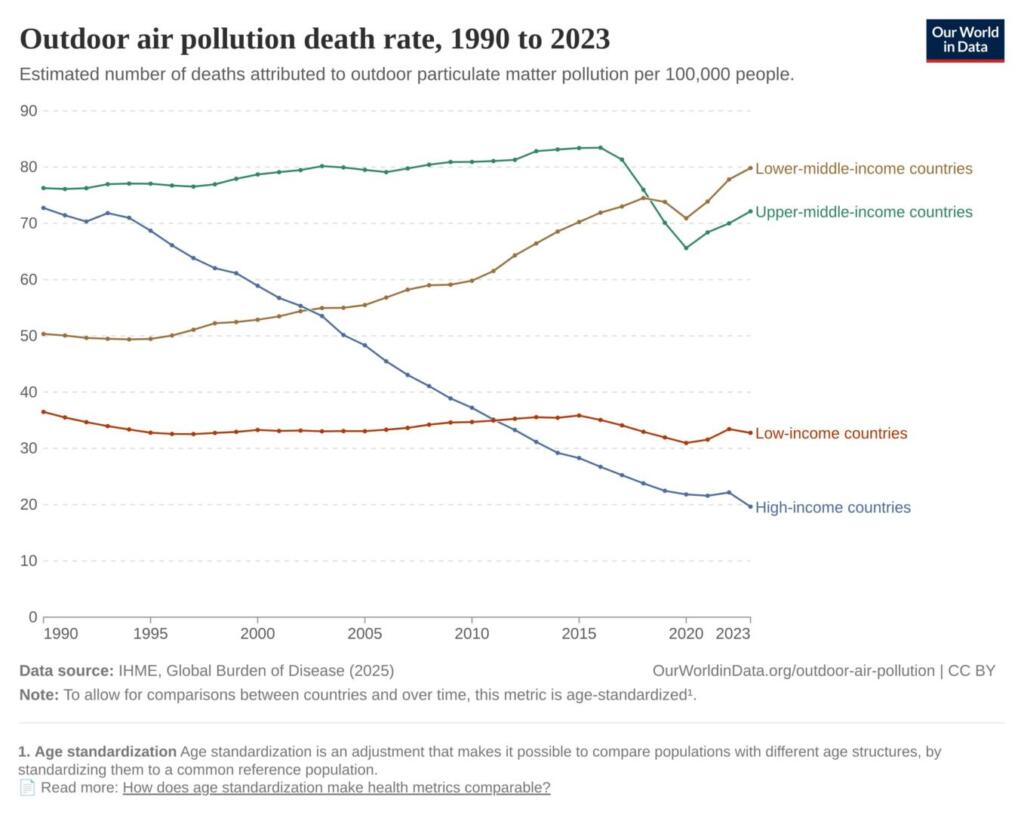
However, as national incomes rise, deaths due to outdoor air pollution clearly decline sharply, which suggests that economic growth is, indirectly, the best way to achieve cleaner air.
It is important to recognise that while we do face environmental problems, and there are excessive pressures on some natural ecosystems, it isn’t all doom and gloom.
Economic distinction
Now, what can we learn from the fact that mineral and farmed resources are, effectively speaking, becoming more abundant – by which we mean they decline in price because of higher production and increasingly efficient consumption – while things don’t look quite as rosy for forests, fish, ecosystem services?
The key distinction between these two classes of resources is that the former are, for the most part, subject to the price mechanism of free markets. The latter, by contrast, are largely not privately owned, and are therefore not subject to free market mechanisms.
This is a fundamental difference. The price mechanism exists in order to mediate between scarce resources, on one hand, and unlimited demand, on the other. It signals to producers to increase production, signals to manufacturers to find alternatives, and signals to consumers to economise, the scarcer something becomes.
We see that illustrated daily in oil prices. Reduce (or threaten to reduce) future supply, and prices go up. Promise a recovery in supply, and prices go down.
We see it in, say, the beef industry. There is no risk of cattle going extinct, because they are privately owned, and private owners have an incentive to take care that their assets are productive over the long term. When a crisis like a disease epidemic occurs, prices rise, which signals to consumers to buy less beef or switch to alternatives, signals to beef producers to invest in combating the disease, and signals to non-beef meat producers to increase production to cater for new demand.
With resources that are not privately owned, or not subject to free-market pricing, the situation is different.
If the government controls prices for access to these resources, the economic calculation problem strikes. Regulated prices cannot respond to all information in the market, and cannot respond fast enough, so they are inevitably too low, or too high. If too low, surpluses happen; if too high, shortages occur.
Resources like forests and fisheries are for the most part not subject to private ownership, so they fall victim to the tragedy of the commons. It pays everyone to over-exploit the resource before anyone else does. Nobody is incentivised to manage the resource wisely for long-term sustainability in the way that livestock or crop farming would do.
The same is true for other ecosystem services. They’re not subject to private property rights and free markets, so their use becomes a matter for government regulation, which is inefficient and wasteful. If nobody has proper incentives to manage these resources, then they will, inevitably, be abused and over-exploited.
Many years ago, I wrote about this problem in great detail, and used fisheries as a specific example. The numbers will be dated, but the basic argument still stands.
Wrong solutions
This distinction, between resources controlled by private owners operating in free markets, and resources managed by governments regulation, suggests that many of the solutions promoted by organisations like the GFN are misguided.
They all call for greater government regulation of public environmental resources, without recognising that governments, unlike private owners, are inherently poor at managing resources for future sustainability. They don’t have the right incentives, and do not have access to the right information. The price mechanism provides both.
I’m not claiming to have all the answers, for all environmental resources that are facing pressure from over-exploitation. They’re all different, and these issues can become very complex very quickly.
What is very clear, however, is that prosperity is not the enemy. On the contrary, prosperity and environmental performance are strongly correlated. If we want a society that looks after its environmental resources, then we want a wealthy society.
Nor is government control the solution. If it was, we wouldn’t have these problems in the first place, and environmental conditions in the former Eastern Bloc countries would have been wonderful. They weren’t; they were far worse than in the supposedly over-consuming capitalist West.
Likewise, if capitalism and consumerism are the problem, then the environmental conditions in today’s socialist countries, like Vietnam, Bangladesh, Indonesia and Brazil, ought to be grand. They aren’t.
Right solutions
When considering potential solutions to specific environmental problems, we should always look for ways in which property rights and free markets can relied upon to align private incentives with public interests.
This isn’t always easy. If it was, it probably would have been done ages ago. This is a hard problem to solve. Instead of looking towards doomsayers like the GFN for answers, however, we should consider proposals from think tanks like the Cato Institute, which publishes Human Progress and the Simon Abundance Index, and policy advocacy groups like the Property and Environment Research Center, which bases its solutions on markets and price incentives.
Solving environmental problems requires the correct worldview, and appealing to governments to manage natural resources or to forcibly reduce production or consumption is the wrong approach. To improve the state of our natural resources, we must look to market-oriented solutions that correctly align incentives with both human and environmental welfare.
[Image: Canola and Wetlands.webp]
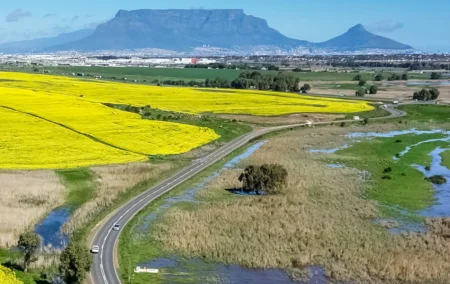
CAPTION: Canola fields adjoin wetlands on the outskirts of Cape Town, South Africa.
The views of the writer are not necessarily the views of the Daily Friend or the IRR.
If you like what you have just read, support the Daily Friend