

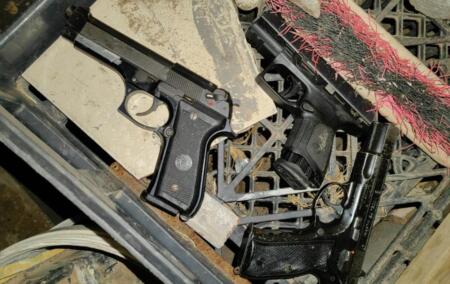
The South African Police Service (SAPS) in Gauteng recently announced that it recovered 511 unlicensed firearms and 7,736 rounds of ammunition in the first quarter of 2026. The recovered firearms include automatic rifles, revolvers, pistols, rifles, and shotguns.
Statistics like these are often presented as evidence of policing success, and of course any effort to remove illegal firearms from the hands of criminals should be lauded, but they also tell a more troubling story: illegal guns remain widely available, deeply embedded in criminal networks, and alarmingly easy to replace. It has been credibly estimated that there are 2,3 million illegal firearms circulating in our country. 511 is not even a drop in the bucket.
The firearms like those recovered during these operations entered illicit circulation through a combination of the sustained failure to remove millions of illegal firearms off the streets, the inability of the SAPS and the SANDF to secure their firearm stores, and continued leakage of weapons into the illicit supply chain from domestic and international criminal networks.
These are the systemic breakdowns that should be addressed by effective policing and the proper implementation of current firearm legislation, and not (as the Minister of Police seems intent on) through new amendments to the Firearms Control Amendment Bill. The proposed amendments will only punish gun owners and restrict legal firearms, and will do little to address the issue of illicit firearms.
The bill has not yet been tabled in parliament, but the proposed amendments have stirred immense unease among critics who see a familiar pattern of overreach: tighter limits on civilian ownership, an expansion of ministerial discretion, new layers of regulation for hunters and sport shooters who have long operated within the law, and the suggestion that self-defence be removed as a legitimate basis for owning a firearm.
The bill, currently before the National Economic Development and Labour Council (Nedlac), thus misguidedly focuses on further restrictions within the lawful ownership framework. This while the primary driver of firearm-related crime (weak enforcement) receives no substantive action.
The long, non-transparent and seemingly one-sided nature of the Nedlac process currently taking place is also deeply concerning.
While Nedlac as an institution certainly plays an essential role in South Africa’s socio-economic landscape, it cannot be used as a primary vehicle for pushing policy and legislative formation. And its role in the wider legislative process must be one of dialogue and openness.
Also, no signs of serious evidence‑based examination have been forthcoming. The proposed amendments are largely a reworking of those floated in 2021, now simply repackaged, without meaningful revision or genuine engagement with the public submissions that, back then, identified its numerous failings. The Socio-Economic Impact Assessment informing the current process also dates back to 2016, and cannot credibly serve as the basis for deliberation in a policy area that has shifted considerably in subsequent years.
Outdoor Investment Holdings (OIH), the largest formal importer, distributor, and retailer in the firearms sector and a significant employer, has not been consulted or provided with any substantive information regarding the bill’s development by Nedlac. That a compliant operator, fully embedded within the regulatory framework, and directly affected by any changes to it, has been excluded from the process should serve as a serious warning sign. OIH is also not the only relevant role-player frozen out of the current process.
The SAPS in Gauteng’s first-quarter figures have confirmed that the state retains the capacity to act, albeit at a very limited scale. Illegal firearms were removed from circulation, criminal networks were disrupted, and the outcomes were concrete and measurable. However, the problem is that this has become our default response: small numbers, routine announcements, and a quiet sense of relief that something, however modest, is being done.
South Africa does not need amendments to its gun laws. It needs better enforcement of its gun laws.
It is against this backdrop that the untransparent processing of the Firearms Control Amendment Bill is so alarming, both for democracy and for safety and security in the country. One gets the sense that support is being drummed up for policy choices that are fundamentally mistaken and disproven, while not nearly enough focus and energy are spent on the hard work of fixing the problems of enforcement, and an evidence-based approach to reasonable firearm control.
When the scale of the firearms crisis is so plainly visible on our streets, it is unacceptable that the response is occasional small-scale confiscation statistics on one hand and opaque lawmaking on the other.
[Image: https://x.com/SAPoliceService/status/2047610336572780880/photo/2]
The views of the writer are not necessarily the views of the Daily Friend or the IRR.
If you like what you have just read, support the Daily Friend