

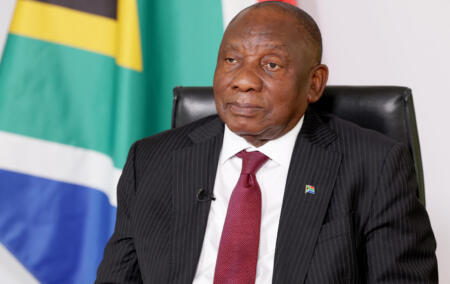
There is a particular kind of political cowardice that presents itself as strategic wisdom. It goes like this: yes, the current leader is problematic but removing him might produce something worse. ‘Better the devil you know.’
This argument is now circulating in boardrooms and parliamentary corridors as a rationale for protecting President Cyril Ramaphosa from any meaningful accountability, whether through a motion of no confidence or an impeachment process. The logic is understandable, to a certain extent; South Africa’s political landscape is littered with figures who would make Mr Ramaphosa’s failures look modest by comparison. Julius Malema – read: Jacob Zuma – wait in the wings. The ANC’s internal factions are also not populated by liberal reformers.
But the “might be worse” argument is not a defence of constitutional democracy; it is a suspension thereof.
The first problem is empirical. The premise assumes that protecting Mr Ramaphosa actually holds the line against something more damaging. There is scant evidence for this. The GNU arrangement does not depend solely on Ramaphosa’s continued occupation of the presidency. Institutions, coalitions, and constitutional frameworks are not one man deep. If they are, that itself is the crisis, and shielding Mr Ramaphosa merely defers a reckoning that institutional reform should be addressing directly.
The second problem is precedential. If parties calculate that any president can avoid accountability by being marginally preferable to a hypothetical successor, then accountability becomes structurally impossible. Every incumbent, however compromised, simply needs to be positioned as the lesser evil. South Africa has spent thirty years learning what happens when consequence is indefinitely postponed in the name of political stability; instability, and destructive policy, compound.
The third problem is democratic. The no confidence and impeachment mechanisms exist precisely for situations where a president has lost the confidence of the legislature or has been found wanting against constitutional obligations. Phala Phala was not a trivial matter. The Section 89 independent panel found prima facie evidence of constitutional violations. At the time, Parliament chose not to act. That choice has a cost; not only in institutional credibility, but in the signal, it sends to every future executive who understands that the political mathematics of succession will protect them.
Parties in the GNU – particularly those who arrived promising a new kind of politics – should consider what they are defending when they shelter Mr Ramaphosa from accountability. They are not defending stability; they are defending the principle that outcomes matter more than process, that the identity of the successor can be used to nullify the obligations of incumbency.
South Africa cannot afford that principle. Not because Mr Ramaphosa is uniquely culpable, but because the country’s recovery depends on restoring the credibility of its institutions – including the institution of democratic accountability itself. A president who survives not on merit, not on record, not on constitutional compliance, but because his removal is deemed too risky, is not a stabilising force. He is a walking argument for the irrelevance of accountability.
The question is not whether Mr Ramaphosa’s successor might be worse; the question is whether South Africa’s institutions are worth defending on their own terms. If they are, the answer writes itself.
[Image: https://www.flickr.com/photos/governmentza/54371041575]
If you like what you have just read, support the Daily Friend