

In 2022 shortly after Russia launched its full-scale invasion of Ukraine, Russian President Vladimir Putin called on the Ukrainian military to overthrow Ukrainian President Vlodomyr Zelenskyy saying:
“I once again appeal to the servicemen of the Ukrainian Armed Forces. Take power into your own hands. It seems, with you, we’ll be able to reach an agreement more easily than with this gang of drug addicts and neo-Nazis entrenched in Kyiv”
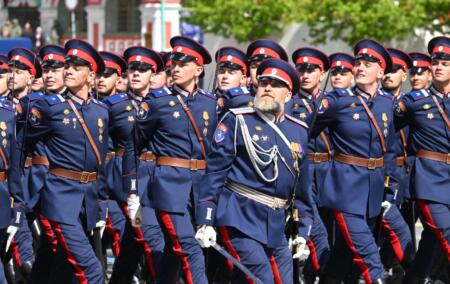
In 2026 in comments made after Russia’s May 9th victory parade Putin referenced a potential future signing of a peace agreement with “Mr Zelenskyy” quite the change in tone from drug-addict neo-Nazi.
The change in tone reflected a general humbling of Russia’s geopolitical position since 2022.
At the launching of Russia’s full-scale invasion of Ukraine in 2022, Russian state TV was full of analysts and commentators triumphantly boasting of a quick and decisive crushing of Ukraine’s resistance. This aligned with Putin’s decision to describe the invasion as a “special military operation”, something that sounds quick and limited rather than anything as long-lasting and dramatic as a war.
US pundits and military commanders largely agreed with this assessment, with, for example, Former Chairman of the Joint Chiefs of Staff Gen. Mark Milley saying shortly before the invasion that Ukraine’s capital Kyiv could fall within 72 hours if a full invasion was launched.
Four years later the conflict drags on with little prospect of an end in sight and Russia finds itself seeing its outposts of influence melting away.
Before and in the first years of the war, Russia had a network of client states and allied countries from whom it could generally either expect diplomatic support or whose internal affairs it could influence. This list included Belarus, the countries of Central Asia, Syria, the countries of the South Caucasus, Venezuela and Cuba. In Africa, Russia’s closest allies are Mali, Burkina Faso, Niger, Eritrea and one of Libya’s two governments. Russia also has good relations with North Korea, China, Iran and India. In Europe, Russia could count on at least some tacit support if not overt support from Hungary and Slovakia.
In 2026 that list is significantly shorter.
The first major domino to fall on this board was Syria. In 2015 Russia joined Iran and its proxy Hezbollah in intervening in the Syrian civil war. This helped to save the regime of Bashar al-Assad and established Russia as a player in the Middle East, securing a naval base for itself in Syria and the loyalty of the Assad regime.
However, after becoming bogged down in Ukraine, Russian support for Assad dropped significantly. After Israel’s major strikes on Hezbollah in 2024 Assad’s regime was left without foreign support and a rebel offensive in December 2024 swiftly and unexpectedly brought down the Assad regime.
The Islamist leader of the rebels, Ahmed al-Sharaa, quickly worked to reinvent himself as a modern world leader and has subsequently aligned with the US and EU. Whilst Russia has not lost its naval base it is now reluctant to use it fully, with most assets being withdrawn. This setback was one of the most public and dramatic that Russia has suffered since 2022, but it is by no means the only one.
In the South Caucasus, Armenia has turned increasingly towards the West after what they see as a Russian failure to support the country in its conflict with Azerbaijan over the Nagorno-Karabakh region.
Despite being a military ally of Russia as part of the Collective Security Treaty Organisation, and having Russian peacekeepers in the disputed Nagorno-Karabakh region, in 2023 Azerbaijan launched an offensive which captured the entire disputed area and collapsed the pro-Armenian separatist government in the region. Since then, Armenia has sought greater cooperation with the US and recently hosted a major European diplomatic event which included Zelensky.
Despite this support for the Azeri dictatorship of President Ilham Aliyev, Russia has also seen its relations with Azerbaijan collapse. Relations dramatically worsened after an Azeri passenger plane was, according to Kazakh accounts, struck accidentally by a Russian air defence missile. To make matters worse, the Russians allegedly tried to cover up the incident by refusing to allow the plane to land at its intended destination in Russia, directing it instead to fly to Kazakhstan hoping it would crash in the Caspian Sea (which would hide the missile damage).
Initially, Russia apologized for the incident, and it was downplayed by Azeri and Russian authorities. However, after the killing of some Azeri men connected to an oligarch ally of Aliyev by Russian authorities, the issue was reopened, with Azerbaijan accusing Russia of a deliberate and cynical cover up of the crash. This has resulted in the cancellation of Russian cultural events in Azerbaijan, and arrests of Russian nationals across the country, and culminated in Aliyev recently warmly embracing and hosting Zelenskyy for a diplomatic summit. This area of the world was once seen as essentially Russia’s backyard and losing influence here suggests a significant downgrade of Russia’s power projection.
Further afield, as tensions between the US and Venezuela grew, Russia lent rhetorical support to its South American ally, to whom it had previously sold air defence systems. In December 2025 Russia pledged ‘full support’ for Venezuela against US ‘hostilities’. Shortly thereafter a US operation to kidnap Venezuelan dictator Maduro went ahead without US casualties and forced Venezuela’s new dictator to offer oil concessions to the US. Russia could offer little other than condemnations.
Perhaps one of Russia’s most important levers of influence globally was in the EU, where since 2022 Hungary and Slovakia provided major diplomatic aid to Russia from within the EU. Whilst governed by Viktor Orban, Hungary maintained warm relations with Russia, slowing down or vetoing sanctions packages against Moscowproposed by the EU, and critically threatening to derail a vital EU loan to Ukraine, which Ukraine needed to keep the government functioning for the next two years.
However, after the crushing electoral defeat of Orban’s government by Peter Magyar, Hungary has warmed towards Ukraine, summoned the Russian ambassador after a Russian strike on the part of western Ukraine where there is a significant Hungarian minority and unblocked the EU loan to Ukraine.
Shortly after Orban’s defeat, Slovakia under Orban ally Robert Fico suddenly reversed course on its opposition towards Ukraine’s joining the EU. Fico was the only EU leader who was expected to attend this year’s May 9th Victory Parade; after his call with Zelenskyy this was downgraded to a private meeting with Putin beforehand. It seems that Russia’s strongest allies within the EU have for now abandoned it.
In Africa, the new military juntas aligned with Russia in the Sahel region were taken as a sign of growing Russian influence on the continent. Here too, however, things seem to be reversing. One of the rationales for these Sahel countries becoming clients of Russia was dissatisfaction with French support against Jihadist rebels which plague all three of these countries. Across Mali, Burkina Faso and Niger, coups by junior officers would be followed by the expulsion of French forces and the inviting in of Russian-aligned mercenaries of the “Africa Corps”, formerly the “Wagner Group”.
These Russian troops have suffered serious setbacks against the Jihadists. Violence seems to have only grown worse in the region, and last month a new offensive by the Jihadists and their Berber allies in Mali killed the minister of defence and placed the capital of Mali under threat, with Russian mercenaries being forced to withdraw from several bases.
Not all of Russia’s allies have flipped or collapsed.
Iran continues to grow its relationship with Russia, but rather than being a boon to Russian strength it is now a drain. At the start of the war with Ukraine, Iran was pivotal in providing Russia with the “Shahed” drones and allowing Russia to set up domestic production of these weapons, which have become the bane of Ukraine. Now, however, Russia is reportedly sending ammunition, intelligence and other supplies to Iran as it faces off against the US and Israel. Of course, Iran is not Russia’s only major ally.
Much has been made by both Russia and China of their growing friendship and closeness since the start of the war. And whilst on the surface these countries seem allies, China’s help has not been for free. Whilst Chinese supplies and trade of goods, especially “dual use” products and tech, have been vital to keeping Russia’s war effort going, this has been paid for by sales of heavily discounted crude oil and extensive Chinese access to Russian tech and systems. Even so, China has been unwilling to openly and fully commit to supporting Russia with weapons. China has effectively kept Russia fighting but has not committed fully to its victory, likely preferring an ongoing conflict as a distraction to the US and Europe.
The other major Asian power that Russia needs to keep onside is India. Whilst India remains very warm rhetorically to Russia and has purchased significant amounts of discounted Russian oil, it is reducing its dependency on Russian defence equipment and has been uncomfortable fully defying Western oil sanctions. India has also recently signed a major trade agreement with the EU and has quite openly embraced Europe, which makes closeness to Russia difficult. Whilst India doesn’t look like it will break from Russia in dramatic fashion anytime soon, like China, it will not expend any real resources to bail Russia out.
The one country that Russia has unambiguously grown closer to is North Korea (DPRK). Faced with major artillery shell shortages in 2023, Russia was on the verge of a major military setback. In stepped the DRPK with its vast stockpiles of Soviet artillery shells to fill the gap. This helped to stabilize Russia’s artillery capabilities and place it back on the offensive. North Korea also has sent troops to aid Russia on the front lines. What the DRPK gets out of this deal isn’t fully known. Certainly, it helps modernize its woefully out-of-date army with some actual combat experience, but there is also some reporting to suggest there may be even more. A CNN report this week examines the case of a Russian cargo ship, escorted by Russian warships, that mysteriously sank off of the coast of Spain. The report suggests that this ship may have been carrying two nuclear reactors for submarines, which possibly were destined for North Korea.
So where to for Russia from here?
2025 saw Russia put major pressure on Ukraine at the same time that the US cut almost all aid to Ukraine. However, after a difficult winter and with some tactical adaptation by Ukraine to compensate for its manpower shortages, Russia seems militarily on the backfoot again. At home there are signs that the economy is not in a healthy state and the pressure on the state budget from war expenditure, sanctions and Ukraine’s strikes on oil facilities is bringing into question Russia’s long-term ability to sustain the conflict. There is however very little in the way of evidence that Putin intends to settle the war quickly, so these problems will not go away anytime soon.
At the same time, more pressure is being placed on yet another Russian ally in Cuba, with the US ramping up blockades of the island and threatening military pressure. Russia has succeeded in supplying some oil to Cuba recently. Should Cuba cave to American pressure it may be forced to break its cooperation with Russia, removing yet another Moscow ally.
The true end of Russia as a significant power on the world stage would become total if the countries of Central Asia, Kazakhstan and Uzbekistan chief among them, moved away from Russian alignment. So far there has been some murmuring on this front, and some growing cooperation by these countries with China, but a true break with Russia has not yet occurred.
Overall, the geo-political picture for Russia seems bleak. Stuck in a brutal struggle with Ukraine which has no end in sight and with a shrinking pool of allies and partners, Russia is headed for a difficult period both externally and internally. If it does not triumph in Ukraine, Russia’s future as a major power looks uncertain.
[Image: https://upload.wikimedia.org/wikipedia/commons/c/c8/2025_Moscow_Victory_Day_Parade_40.jpg]
If you like what you have just read, support the Daily Friend