

With the Jewish holiday of Shavuot beginning at sundown today, the Jews have been reading about the giving of the ten commandments.
We also read the Book of Ruth and commemorate the Yahrzeit (anniversary of death) – of her great-grandson, King David. Moses, the lawgiver, represents the written law, while Ruth and David represent the reality of legal interpretation of a part of that law dealing with the treatment of the outsider.
The Lubavitcher Rebbe tells us that the Torah lives with the times. Today in South Africa, there has been a new recurrence of xenophobic protests against foreigners. Virtually all the shops in the central business district of Johannesburg were shuttered, and all of a sudden the legal battle over the lineage of Ruth and David was no longer just a biblical story. It has become a sign of today’s society.
To understand the similarities of then and now, we need to look back at the constitutional crisis that confronted King David. Ruth was a Moabite entering into the land of Judah with Naomi, her mother-in-law. Upon arrival, she is confronted with the written law that “An Ammonite or a Moabite shall not enter the assembly of the Lord… forever.”
Applying the grammatical interpretation, Ruth’s presence in Judah is illegal, she is deemed an illegal migrant worker, or perhaps even a political refugee.
Ruth’s status will affect the future of her offspring, and this plays out generations later. King Saul’s chief advisor, Doeg, launches a full-frontal attack against David. David is a direct descendant of a Moabite migrant, he is compromised. According to the written law, David is a foreigner, an illegal alien, he is disqualified. Not only from the throne, but also from membership of the community. It is a swift, devastating and seemingly legal knockout blow.
Beyond the written law
The sages of the Sanhedrin do not dismiss Doeg’s argument. They do not pretend the text says something other than what it says. They engage this constitutional crisis head-on, and they go beyond the written law to produce something that the written law cannot provide; they look to the oral tradition They realise that a purely literal reading of the law would destroy human lives and the divine potential within, which cannot be acceptable.
As Antonio Guterres would state centuries later, a law cannot be read in a vacuum. One needs to discover the legislative intent. By following the oral tradition, the sages come up with an answer of four words which changes everything: Moavi v’lo Moavit. A Moabite – but not a Moabitess. In other words, the prohibition in Deuteronomy applied specifically to a Moabite man, but not to a Moabite woman.
The women of Moab were not party to the offence committed by the men. Ruth committed no wrong. Ruth is no longer an illegal migrant – and therefore by extension, nor is David. But only by application of the oral law are they legitimate. Because of that single, nuanced legal distinction, David is validated and Ruth is vindicated. And here we see how the law must always bend toward life, inclusion, and equity.
Complete legal system
Shavuot is the intersection between the written text and the oral interpretation. The written Torah is the foundational document, from which all other laws acquire their authority. Moses brings down the text. Ruth embodies its oral interpretation. Together, they constitute a complete legal system. Separately, each is incomplete.
Without interpretation, law can be a blunt instrument. Interpretation without a fixed text can become convenient fiction. The Torah, just like a constitution, cannot be read in isolation. It is not self-interpreting. In every generation the written law poses new questions – questions about scope, about intent, about what the legislature actually means to achieve. This is why we have courts. This is why I have a job. It is the oral Torah that allows the Ruth to guide the Moses and to decide the appropriate meaning of the law in every generation.
This reality applies equally to the streets of Johannesburg and to the shacks of Nyanga. South Africa possesses a progressive, written constitution. Like the Torah at Sinai, it has been forged in the fires of liberation. It explicitly guarantees the rights and dignity of all who live in the Republic.
Yet, we live in a society where the ghost of Doeg walks our streets. He has changed his clothing and his language. He has become a populist, a demagogue, a xenophobic politician, but his argument is no different from the one he made against David three thousand years ago. He says: the law is the law. He says Section 41 of the Immigration Act obliges undocumented foreigners to be detained and deported. The jobs belong to South Africans. The resources are finite. And we, the average South Africans, have absorbed the xenophobic narrative so completely that we no longer recognise it as a choice.
How different are we from those citizens of Bethlehem?
Applies equally to us
Ruth arrives with Naomi, who is returning from Moab. The people recognised Naomi, she was one of them. But Ruth is the foreigner, the outsider, the other. So both are shunned. And just as they rejected Naomi, in the company of Ruth, this is how we reject foreigners. The unspoken, no one offered them a home or a piece of bread applies equally to us. We, like the Bethlehemites, look at the foreigner and choose, at the very least, indifference.
Working in a legal aid clinic that deals with, among other things, asylum seekers and refugees, I see the consequences of literal-minded legal interpretation every week. I see how xenophobia is regularly resurrected, how we remain silent, how we “other” these people, how we exclude them from the economy, and how it is politically convenient to attack them. And I see how we treat our laws as fixed, and how we look only to protect our own privileges. We ignore the oral tradition that allows for universal human dignity.
The way in which the Book of Ruth introduces us to Boaz, I want to suggest, is what purposive legal interpretation looks like in practice. When Ruth comes to glean in his field, Boaz does not merely do what the law specifies. He goes beyond it. He ensures that she receives extra grain. He tells his servants not to harass her. He offers her water and shade. Boaz doesn’t ask Ruth for her Section 22 refugee documentation. He doesn’t demand proof of registration with the Department of Home Affairs. He saw a vulnerable person and he used the tools available to him – his land, his workers, his social standing – to grant some protection to her.
Later, when Ruth comes to him and says “Spread your cloak over your handmaid, for you are a redeemer,” it is not just a personal request. She is asking Boaz to understand the inherent desire of every alien: that inclusion without access to resources is a hollow thing.
“Let me in …”
She, like every other alien, is pleading “Let me in; and then let me eat. Recognise my dignity; and then support it with something material.”
This is precisely the gap between our written Constitution and the lived experience of foreign nationals in South Africa. The Constitution lets them in. The system – the Home Affairs office queues, the Section 22 asylum-seeker permits, the hostile environment, the exploitative employers, the attacks on the unfamiliar other – does not spread the cloak. It hands people a piece of paper and calls it protection.
This is not the way of the oral law. The oral law asks what the law is for. And the answer is unambiguous: the law is for life, not bureaucracy and unnecessary hurdles.
The Torah commands us thirty-six times – more than any other single injunction – to love and protect the ger, the stranger. The reason given is always the same: “for you were strangers in the land of Egypt”. This is not a suggestion. For the Jewish community of South Africa, it is a constitutional imperative. Ours is a history where the overwhelming majority of us descended from people who arrived here as refugees, from Lithuania and Latvia and the Pale of Settlement and from the pogroms of Eastern Europe. We came with nothing except our culture and our willingness to work. We were the gerim, we were the makweri-kweri, we were the ones taking jobs.
We now have the opportunity to be the Boaz of the story. The question Shavuot puts to us is the question Boaz faced in his field: how do we use our position?
What is missing
The oral-law tradition offers South Africa something it needs: a way of reading written law so that it does not betray its own purpose. Our courts have interpreted the law, but what our courts have not been able to do is change the culture. The jurisprudence exists. The constitutional framework exists. What is missing is the Boaz – the people with power and standing who are willing to use their position to extend the boundary, to spread the cloak, to leave extra grain in the path of the stranger who has the legal right to be here but who is too vulnerable to benefit from it.
Without the oral law, there is no Ruth in our midst. Without Ruth, there is no David. Without David, there is no redemption.
Without the courage to read our Constitution purposively – to ask not merely what Section 41 of the Immigration Act literally permits but what it is actually for – there is no Grootboom, no Watchenuka, and there is no Boaz to spread his cloak over the gleaner in the field.
Let us look at the strangers in our midst not with fear or suspicion, but with the understanding that our own redemption is bound up in how we treat the vulnerable among us.
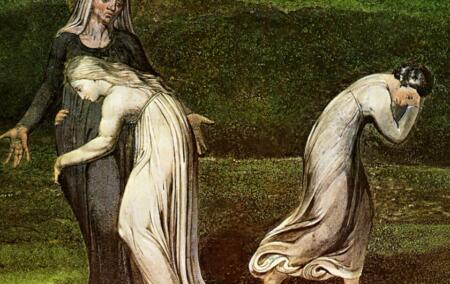
[Image: Ruth and Naomi by William Blake. https://en.wikipedia.org/wiki/Ruth_(biblical_figure)#/media/File:1795-William-Blake-Naomi-entreating-Ruth-Orpah.jpg]
The views of the writer are not necessarily the views of the Daily Friend or the IRR.
If you like what you have just read, support the Daily Friend