

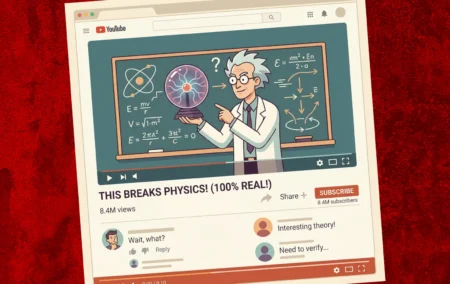
The quality of online content is taking a nosedive, and it’s not only artificial intelligence that’s to blame.
I’ve always tried to keep my YouTube feed pretty clean. I don’t let anyone else search for videos using my account. I pause my watch history or search for videos while logged out when I’m looking for stuff that I won’t be interested in tomorrow. I take care not to pollute the viewing history that influences the content that the algorithm surfaces.
For years, this worked quite well. I had a neatly curated feed that recommended a lot of stuff I was actually interested in. It probably kept me more engaged than I should have been, but at least it didn’t piss me off.
Until now. Lately, I’ve been bombarded with bullshit at a breathtaking pace.
To be clear, this article is not based on comprehensive research. Perhaps the quality of content remains stellar for everyone else, and I’m just the unlucky sucker at the wrong end of an algorithmic sewerage pipe. But I don’t think so.
Breaking physics
My pet peeve lately is videos about things that “break physics”, or “break maths”.
No, mate. Flying faster than light into the past and killing your past self would “break physics”. And I’d actually pay to watch that.
A vortex in your boiling pasta pot that you can’t explain does not break physics.
“The Engine That Breaks Physics”, blared a YouTube short I was offered yesterday. It’s from a channel I never subscribed to, which has fewer than 8,000 subscribers, has 18 AI-generated videos, and is littered with nonsensical phrases like “biological vacuum”.
Spoiler alert: that engine did not break physics. It’s pretty weird, and its operating principle is very hard to model mathematically, but it just didn’t really work. Physics explains it all perfectly well.
Here’s a “Most Priceless Hypercar Concept that Just Breaks Aerodynamic Physics”, from the legit-sounding (but entirely bogus) NextDrive channel.
It’s a “concept” in the same way that the hypercars I doodled as a child is a “concept”. It looks cool. Too cool. And that’s because it’s completely non-existent. Not only can a non-existent hypercar not break aerodynamic physics, neither can a real hypercar.
Legit content
I am not only incensed that the YouTube algorithm looked at my viewing history, saw that half of it involved maths, physics, and technology, and decided I was now part of the target market for cockamamie AI-generated claptrap. It’s also not just the vapid viral videos targeted at gullible garbage guzzlers that do this.
Increasingly, legit sites are pulling the same stunt. After all, with the horses of the AI apocalypse breathing down their necks, they have to bait ever more blatantly for clicks.
Here’s Matt Parker: “The bubble that breaks maths”. Normally, he’s well worth watching, if you’re into maths. Here, he crosses a line, though.
His real problem is that he’s trying to model a physical system, and finding it difficult to do so. That breaks neither physics nor maths.
Maths was never supposed to represent reality. That’s physics. And the maths used in physics is at best an approximation of reality. Sometimes a very good approximation, but when your approximation falls apart, that’s not maths breaking.
Nate From the Internet, with over a million subscribers, claims that liquid nitrogen breaks physics. Nah, brother Nate. It changes the physical properties of things you put in it, sometimes in surprising ways, but physicists have been making roses that shatter like glass since long before you were born.
Another channel, The Studio, likewise with over a million subscribers, claims that this hologram breaks physics.
Well, no. It does not. It uses physics in a clever and innovative way, but it doesn’t break any of the laws of physics. Everything in this video can be explained by known and published physics.
That same channel discovered something that broke physics not once, but twice! Here, it’s a speaker that broke physics.
And yet, against all physics known to man, someone, somehow, built it. I’ll await the next Nobel Prize ceremony with bated breath.
Very popular content
The Infographics Show has over 15 million subscribers. It looks credible. It has a human narrator. It claims to use only Adobe Audition for voice recording, Adobe Illustrator for dealing with vectors, and Adobe After Effects for animation.
But it needs to compete, right? So it produces one or more long-form videos every single day. Some of them are hours long. All of it made in Illustrator and After Effects, they say.
And then they produce this: NASA STUNNED as Deep Space Signal BREAKS All Known Laws of Physics. In the middle of it, there’s a scene where the James Webb Space Telescope says, “It’s giving artificial.”
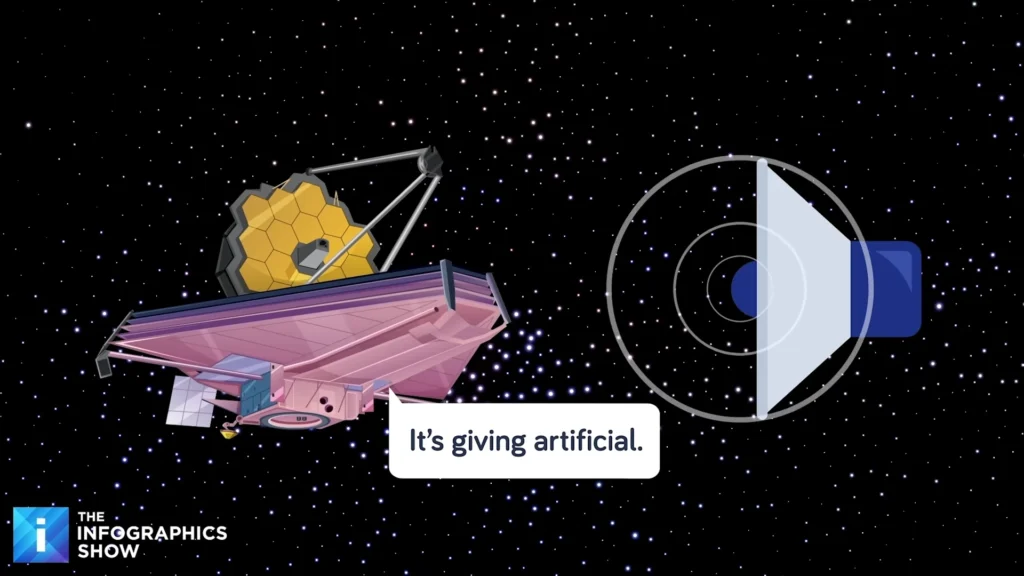
It sure is giving artificial. What the video talks about is a recurring “signal” from deep space that astronomers cannot explain.
The thing is, that happens all the time. And every time astronomers found a new, unexplained signal from deep space, it turned out to be explainable. It turned outnot to break the laws of physics. And there are indeed good hypotheses for the likely source of this particular signal.
Yet the video goes on to speculate about aliens. Never mind that aliens broadcasting a recognisable signal from that far away would have had to harness the entire energy of several nearby stars to do so.
The video confuses phenomena that are merely unexplained, or hypotheses that are merely unproven, with evidence that positively contradicts the known laws of physics.
If this signal turns out to break any known laws of physics, I’ll eat my hat. If it breaks all known laws of physics, well, then we’re not in Kansas anymore.
Millions of subscribers
The SciShow, a legit show with over 8 million subscribers, says that Quipu, the largest cosmic structure discovered to date, “breaks the laws of physics”.
It certainly challenges some hypotheses. In particular, it seems to be inconsistent with the cosmological principle, which says that at large enough scale, the universe is homogeneous and isotropic. That is, no matter where you are in the universe, it looks the same all around you. Or in other words, at large scale, the universe’s density is uniform.
This principle appears to preclude very large-scale structures like Quipu, but then, this principle is not a law of physics. Karl Popper once wrote: “[T]he ‘cosmological principles’ were, I fear, dogmas that should not have been proposed.”
There are numerous observations that are inconsistent with the cosmological principle as it is known today, and there are numerous hypotheses for why these observations are inconsistent with the cosmological principle.
Violating a conjecture about the universe does not “break the laws of physics”. Physics doesn’t get broken on YouTube.
Credentialled
There are highly credentialled voices that fall down the clickbait trap, too. Sabine Hossenfelder is a theoretical physicist and science communicator who has made numerous radical claims in her videos, including that the speed of light is not a fundamental limit, that quantum physics is wrong, that physics is a mathematical fiction, that science is failing, and that universities are places where lazy fantasists conspire with one another to consume taxpayer money.
Her alarmist pronouncements kept growing. First, particle physics was dying. Then all of physics was dying. Then all of science was dying. She exhibits the classic symptoms of a conspiracy theorist: taking a kernel of truth, and blowing it up to systemic, even apocalyptic, proportions.
Epistemic crisis
I wrote recently about the epistemic crisis that large language models have unleashed upon the world.
That certainly concerns me. The more AI slop there is, the harder it will be to tell truth from fiction.
Even without AI, however, the attention-engagement algorithms are doing an excellent job at poisoning our well of knowledge. Everything has to be a breakthrough. Everything has to break the laws of maths or physics. Everything has to stun NASA, or stagger scientists.
Every invention, every new prototype, every new technique – even just incremental progress – has become terrifying, is defying the laws of physics, spells “it’s over”, or is the end as we know it. (And those last examples were from my favourite channel about high-end silicon chip design.)
Nothing is normal anymore, because normal is boring, and nobody reads boring. Maybe I should have titled this, “This column breaks every known principle of journalism”.
It doesn’t, for the most part, but how else am I going to get people to read it?
[Image: Videos that claim their subject “breaks physics” or “breaks maths” are everywhere these days. Image concocted by author using Nano Banana 2, breaking every rule of good journalism]
The views of the writer are not necessarily the views of the Daily Friend or the IRR.
If you like what you have just read, support the Daily Friend