

Just before the turn of the millennium, I was sitting in a flat in Stellenbosch when I got a call from a guy I knew from school, called Conrad Koch. Koch told me he was driving from Cape Town to see me with a brilliant business idea but didn’t reveal what it was. I told him the address: dude might be into that computer stuff, I thought to myself (pre-dotcom peak) – this may well be worth listening to.
Koch arrived and we sat down. Was he going to unveil the next Netscape Navigator? A home-grown competitor to that Google thing, launched the year before? Nah. Amway. He had come to sell multi-level marketing, and was (wisely) trying to lure his old school network into it.
There’s nothing wrong with Amway. Exposure at an early age is good training; if you got into crypto at the right time, the multi-level crypto strategy (partially aped from Amway) was particularly effective in separating people – and some fools – from their cash. But Koch’s mistake was to assume nobody had heard of it before, so wasn’t thrilled when his reception party declined to pile in.
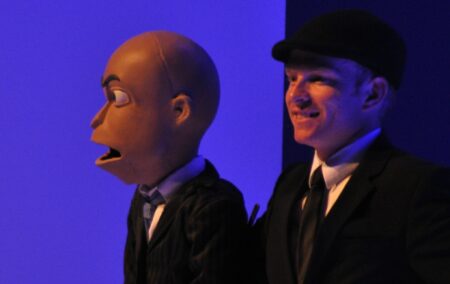
Some years later Koch re-invented himself as a ventriloquist. His puppet charge, Chester Missing, became something of a quirky cultural and political commentator, joining comedian Loyiso Gola to satirize Jacob Zuma, Patricia de Lille, Helen Zille and others, before a steady rise in popularity led to shows at the Baxter Theatre in Cape Town. His routines were okay (puppetry is, after all, an acquired taste).
Thereafter Koch would add social justice to his creative treatment: the most notorious, cold-blooded murderer of all comedy. His Wikipedia page was edited to read “Chester Missing is a fictional political commentator who confronts racism and white privilege in post-apartheid South Africa”. Suddenly comedy turns to young adult sci fi, positioned between those stupid, inappropriate books those mental teachers in the US force their subjects to read, and The Hunger Games.
Similar routines have destroyed humour in the UK. They’ve prompted audiences to applaud – not laugh – and contaminated a once pioneering legacy of wit that included Monty Python, Fawlty Towers, Only Fools & Horses and most if not all of Ricky Gervais’s content.
If puppetry is tough, then social justice comedy is an impossible concept that is impossible to get right. Theatres turn into hissing mobs and the protagonist’s future is immediately limited, resulting in no capacity to adjust to different audiences. Some years ago, a South Asian comedian performing at an after-dinner event in the city got left-over bread rolls thrown at him from the tables (Nish Kumar) – which, given the poor state of his routine, was actually quite polite.
Badgering
Koch’s latest project (as Chester Missing) involves trying to cancel a musician from an imminent Kirstenbosch concert. He openly describes the musician as “KKK” and is badgering the Gardens not to platform his act.
The UK is exceptional at cancel culture; South Africa is very bad. The UK’s media is naturally primed to destroy the careers of artists whose politics or humour it doesn’t like, not just by the structure of its editorial policies, but by its ability to ensnare institutional support for its cause. It’s a monstrous cycle: if a comedian or public commentator says something the media doesn’t like, the media targets its revenue streams. If the revenue streams don’t abide by the decision, the media attacks and exposes them as complicit.
South Africa is pathetic at cancel culture because of its unique wiring. For too long, ordinary South Africans deferred on political commentary for reasons relating to offence, fear, or the country’s history. The process of emerging from a largely self-imposed isolation has been emboldening. Individuals have discovered that they can criticize, and they must (you can thank Helen Zille for her part in contributing to the national conversation).
Seven months ago, a (failing) media organization targeted the owner of a social media account. The process of doxxing the individual who owned the account was both craven and hysterical, putting a family in danger by revealing unnecessarily personal information. Had this occurred in the UK, arguably where this strategy of political annihilation was conceived, there’s a strong chance that the owner would have been de-banked or even placed under the scrutiny of the security services.
But despite the initial threat imposed by the media, the event was dismissed and the intent behind it jeered, prompting the media organization to diminish the importance of its “investigation” portfolio, resulting in a series of humiliations for the journalists involved.
Shouts the “n” and “k” words
Similarly, the musician whom Koch is trying to cancel recently responded to Koch with a live clip of a Chester Missing performance where the puppet shouts the “n” and “k” words at an audience. Koch immediately scrambled to the South African Human Rights Commission with a plea not to investigate him as the clip required context. See how idiotic these things get?
But more than self-reporting, Koch’s crusade to emphasise “racism” and “white privilege” sits in contrast to some remarkable data that contradicts – if not embarrasses – the portrayal of an activist society. South Africans want jobs, growth, safety and real justice, items revealed in various polls in the final quarter of the year. If the polls are correct, and social media does not represent reality (which it doesn’t) there is simply no notable appetite from any quarter of society for grudges or revenge, the principal forces behind cancellation.
Pleasingly, the exercise is now being examined through the most important measurement of failure – boredom. It’s boring to watch an attempt to dismantle a profile on account of perceptions or interpretations. It’s boring to listen to yet another podcast hyping the concept of sensitivity. It’s boring talking about it.
The UK likes to think of South Africa as somewhat behind the curve – that zeitgeist arrives much later down south and by the time that happens, the miserable little island has already moved on to the next fashionable outrage. Here we are witnessing the converse.
[Image: https://www.flickr.com/photos/merajchhaya/7009867031/]
The views of the writer are not necessarily the views of the Daily Friend or the IRR.
If you like what you have just read, support the Daily Friend